Everyone knows that usability testing is crucial for a successful product. You build a prototype, you test it, you find bugs, you fix them. Simple, right?
None of that is wrong. But it’s incomplete.
The hard truth is that most agencies treat prototype testing as a QA step, not a strategic financial one. This mindset leads to mistakes that drain budgets, delay launches, and kill profitable client relationships. You’re not just testing for function; you’re testing for future revenue.
1. Testing the Wrong Things
Your prototype is a hypothesis. Testing should validate or invalidate core assumptions about user behavior and market fit. Focusing solely on button clicks and navigation paths is a narrow view.
What are the real assumptions?
- Will users understand the value proposition?
- Will they complete the core task that drives revenue?
- Is the perceived value high enough to justify the price?
- Does it solve a problem they’re willing to pay to fix?
Testing only surface-level usability means you might launch a product that works perfectly but doesn't sell. That’s not a usability failure; it’s a strategic one. And it’s far more expensive.
The Assumption Trap
Agency teams often fall into the trap of validating their own design decisions rather than user needs. This is especially true when project managers or account leads are involved in testing, pushing for confirmation of their initial brief.
The result? A prototype that satisfies the internal team but leaves the target audience cold. This leads to wasted development cycles and significant rework post-launch, all while the client’s budget ticks down.
2. Not Testing Early or Often Enough
The biggest financial drain is waiting too long to test. You’ve invested hours, maybe weeks, into design and development. Now you discover a fundamental flaw.
The cost of change increases exponentially the later it occurs in the development lifecycle. A small tweak in wireframes is cheap. A change after a fully functional prototype is built, let alone after launch, is astronomically expensive.
Many agencies only test once, at the very end of the prototyping phase. This is a critical mistake.
The 'Big Bang' Test Fallacy
Agencies think one big test is sufficient. It’s not.
You need iterative testing. Test early with low-fidelity wireframes. Test again with interactive prototypes. Test before significant development begins. Test after key features are implemented.
Each stage of testing catches different types of issues. Early tests catch fundamental concept and flow problems. Later tests catch micro-interactions and edge cases. Skipping early tests means you’re building on a shaky foundation.
3. Testing with the Wrong Audience
Who are you testing with? If it’s not your actual target user, your results are meaningless. Testing with internal staff, friends, or existing clients who don't represent the end-user is a common, costly error.
You need to recruit participants who fit the demographic, psychographic, and behavioral profiles of your ideal customer. This requires effort and sometimes budget, but the cost of getting it wrong is far higher.
The 'Convenience Sample' Trap
It’s easy to grab whoever is available. That’s the convenience sample.
This leads to skewed feedback. For instance, testing a B2B SaaS product with consumers will yield irrelevant insights. Testing a gaming app with senior citizens will produce different results than testing with teenagers.
Recruiting the right participants is non-negotiable. It directly impacts the validity of your findings and the financial viability of the product you're building.
4. Poorly Designed Test Scenarios
Your test scenarios should guide users through the prototype in a way that reveals their natural behavior. Vague or leading instructions are a recipe for disaster.
You're not there to teach them how to use the prototype; you're there to observe how they *naturally* try to use it to achieve a goal.
Leading Questions and Unrealistic Tasks
Avoid questions like, “Was it easy to find the checkout button?” Instead, ask, “Imagine you want to purchase this item. Please show me how you would do that.” Then observe.
Unrealistic scenarios also create noise. Asking a user to perform a task that’s unlikely in real-world usage provides data that’s not actionable. Focus on core user journeys that represent the primary value drivers of the product.
Poorly designed tests lead to ambiguous feedback, forcing you to guess what users actually meant. This guesswork translates into wasted development time and budget on features or fixes that don’t move the needle.
5. Ignoring or Misinterpreting Data
You’ve done the testing, gathered the feedback. Now what? The most expensive mistake is failing to act on the insights or acting on the wrong ones.
This often happens when the data contradicts internal biases or pet features. Teams might cherry-pick positive feedback and ignore negative trends, or overemphasize a single user’s extreme opinion.
Confirmation Bias in Action
Confirmation bias is rampant. If your team is emotionally invested in a certain feature, they'll look for data that supports its existence and dismiss data that suggests otherwise.
This leads to launching products with critical flaws that were identified during testing but ignored. The subsequent user complaints, churn, and need for expensive post-launch fixes are a direct result of this data mismanagement.
Proper analysis requires looking at patterns across multiple users. What do the majority of participants struggle with? What feedback is consistent?
6. Not Defining Success Metrics Before Testing
What does success look like for this prototype? If you don't define it beforehand, how will you know if your tests are actually valuable?
Success metrics should align with business goals. For an e-commerce prototype, it might be conversion rate or average order value. For a content app, it could be time spent on site or content completion rate. For a B2B tool, it might be task completion time or error rate on critical functions.
The Vanity Metric Trap
Without clear, measurable goals, you risk chasing vanity metrics. You might feel good that users found a button 'easy to click,' but did that translate into them completing a purchase or achieving their primary objective?
Setting clear KPIs before testing ensures that your feedback is actionable and directly tied to the product's potential financial success. It provides a framework for evaluating the prototype's performance objectively.
Where Revue Fits In
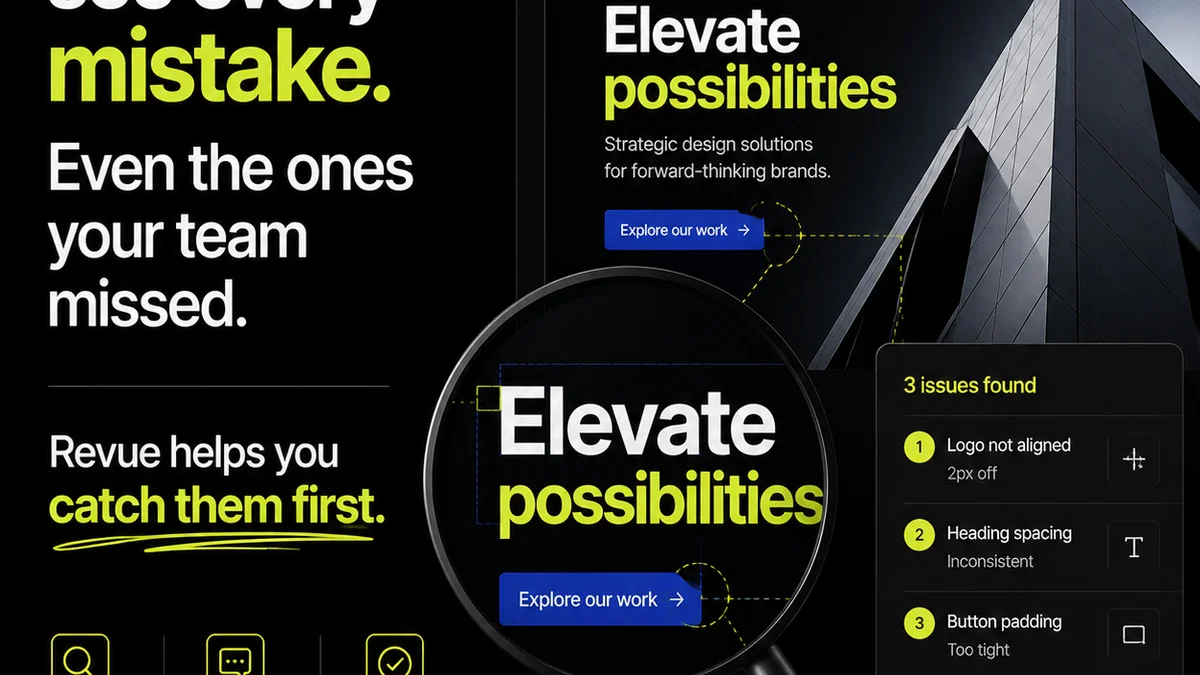
Managing prototype testing effectively, especially across multiple stakeholders and iterations, is a significant operational challenge. This is where a centralized platform like Revue becomes invaluable.
Revue provides a single source of truth for all client feedback, design iterations, and testing results. Instead of scattered spreadsheets and email threads, you have a clear, auditable trail.
- Centralized Feedback: Consolidate all comments, annotations, and feedback from various testing rounds in one place. No more lost insights or conflicting reports.
- Revision and Approval Visibility: Track every change made based on feedback. See which decisions were approved and by whom, ensuring accountability and clarity.
- Quality Assurance Streamlining: Integrate testing feedback directly into your QA workflow. Ensure that critical issues identified during prototype testing are addressed before development sprints begin.
By streamlining the feedback and revision process, Revue helps agencies ensure that prototype testing isn't just a compliance step, but a strategic tool that drives product success and protects client budgets.
Final Thought
Prototype testing isn't just about finding bugs. It's about de-risking investment and ensuring you're building something people will actually use and pay for. Are you treating it as a strategic financial review, or just another box to tick?
Frequently asked questions
What's the biggest mistake agencies make in prototype testing?
The biggest mistake is treating prototype testing as a mere quality assurance step rather than a strategic financial review. This leads to testing the wrong things, not testing early or often enough, and ignoring critical feedback that impacts market viability and revenue.
How can I ensure I'm testing with the right audience?
Recruit participants who precisely match your target user's demographic, psychographic, and behavioral profiles. Avoid using internal staff, friends, or family, as their feedback will likely be biased and irrelevant to your actual customer base.
Why is early and frequent testing so important?
The cost of making changes increases exponentially as a project progresses. Testing early and often with low-fidelity and interactive prototypes allows you to catch fundamental issues when they are cheapest to fix, preventing costly rework later in development or post-launch.
How does Revue help with prototype testing?
Revue centralizes all feedback and testing results, providing a clear audit trail of revisions and approvals. This streamlines the process, ensures no insights are lost, and helps teams act decisively on feedback, thus reducing costly rework and delays.