Everyone says Jira is the king of project management. For software development, that’s often true. It tracks bugs, sprints, and complex dependencies with a rigor few tools can match.
But for creative agencies? Not so much.
The hard truth is that using Jira for creative feedback and client approvals is like using a sledgehammer to crack a nut. It’s overkill, cumbersome, and fundamentally misaligned with how creative work flows.
1. The Fundamental Disconnect: Dev vs. Creative Workflows
Software development is linear. You build a feature, test it, deploy it. There are clear stages, discrete tasks, and often predictable outcomes. Jira excels at managing this.
Creative work, however, is iterative and subjective. It involves interpretation, emotional response, and a constant back-and-forth. Clients don’t just approve a “build”; they react to a visual, a message, a feeling.
This difference is critical. Jira’s strength lies in tracking technical tasks. Its weakness is handling the nuanced, subjective nature of creative feedback.
The Symptoms of Using Jira for Creative Feedback
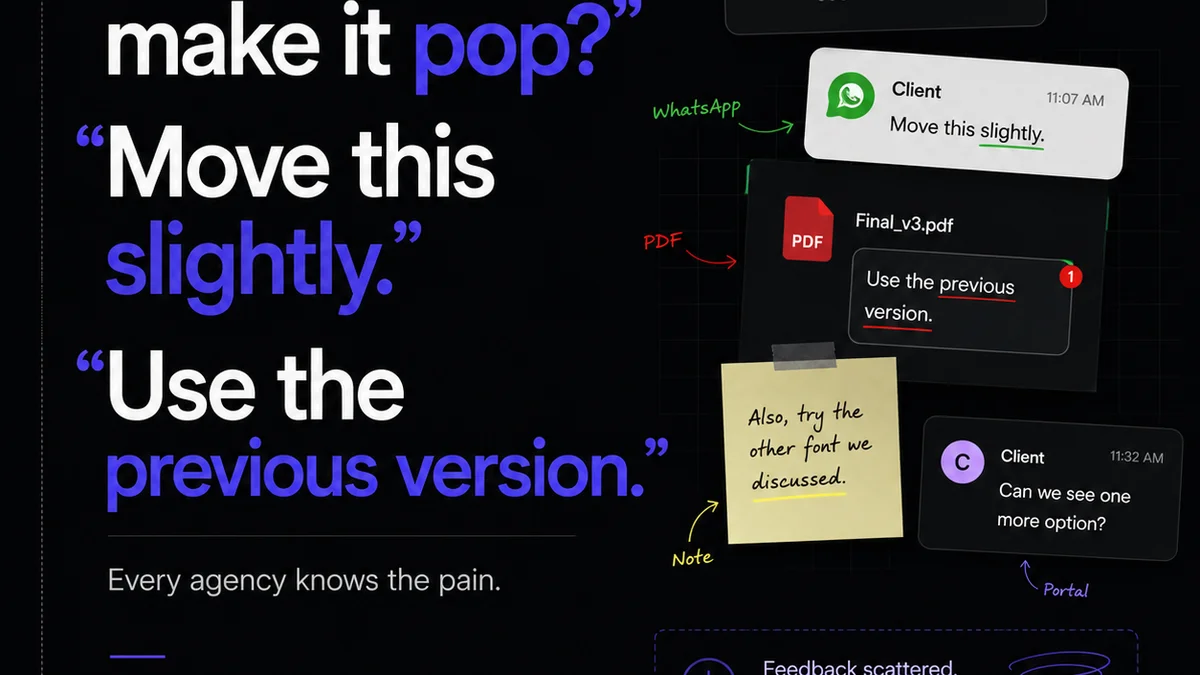
- Endless email chains to clarify feedback buried in Jira comments.
- Version control nightmares where the wrong file gets approved.
- Misinterpreted feedback leading to costly rework.
- Long delays waiting for subjective client input.
- Frustrated designers and account managers drowning in tickets.
These aren’t minor annoyances; they’re workflow killers.
2. Jira's Feedback Loop: A Black Hole for Context
In Jira, feedback is often a comment attached to a ticket. It’s detached from the visual asset itself. A designer has to leave the ticket, open the asset, find where the comment applies, and then try to interpret it.
This creates a massive context gap. Was that feedback about the kerning on the headline, or the overall mood of the image? Was it a
Frequently asked questions
Can Jira be customized for creative feedback?
While Jira is highly customizable, its core structure is built for software development. Adapting it for creative feedback often involves complex workarounds that can be fragile and hard to maintain, leading to more problems than they solve.
What are the main differences between Jira and Revue for agencies?
Jira is primarily a bug and issue tracker for software teams, focusing on task management and development lifecycles. Revue is designed for creative collaboration, centralizing visual feedback, managing revisions, and streamlining client approvals directly on creative assets.
Is Jira too complex for creative teams?
For many creative teams, Jira's complexity is a significant hurdle. Its interface, terminology, and workflow are geared towards developers, making it unintuitive and inefficient for designers and clients who need a more visual and direct way to collaborate on creative work.
How does Revue improve client feedback?
Revue provides a centralized platform where clients can leave feedback directly on designs, videos, or websites. This eliminates confusing email chains and ensures all comments are linked to the specific asset, providing clear context and reducing misinterpretations.