You’ve probably heard that Notion is the ultimate all-in-one workspace for managing projects, client feedback, and internal documentation. And that Revue is a specialized tool for creative feedback and approvals. None of that is wrong. But it’s incomplete.
The hard truth? Both tools have strengths, but they operate on fundamentally different principles when it comes to the messy, iterative reality of creative work in healthcare. Choosing the right one isn’t about picking the most feature-rich app; it’s about understanding which system aligns with your actual workflow and client needs.
1. The 'All-in-One' Illusion: Notion's Scope
Notion’s power lies in its flexibility. It’s a blank canvas that can be molded into almost anything: a CRM, a project tracker, a knowledge base, a content calendar, even a simple database for patient testimonials (though security and HIPAA compliance would be a major concern there, outside the scope of this discussion).
For healthcare marketing and creative teams, this means you *can* build a system to manage client briefs, track campaign progress, store assets, and even collect feedback. You can create elaborate templates for everything from campaign planning to post-mortem reports.
The Trade-offs of Infinite Customization
But this flexibility comes at a cost. Building and maintaining a robust Notion workflow requires significant upfront investment in setup and ongoing administration. It demands discipline from every user to adhere to the structure you’ve painstakingly created.
Think about it:
- Every piece of feedback needs to be manually logged into a specific database entry.
- Revisions might be tracked via status changes or comments, but visual comparison and clear annotation are often missing.
- Approval trails can become complex, relying on checkbox toggles or linked pages rather than a definitive, auditable record.
- The system is only as good as the people using it. A single missed step in data entry can break the chain.
This is where the 'all-in-one' promise can feel like an illusion. You’re not just using a tool; you’re building and managing an entire operational system within it.
2. The Specialized Tool: Revue's Focus
Revue, on the other hand, is built for a specific purpose: streamlining creative feedback, revision management, and approvals. It doesn't try to be your entire company's operating system. Instead, it focuses on solving the critical pain points that plague creative workflows, especially in regulated industries like healthcare.
This specialization means its core features are designed to address the nuances of creative review.
Designed for the Creative Loop
Consider the core components of creative review:
- Visual Feedback: The ability to leave comments directly on specific parts of an image, video, or document.
- Version Control: Clearly seeing which version is current, previous versions, and how feedback evolved.
- Actionable Revisions: Feedback that is clear, contextual, and easily assigned.
- Clear Approvals: A definitive, recorded sign-off that removes ambiguity.
Notion *can* simulate some of these, but it’s not its native function. Revue is built around them. This distinction is critical for healthcare teams juggling compliance, multiple stakeholders, and the need for irrefutable records.
3. Healthcare Specifics: Compliance and Clarity
Healthcare is a unique beast. Beyond the usual client demands, there are layers of compliance, regulatory requirements (like HIPAA, though direct patient data handling is outside the scope of creative review tools), and a high degree of stakeholder involvement.
The Assumption: Any project management tool will work if you set it up right.
The Hard Truth: Tools that force manual data entry and lack visual context create compliance risks and slow down approvals. In healthcare, ambiguity is expensive and potentially dangerous.
Where Clarity is Non-Negotiable
In healthcare marketing, an approving stakeholder might be a busy physician, a legal counsel, or a marketing director. They need to see:
- Exactly what they are approving.
- The specific changes made since the last review.
- Who provided what feedback and who gave the final sign-off.
Trying to cobble this together in a generic tool can lead to:
- Misinterpretations of feedback.
- Lost revision history.
- Delayed campaign launches due to back-and-forth clarification.
- Difficulty in auditing the approval process if questions arise.
A tool designed for visual review and clear approval chains offers a much more robust and defensible process.
4. The Workflow Bottleneck: Where Things Go Wrong
Most creative project failures aren't due to a lack of talent. They're due to breakdowns in communication and process. This is amplified in healthcare where stakes are high.
Notion Workflow Example (Potential Issues):
- Client provides feedback via email.
- Team member manually copies feedback into a Notion task/comment.
- Designer makes revisions, uploads new file to a linked cloud storage.
- Team member updates Notion status and links to new file.
- Next stakeholder reviews, provides feedback via a different channel.
- Repeat, with increasing risk of miscommunication or lost context.
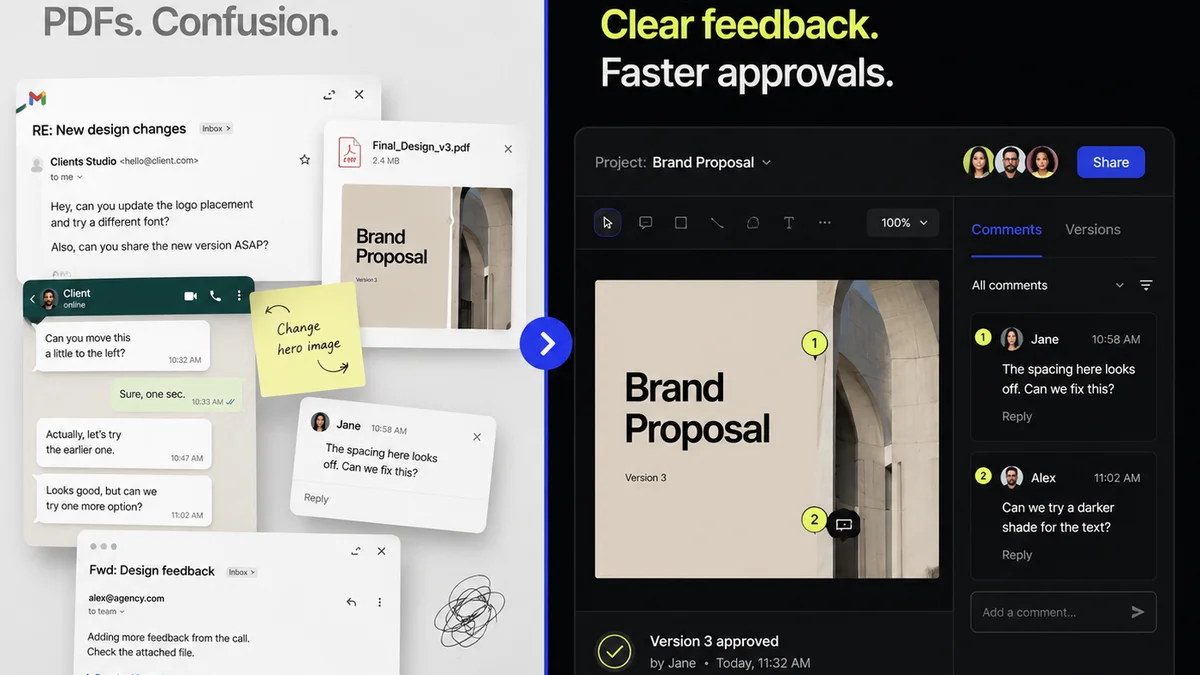
Revue Workflow Example (Streamlined):
- Client receives a review link for the latest version of the creative.
- Client annotates directly on the design, leaving contextual comments.
- Designer sees comments, makes revisions, uploads a new version within Revue.
- Previous versions and all feedback are preserved.
- Stakeholder receives a notification for final approval, clicks to review and approves with a single click.
The difference is the friction. Notion requires you to build and maintain the friction-reducing mechanisms yourself. Revue provides them out of the box.
Where Revue Fits In
Revue is purpose-built to eliminate the friction points in creative collaboration, making it ideal for healthcare agencies and in-house teams that can’t afford ambiguity or delays.
It centralizes client feedback, ensuring that all comments, annotations, and discussions happen in one place, directly tied to the creative asset. This eliminates the chaotic email chains and scattered messages that plague complex projects.
Managing revisions becomes visual and clear. You can see exactly what changed, compare versions side-by-side, and track the evolution of the creative piece. This visibility is crucial for keeping projects on track and ensuring everyone is aligned.
Finally, Revue provides a clear, auditable trail for approvals. When a stakeholder signs off, that record is definitive. For healthcare, where accuracy and accountability are paramount, this provides peace of mind and a robust process.
5. The Hidden Cost: Time and Resources
Let's talk about the real cost of a system. It's not just the subscription fee. It's the time spent building, training, and troubleshooting.
Notion: The Resource Drain
- Setup Time: Weeks or months to design and implement a robust system.
- Training Time: Ensuring every team member understands the complex workflows.
- Maintenance: Constantly refining databases, views, and permissions as needs evolve.
- Lost Productivity: Time spent manually logging data or searching for feedback instead of creating.
Revue: The Efficiency Gain
- Onboarding: Quick setup, intuitive interface.
- Focused Use: Team members use it for its core purpose: feedback and approvals.
- Reduced Errors: Visual context and clear processes minimize mistakes.
- Faster Turnaround: Streamlined communication leads to quicker approvals and project completion.
For healthcare teams, where efficiency directly impacts patient communication and campaign effectiveness, this time savings is not trivial. It translates to faster market entry for critical health information and reduced operational overhead.
Final Thought
The debate between a flexible, all-encompassing tool like Notion and a specialized, focused tool like Revue isn't about which is
Frequently asked questions
Can Notion handle creative feedback effectively for healthcare projects?
Notion can be customized to track feedback, but it lacks the visual annotation and contextual commenting features that make dedicated tools like Revue more effective and less prone to misinterpretation for creative assets. This can be a significant drawback in detail-oriented healthcare projects.
What are the main advantages of Revue over Notion for healthcare creative approvals?
Revue's primary advantage is its specialized focus on visual feedback, clear version control, and auditable approval trails. For healthcare, where clarity and compliance are critical, Revue provides a more direct and reliable system for managing the review and approval process compared to Notion's more general-purpose approach.
How does Revue help with the compliance aspects of healthcare creative work?
While Revue doesn't handle patient data (HIPAA compliance is a separate concern), it ensures an irrefutable, documented record of feedback and approvals for creative assets. This clarity reduces the risk of errors or miscommunication during the review process, which is vital for regulated healthcare content.
Is it better to build a custom workflow in Notion or use a specialized tool like Revue for healthcare agencies?
For creative feedback and approvals, a specialized tool like Revue is generally more efficient and less prone to error. Building a custom Notion workflow requires significant setup and ongoing maintenance, whereas Revue offers built-in features designed to streamline these specific tasks, saving time and reducing risk for healthcare agencies.