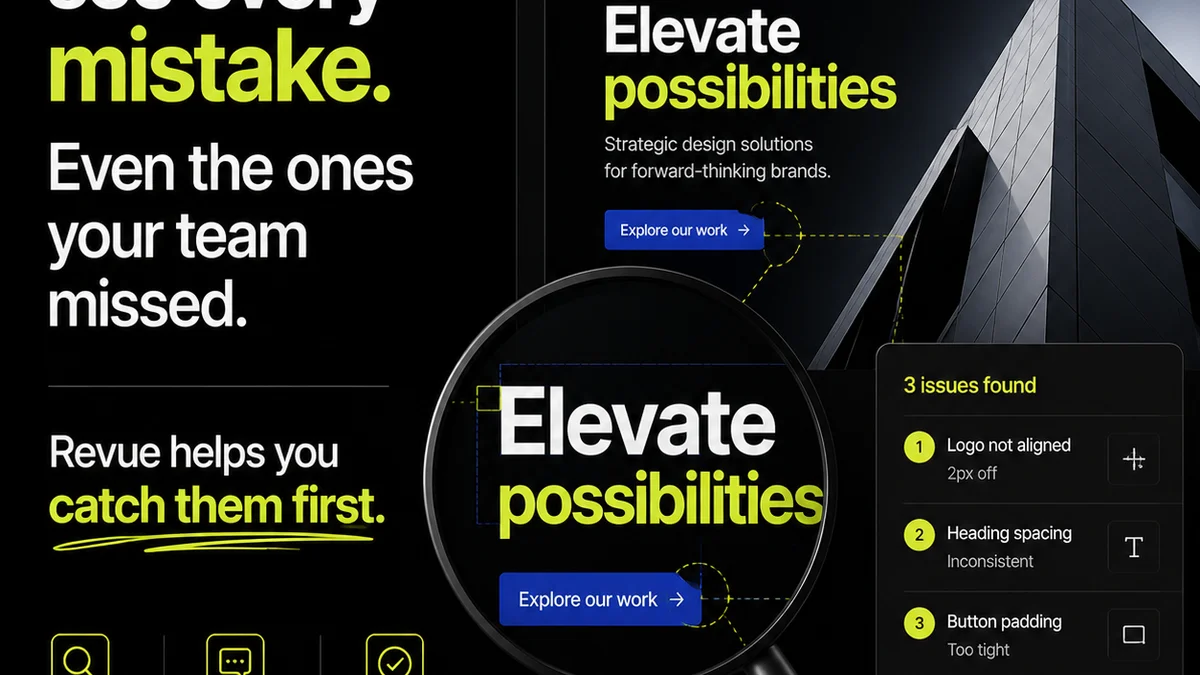
Everyone wants the best creative review software. They compare features, pricing, and integrations. They look at platforms like Revue and Ziflow and think picking the right one is about finding the most bells and whistles.
None of that is wrong. But it’s incomplete.
The hard truth is that the best software isn't just about what it *can do*. It's about what it *allows your team and your clients to do*, and how smoothly that happens. It's about the friction you eliminate and the clarity you create.
1. The Core Problem: Creative Feedback Chaos
Before diving into Revue vs. Ziflow, let's face the universal pain point: managing creative feedback is messy. Projects get bogged down by:
- Endless email chains with conflicting instructions.
- Version control nightmares where no one knows which file is final.
- Clients providing feedback via Slack, text messages, or even phone calls.
- Lack of clear approval status, leading to rushed revisions or missed deadlines.
- Disagreements over subjective feedback that lacks context.
This chaos costs agencies time, money, and reputation. It’s why tools like Revue and Ziflow exist.
2. Ziflow: The Enterprise-Grade Workhorse
Ziflow positions itself as a comprehensive solution for creative workflow automation, particularly for larger teams and enterprise clients. It aims to be an all-in-one platform for managing the entire creative lifecycle.
Key Strengths of Ziflow
- Broad Integrations: Ziflow boasts extensive integrations with popular creative tools and project management software. This can be a significant advantage for teams already invested in a specific ecosystem.
- Advanced Automation: It offers robust automation capabilities, allowing for complex workflow setups, automated task assignments, and sophisticated approval processes. This is geared towards streamlining high-volume creative production.
- Detailed Reporting: For managers and stakeholders, Ziflow provides in-depth analytics and reporting on project progress, team performance, and bottlenecks.
- Customization: The platform offers a high degree of customization, enabling teams to tailor workflows and features to very specific operational needs.
Potential Drawbacks
While powerful, Ziflow's complexity can be a double-edged sword.
- Steep Learning Curve: The sheer number of features and customization options can make Ziflow challenging for new users to adopt quickly.
- Overkill for Smaller Teams: For agencies that don't require extensive automation or enterprise-level reporting, Ziflow might be more than they need, leading to unnecessary complexity and cost.
- User Experience: Some users find the interface less intuitive or modern compared to newer platforms, potentially impacting day-to-day usability for creative teams.
3. Revue: The Focused Collaboration Hub
Revue, on the other hand, focuses on being the central nervous system for creative feedback and approvals. Its strength lies in its simplicity and directness, aiming to make the review process as frictionless as possible.
Key Strengths of Revue
- Intuitive Interface: Revue is designed with a clean, user-friendly interface that requires minimal training. Creative teams and clients can jump in and provide feedback quickly.
- Centralized Feedback: It excels at consolidating all feedback, comments, and annotations in one place, directly on the creative asset. This eliminates the scattered nature of email and chat.
- Clear Revision Tracking: Version control is built-in, showing clear histories of revisions and approvals. This transparency is crucial for accountability and dispute resolution.
- Streamlined Approvals: The approval workflow is straightforward, allowing for clear sign-offs and reducing ambiguity.
- Project Visibility: Stakeholders get a clear view of project status and feedback loops without needing to navigate complex dashboards.
Potential Drawbacks
Revue's focus means it intentionally omits certain enterprise-level features found in platforms like Ziflow.
- Limited Automation: If your agency requires highly complex, multi-stage automated workflows with intricate conditional logic, Revue's approach is more direct and less automated.
- Less Extensive Integrations: While integrations exist, they might not match the breadth of Ziflow's ecosystem, especially for niche enterprise tools.
- Reporting Simplicity: Reporting is focused on project status and feedback summaries, not deep operational analytics.
4. The Critical Differentiator: Workflow Philosophy
When comparing Revue and Ziflow, the most significant difference isn't a feature; it's their underlying philosophy on creative workflow.
Ziflow is built for process automation. It's designed to manage and automate the *entire* creative production pipeline, often integrating with existing systems to orchestrate tasks at scale. It's about controlling the flow of work through a defined system.
Revue is built for feedback clarity and control. Its primary goal is to ensure that the *communication* around creative work is clear, actionable, and easily managed. It focuses on the critical review and approval stages, aiming to make them as painless as possible for everyone involved.
Who is Each For?
- Ziflow might be better for: Large agencies or enterprises with high volumes of creative work, complex multi-departmental workflows, and a need for deep integration with existing enterprise software. They likely have dedicated operations teams to manage complex systems.
- Revue might be better for: Creative agencies and in-house teams that prioritize speed, clarity, and ease of use in their feedback and approval process. Teams that want to reduce email clutter and get to clear sign-offs faster, without the overhead of enterprise-level automation.
5. Beyond Features: Client Experience Matters
A common mistake is focusing only on internal team needs. But the client experience is paramount. How easy is it for your clients to:
- Understand where to provide feedback?
- Provide that feedback without technical hurdles?
- See the history of revisions and approvals?
- Feel confident that their input is captured accurately?
A clunky client experience, regardless of the software's internal power, can damage relationships and slow down projects.
Revue's strength here is its direct, uncluttered interface. Clients see the creative asset and the feedback tools, often without needing a tutorial.
Ziflow, with its broader feature set, can sometimes present a more complex client-facing interface, depending on how it's configured. This isn't inherently bad, but it requires more careful onboarding.
6. Where Revue Fits In
Revue is built to be the central point for creative feedback and approvals. It’s where your team and your clients converge to refine creative work.
It tackles the chaos of scattered feedback by providing a single source of truth on each asset. This means no more hunting through emails or Slack messages for that one crucial comment.
The platform offers clear visibility into revision cycles, ensuring that every iteration is tracked and accounted for. This transparency is key for managing client expectations and internal accountability.
Ultimately, Revue helps agencies and creative teams run quality checks by making the approval process definitive. When a client approves, it's recorded. This clarity prevents costly scope creep and disputes down the line.
7. The Cost of Complexity
While Ziflow's extensive features are powerful, they come with a cost – both financially and in terms of adoption. Implementing and managing a highly complex system requires time, training, and potentially dedicated resources.
For many agencies, the ROI on advanced automation and reporting might not justify the investment if their core need is simply better creative review and approval management.
Revue offers a more streamlined cost structure, reflecting its focused purpose. The value is in the efficiency gained from a simpler, more direct workflow, rather than a vast feature set.
8. Final Thought
The choice between Revue and Ziflow, or any creative review software, hinges on a simple question: Are you trying to automate an entire production pipeline, or are you trying to perfect the critical feedback and approval loop?
One isn't inherently better; it's about matching the tool to your specific operational reality and strategic goals. The
Frequently asked questions
What is the main difference between Revue and Ziflow?
Ziflow focuses on broad creative workflow automation for enterprise needs, offering extensive integrations and customization. Revue focuses on streamlining creative feedback and approvals with an intuitive, centralized hub for clarity and speed, especially for agencies prioritizing ease of use and a smooth client experience.
Is Ziflow too complex for small creative agencies?
Potentially, yes. Ziflow's extensive features and automation capabilities can have a steep learning curve and may be overkill for smaller teams whose primary need is efficient feedback and approval management, not enterprise-level workflow orchestration.
How does Revue improve client collaboration?
Revue simplifies the client experience by providing a clear, uncluttered interface directly on the creative asset for feedback. It centralizes all comments and approvals, eliminating confusion from scattered communication channels and ensuring clients feel heard and understood.
Which software is better for managing revisions?
Both manage revisions, but Revue emphasizes clear version tracking and approval history as a core function for accountability. Ziflow can integrate revision tracking into broader automated workflows, offering more complex management possibilities.