Everyone talks about good SaaS UX. They say it’s important. They say it drives adoption. They say it makes users happy.
None of that is wrong. But it’s incomplete.
The hard truth? If you can’t quantify the return on investment (ROI) of your SaaS user experience (UX) efforts, you’re essentially flying blind. You’re making expensive decisions based on gut feelings, not data. That’s a recipe for wasted resources and missed opportunities.
1. The Assumption: UX is a Cost Center
The most common misconception is that UX is purely an expense. Designers need tools, researchers need time, and developers need to implement features. It all adds up, right?
Sure, there are costs. But framing UX solely as a cost center misses the point entirely. It ignores the massive revenue-generating potential and cost-saving implications of a well-designed product.
The Deeper Truth: UX is a Profit Driver
Think about it. What does good UX actually do?
- It makes it easier for new users to onboard and understand your product's value.
- It reduces the effort users need to accomplish their goals, leading to higher engagement.
- It minimizes errors and confusion, cutting down on support tickets and churn.
- It creates a delightful experience that encourages repeat business and positive word-of-mouth.
These aren’t just nice-to-haves. They directly impact key business metrics like customer acquisition cost (CAC), lifetime value (LTV), and churn rate. That’s the real ROI of SaaS UX.
2. Measuring the Unmeasurable? Not Anymore.
The challenge, of course, is *how* to measure this. How do you put a dollar figure on a “delightful experience” or “reduced confusion”?
You don’t measure the feeling directly. You measure the outcomes that feeling enables.
Key Metrics for SaaS UX ROI
Focus on quantifiable results. Here are the critical areas:
- Conversion Rates: How many visitors turn into sign-ups? How many free trials convert to paid subscriptions? Improved UX in sign-up flows and onboarding directly boosts these numbers.
- Customer Acquisition Cost (CAC): If your product is intuitive and easy to understand from the start, you need less marketing spend and a more efficient sales process to acquire each new customer. Word-of-mouth referrals, driven by great UX, further reduce CAC.
- Customer Lifetime Value (LTV): Happy, engaged users stick around longer and spend more. A product that consistently delivers value through excellent UX will naturally increase LTV.
- Churn Rate: This is the big one. Poor UX is a primary driver of customer churn. If users can't figure out how to use your product, get frustrated, or find a better alternative, they leave. Reducing churn by even a few percentage points can have a massive impact on revenue.
- Support Costs: Confusing interfaces, unclear instructions, and frequent bugs lead to a flood of support tickets. Streamlining workflows and improving clarity through UX design directly reduces the burden on your support team, saving significant operational costs.
- Feature Adoption: Are users actually using the features you build? If a feature is buried, poorly explained, or difficult to operate, adoption will be low. Good UX ensures users discover and utilize valuable functionality, maximizing the return on your development investment.
- Net Promoter Score (NPS) / Customer Satisfaction (CSAT): While softer metrics, these correlate strongly with retention and LTV. A higher NPS or CSAT, often a direct result of positive UX, indicates a healthier customer base.
3. The Cost of *Bad* UX
It’s often easier to see the ROI of UX by looking at the flip side: the cost of getting it wrong.
Bad UX isn’t just annoying. It’s expensive.
- Wasted Development: Building features nobody uses because they're hard to find or understand.
- High Churn: Losing customers because the product is too difficult or frustrating.
- Increased Support Burden: Drowning in tickets from users who can't figure things out.
- Damaged Reputation: Negative reviews and word-of-mouth deterring new prospects.
- Missed Market Opportunities: Competitors with better UX capturing your market share.
Every dollar spent on fixing bad UX is a dollar that could have been invested in growth. Every user lost to a competitor is revenue gone forever.
4. Integrating UX into Your SaaS Strategy
So, how do you move from assumption to action? You embed UX into your core business strategy, not as an afterthought.
Start with User Research
Before you build, before you design, understand your users. Conduct interviews, surveys, and usability tests. Analyze user behavior data. What are their real problems? What are their goals? What’s their context?
Prioritize Based on Impact
Not all UX improvements are created equal. Use data from your research and analytics to identify the areas that offer the biggest potential ROI. Focus on:
- High-friction onboarding steps.
- Common points of user error.
- Features with low adoption rates.
- Key conversion funnels.
Iterate and Measure
UX is not a one-and-done project. It’s a continuous process of improvement. Launch changes, measure their impact on your key metrics, learn, and iterate. This is where a robust feedback and revision management system becomes critical.
Where Revue Fits In
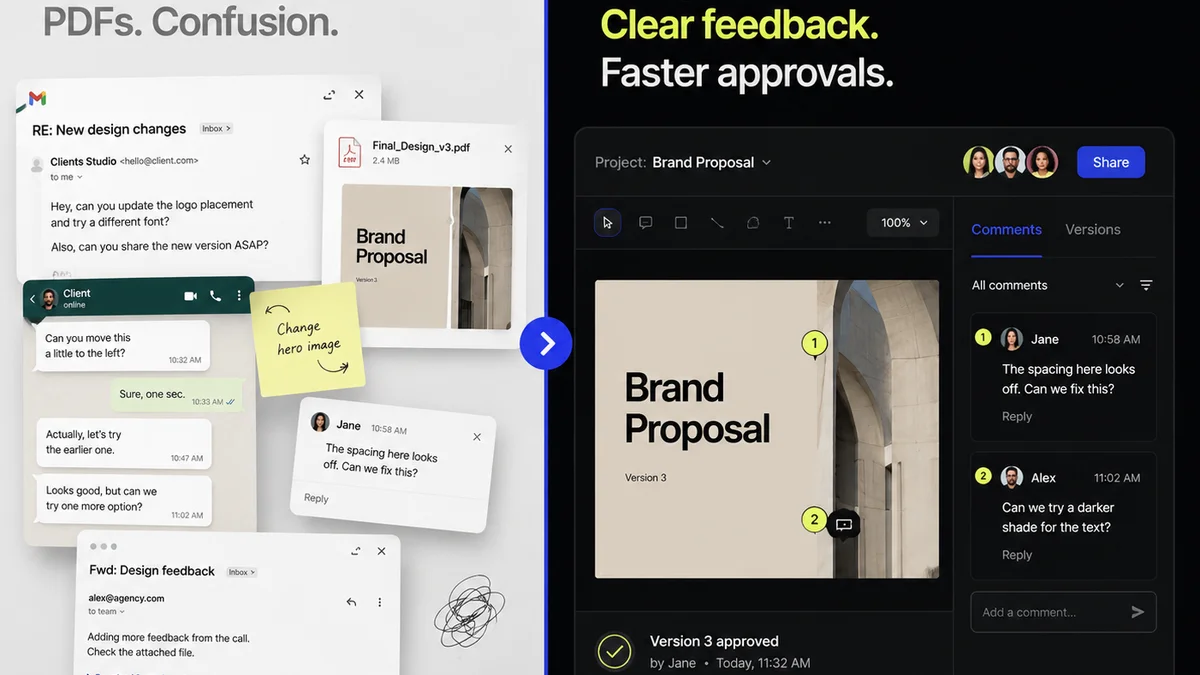
Managing client feedback and creative revisions can be a UX nightmare for agencies and their clients. Miscommunication, lost feedback, and endless revision cycles kill productivity and erode satisfaction.
Revue tackles this head-on by centralizing client feedback directly on creative assets. This means:
- Clearer Communication: All feedback, comments, and annotations live in one place, tied to the specific version of the creative. No more sifting through emails or Slack threads.
- Streamlined Revisions: Track the history of revisions and approvals easily. Understand who signed off on what and when, reducing ambiguity and speeding up the approval process.
- Enhanced Quality Checks: With a clear audit trail of feedback and revisions, you can ensure that all client requirements are met before final delivery, improving the quality of your output.
By improving the internal and client-facing UX of the creative review process itself, Revue helps agencies reduce friction, save time, and ultimately deliver better work, faster. This directly impacts your agency’s operational efficiency and client satisfaction metrics – key components of your overall business ROI.
5. Making the Business Case for UX Investment
When you can articulate the ROI of UX, you can make a compelling case for investing in it. You move the conversation from “Can we afford this?” to “Can we afford not to?”
Frame your proposals around business outcomes, not just design deliverables.
- Instead of: “We need a UX audit.”
- Try: “A UX audit will identify friction points in our onboarding flow, projected to reduce churn by X% and increase LTV by Y%.”
Use data. Use projections. Show how UX investments translate into tangible business value.
Final Thought
The best SaaS products aren’t just functional; they’re remarkably easy and intuitive to use. This isn’t accidental. It’s the result of intentional, data-driven UX investment.
If you’re not actively measuring and articulating the ROI of your SaaS UX, you’re leaving money on the table. Are you ready to start treating UX as the profit center it truly is?
Frequently asked questions
What is SaaS UX ROI?
SaaS UX ROI (Return on Investment) refers to the measurable financial benefits gained from investing in user experience design for a Software as a Service product. It quantifies how improved UX directly contributes to increased revenue, reduced costs, and enhanced customer loyalty.
How can I measure UX ROI without direct user feedback?
You can measure UX ROI by tracking key business metrics that are directly influenced by user experience. These include conversion rates, customer acquisition cost (CAC), customer lifetime value (LTV), churn rate, support ticket volume, and feature adoption rates. Analyzing changes in these metrics after UX improvements provides an indirect measure of ROI.
Is UX primarily a cost or an investment for SaaS companies?
While UX efforts involve costs (tools, personnel, time), they should be viewed as a strategic investment. Well-executed UX drives revenue through higher conversion and retention, reduces operational costs by lowering support needs and churn, and ultimately contributes to profitability, making it a profit driver rather than just an expense.
What are the biggest UX mistakes that hurt SaaS ROI?
The biggest mistakes include poor onboarding that leads to high initial churn, confusing navigation that frustrates users and increases support load, complex workflows that reduce efficiency, and neglecting user research which results in building features nobody wants or needs. These all directly increase costs and decrease revenue.