Everyone knows stakeholder reviews are a necessary evil. They’re a hurdle. A bottleneck. A place where good ideas go to die a slow, agonizing death by committee. That’s the common wisdom, anyway. And none of that is wrong. But it’s incomplete.
The hard truth is that the *process* of stakeholder review is often the real problem, not the stakeholders themselves. If your reviews feel like a battle, you’re probably doing them wrong. You’re treating them like a binary gate—approved or rejected—instead of a crucial stage in the creative development process.
1. Define the Purpose of Every Review
Before you even send a design, a draft, or a wireframe, you need to know *why* you’re asking for feedback. Is it for high-level strategic alignment? Detailed usability testing? Final sign-off on a specific element? Each stage demands a different kind of input and a different approach.
Strategic Alignment vs. Tactical Feedback
Early on, you might need to confirm that the creative direction aligns with business goals. Stakeholders should be thinking about the 'what' and 'why'. Later, when you’re deep in the weeds of pixel perfection, you need them focused on the 'how'.
Asking for strategic feedback on a nearly finished UI is a recipe for disaster. It’s like asking for architectural feedback on the paint color when the foundation is still wet. It wastes everyone’s time and breeds frustration.
Clarify Deliverables and Decision-Makers
What exactly are you asking them to review? A full prototype? A single landing page mock-up? A draft of copy? Be crystal clear. Equally important: who has the final say? Designating a single point person for final approval, even if they gather input from others, can streamline the process dramatically.
2. Structure Your Feedback Process
A chaotic review process leads to chaotic feedback. You need a structured approach that guides stakeholders and ensures you get actionable insights.
Set Clear Timelines and Expectations
When will the review happen? How long do stakeholders have to provide feedback? What format should their feedback take? Communicate this upfront. A common mistake is to leave review periods open-ended, allowing feedback to trickle in over weeks, derailing your timeline.
“Just wanted to circle back on the XYZ project” is not a feedback loop. It’s a sign of a broken process.
Prepare a Review Brief
For significant reviews, a brief is invaluable. This document should:
- State the project goals.
- Outline the specific objectives of this review stage.
- Highlight key areas for feedback.
- Provide context on previous decisions or constraints.
- Include a link to the work being reviewed.
- Specify the deadline for feedback.
This isn't just for stakeholders; it's a reference for your team too, ensuring everyone is aligned on what's being asked.
Use a Centralized Platform
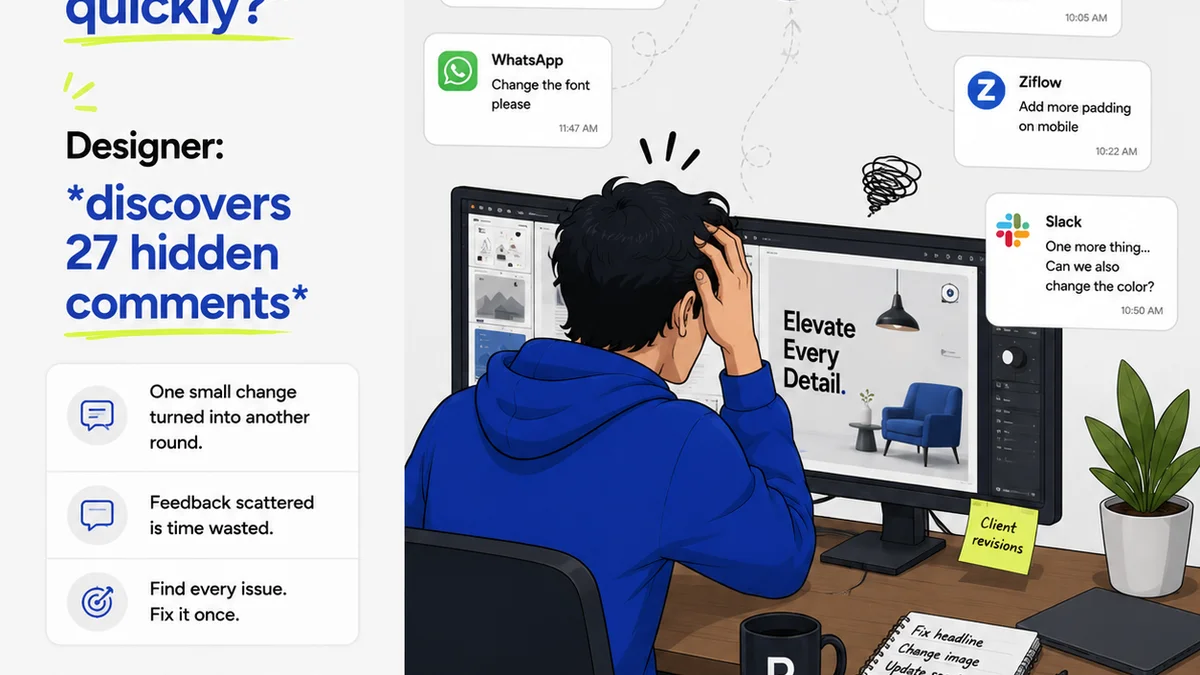
Scattered feedback across emails, Slack messages, and random documents is a nightmare to manage. You need a single source of truth for all comments, revisions, and approvals.
This prevents questions like “Did you see my comment on the second revision?” from becoming a recurring, time-wasting refrain.
3. Guide Stakeholder Input
Stakeholders aren't necessarily designers or UX experts. Your job is to help them provide feedback that is useful and constructive.
Provide Specific Prompts
Instead of asking, “What do you think?” try specific questions:
- “Does the call-to-action button clearly convey its purpose?”
- “Is the information hierarchy easy to follow on this page?”
- “Does the tone of this copy align with our brand voice?”
- “Are there any potential accessibility issues you notice?”
This directs their attention to critical aspects of the work and elicits more targeted responses.
Educate on Design Principles (Briefly)
You don't need to give them a design degree, but a quick primer on a relevant concept can go a long way. For example, before a usability review, you might briefly explain the concept of user flow or the importance of clear navigation.
Understanding *why* a certain layout is proposed makes it easier for them to provide constructive critiques rather than subjective opinions.
Distinguish Subjective vs. Objective Feedback
Help stakeholders differentiate between personal preference (“I don’t like the color blue”) and objective issues (“The contrast ratio on this text is too low for readability”).
Your role is to filter out the subjective noise and focus on feedback that impacts usability, accessibility, brand consistency, or business goals. This is where tools that visualize contrast ratios or user flows become incredibly helpful.
4. Manage the Feedback Loop
Receiving feedback is only half the battle. Processing and responding to it effectively is where the real magic happens.
Consolidate and Categorize Feedback
Gather all feedback into one place. Then, categorize it:
- Actionable: Clear, specific issues that can be addressed.
- Discussion: Feedback that requires further conversation or clarification.
- Subjective: Personal preferences that may or may not be incorporated.
- Out of Scope: Feedback that doesn't align with project goals or constraints.
This makes it easier to prioritize and respond.
Schedule Follow-Up Meetings Strategically
Don't just send a summary email. A brief meeting can clarify misunderstandings, resolve conflicting feedback, and build consensus much faster than back-and-forth emails.
Use this time to present your proposed solutions to the feedback received. This shows you’ve listened and are actively problem-solving.
Communicate Decisions Clearly
After discussion and consolidation, clearly communicate what feedback was incorporated, what was deferred, and why. Transparency builds trust and ensures everyone understands the final direction.
This is crucial for managing expectations and preventing the same feedback from resurfacing later.
5. Embrace Iteration, Not Perfection
Few creative projects are perfect on the first try. Stakeholder reviews are designed to help you get closer to that ideal, not to demand it instantly.
View Feedback as Collaboration
When approached correctly, stakeholder reviews aren't an adversarial process. They are a collaborative effort to achieve the best possible outcome. Your stakeholders have valuable institutional knowledge and market insights.
Leveraging that expertise, even if it requires careful management, makes the final product stronger.
Don't Fear Revision Cycles
Multiple rounds of review are normal. The goal is to make each cycle more efficient and productive than the last. This is achieved through clearer briefs, better-defined feedback prompts, and structured processes.
The alternative—pushing for a single, perfect pass—is unrealistic and often leads to rushed, compromised work.
Where Revue Fits In
Managing stakeholder feedback effectively requires robust tooling. Relying solely on email and spreadsheets quickly becomes unmanageable as projects scale.
Revue is built to centralize the entire creative review and approval process. It provides a single source of truth for feedback, making it easy to:
- Collect and organize comments directly on creative assets.
- Track the history of revisions and approvals.
- Ensure all stakeholders are providing feedback in a structured way.
- Identify bottlenecks and understand the status of each review.
- Maintain a clear audit trail for accountability.
By streamlining these workflows, you can transform stakeholder reviews from a point of friction into a powerful engine for creative collaboration and quality assurance.
Final Thought
Are your stakeholder reviews a source of frustration or a catalyst for better creative work? The difference often lies not in the people involved, but in the process you’ve established. By focusing on clarity, structure, and collaboration, you can move beyond the binary 'yes/no' and unlock the true value of stakeholder input.
Frequently asked questions
What is the main goal of a stakeholder review?
The main goal is to gather informed feedback and secure approvals at key stages of a creative project, ensuring the work aligns with strategic objectives and meets quality standards before final delivery. It's about collaboration and validation, not just a simple 'yes' or 'no'.
How can I ensure feedback from stakeholders is actionable?
Ensure feedback is actionable by setting clear expectations, providing specific prompts or questions during the review, distinguishing between subjective preferences and objective issues, and educating stakeholders briefly on relevant design or project goals. Using a centralized platform also helps capture feedback clearly.
What's the best way to manage conflicting feedback from multiple stakeholders?
Consolidate all feedback first. Then, categorize it and schedule a strategic follow-up meeting with key stakeholders. During this meeting, present proposed solutions, discuss trade-offs, and aim to build consensus. Clearly communicate the final decisions and the reasoning behind them to all parties.
How often should stakeholder reviews occur?
The frequency depends on the project's complexity and phase. Reviews should occur at logical milestones: after initial concepting, after significant design development, before final asset creation, and for final approval. Avoid excessive reviews that can derail timelines; focus on strategic touchpoints.