Everyone agrees user research is good. You need to understand your audience, right? That much is obvious.
But knowing you *should* do user research and actually *doing* effective user research are two different planets.
The hard truth? Most marketing teams treat user research like a box-ticking exercise. They gather surface-level data and call it a day, missing the goldmine of deep insights that actually move the needle.
1. Define Your Research Goals — Clearly
Before you talk to a single user, you need to know *why*. What specific questions are you trying to answer?
Vague goals lead to vague research. Vague research leads to wasted effort and bad decisions.
What's the Business Problem?
Is your conversion rate stagnant? Are customers churning unexpectedly? Is a new product failing to gain traction?
Every research project should tie back to a tangible business problem or opportunity.
What Do You Need to Know?
Get granular. Instead of 'understand our users,' ask:
- What are the primary pain points our target audience faces related to [our product/service category]?
- What language do they use to describe their problems and desired solutions?
- What features do they find most valuable in competing solutions?
- What are their biggest hesitations when considering a purchase like ours?
- What channels do they trust for information about [our industry]?
2. Identify and Segment Your Target Audience
Who are you actually trying to reach? Be ruthless in defining this.
Don't fall into the trap of 'everyone is our customer.' That's a recipe for research that's too broad to be useful.
Create User Personas (If You Don't Have Them)
If you have existing personas, dust them off and validate them against current data. If not, create them.
A good persona isn't just demographics. It includes:
- Goals and motivations
- Pain points and frustrations
- Behaviors and habits
- Technological proficiency
- Information sources
Segment for Targeted Insights
Even within your target audience, there will be variations. Consider segmenting by:
- User journey stage (new vs. existing vs. lapsed)
- Product usage level (light vs. power users)
- Demographics (age, location, industry — if relevant to your product)
- Psychographics (values, attitudes, lifestyle)
3. Choose the Right Research Methods
There's no one-size-fits-all method. The best approach combines qualitative and quantitative data.
Your goals and audience will dictate the best methods.
Qualitative Methods (The 'Why')
These methods explore opinions, motivations, and experiences in depth.
- Interviews: One-on-one conversations. Great for deep dives.
- Focus Groups: Group discussions. Good for exploring opinions and group dynamics, but can be swayed by dominant personalities.
- Usability Testing: Observe users interacting with a product or prototype. Essential for identifying friction points.
- Diary Studies: Users log their experiences over time. Useful for understanding long-term behaviors.
Quantitative Methods (The 'What' and 'How Many')
These methods collect data that can be measured and statistically analyzed.
- Surveys: Gather data from a large sample. Best for validating hypotheses or measuring attitudes.
- A/B Testing: Compare two versions of a page or element to see which performs better.
- Analytics Data: Website and app usage data. Crucial for understanding user behavior at scale.
- Card Sorting: Understand how users categorize information. Useful for information architecture.
4. Develop Your Research Instruments
This is where you translate your goals into specific questions and tasks.
Poorly designed instruments yield unreliable data. Think of it like a faulty thermometer — it won't give you an accurate reading.
Interview/Survey Questions
Craft open-ended questions that encourage detailed responses. Avoid leading questions.
- Good: 'What challenges do you face when trying to achieve X?'
- Bad: 'Don't you think feature Y would solve your problem?'
Structure your questions logically, starting broad and then narrowing down.
Usability Test Tasks
Define clear, realistic tasks for users to complete. Ensure they align with your research goals.
- 'Imagine you need to find a [specific type of product]. Show me how you would do that on this website.'
- 'You've just received an email about a new feature. What's the first thing you'd do?'
5. Recruit the Right Participants
Your research is only as good as the people you talk to. Garbage in, garbage out.
You need participants who genuinely represent your target audience, not just anyone who's willing.
Screening Criteria
Develop a screener questionnaire to filter potential participants based on your defined audience segments and goals.
- Ask questions about their usage of similar products or services.
- Inquire about their job roles, company size, or other relevant demographics.
- Test their understanding of key concepts related to your research.
Recruitment Channels
Where will you find these people?
- Existing customer lists (use with caution to avoid bias)
- Social media platforms (targeted ads)
- Professional networks (LinkedIn)
- User research recruitment platforms
- Third-party panel providers
Consider offering fair compensation for their time.
6. Conduct the Research and Take Meticulous Notes
Execution is everything. Stick to your plan, but be ready to adapt.
This phase requires focus and discipline. Distractions kill insights.
During Interviews/Focus Groups
- Actively listen more than you speak.
- Ask follow-up questions ('Tell me more about that,' 'Why was that important?').
- Observe non-verbal cues.
- Record the session (with permission).
During Usability Testing
- Encourage participants to think aloud.
- Note down hesitations, errors, and points of confusion.
- Observe their body language and facial expressions.
During Surveys
- Monitor response rates.
- Look for incomplete or nonsensical answers.
Have a dedicated note-taker if possible, or ensure high-quality recordings.
7. Analyze and Synthesize Your Findings
This is where raw data transforms into actionable intelligence.
Don't just present a list of quotes. Look for patterns, themes, and underlying causes.
Qualitative Analysis
- Transcribe recordings.
- Code the data by identifying recurring themes, concepts, and keywords.
- Group similar codes into broader themes.
- Identify user needs, pain points, and mental models.
- Look for contradictions and surprising insights.
Quantitative Analysis
- Use statistical software or spreadsheet functions.
- Calculate frequencies, percentages, means, and medians.
- Perform cross-tabulations to find relationships between variables.
- Visualize data with charts and graphs.
Synthesize findings from both qualitative and quantitative methods to build a holistic picture.
8. Report and Act on Insights
Research is useless if it sits in a document, gathering digital dust.
Your findings need to be communicated clearly and concisely to stakeholders, and then translated into concrete actions.
Create Actionable Reports
Tailor your report to your audience.
- Start with key takeaways and recommendations.
- Use visuals (charts, quotes, user journey maps) to illustrate findings.
- Prioritize insights based on their potential impact and feasibility.
- Clearly outline the 'so what?' for each finding.
Integrate into Strategy
User research should inform:
- Product development roadmaps
- Marketing campaign messaging and creative
- Website and landing page optimization
- Customer support strategies
- Sales enablement materials
Establish a feedback loop to measure the impact of changes made based on research.
Where Revue Fits In
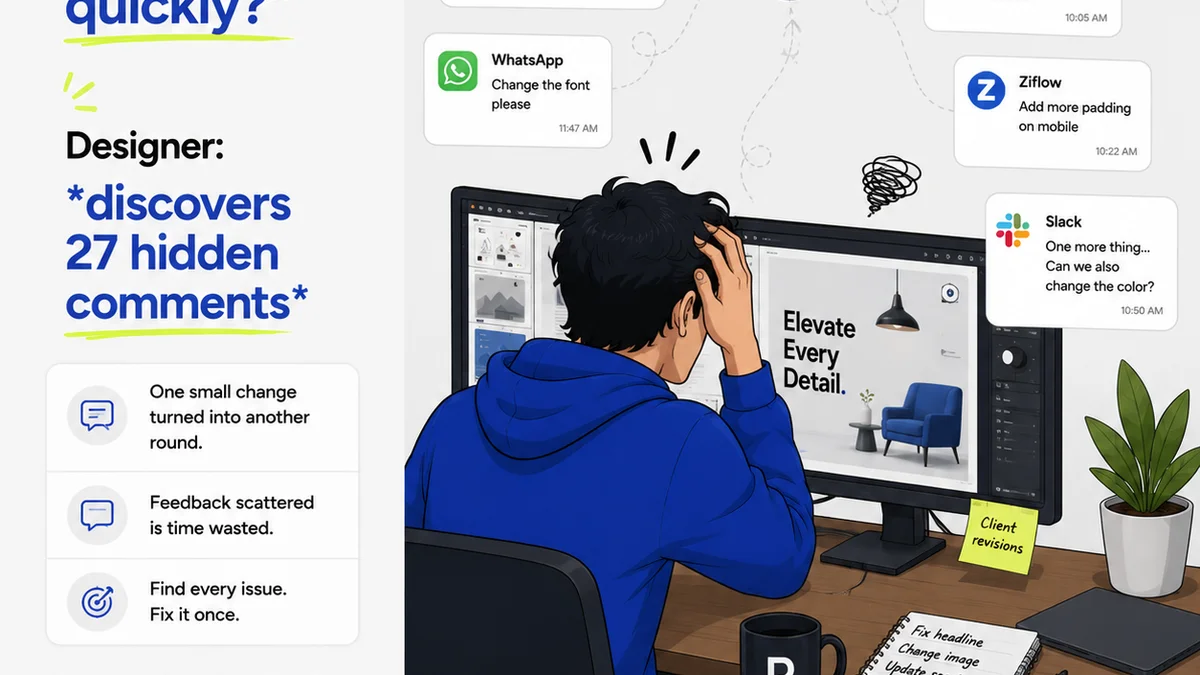
Managing the user research process, especially across multiple projects and stakeholders, can get messy. Keeping track of feedback, revisions, and approvals is critical.
Revue helps centralize client and stakeholder feedback, making it easier to:
- Gather and organize qualitative feedback from various sources.
- Track revisions and approvals, ensuring everyone is aligned on user insights.
- Maintain a clear audit trail of decisions informed by user research.
- Ensure quality checks are based on validated user needs, not just internal assumptions.
By streamlining these workflows, Revue frees up your team to focus on what matters most: deeply understanding and serving your users.
Final Thought
Are you conducting user research, or are you just collecting opinions?
The difference lies in the rigor of your process, the clarity of your goals, and your commitment to acting on genuine insights, not just what's easiest to hear.
Frequently asked questions
What is the most important part of a user research checklist?
Clearly defining your research goals. Without knowing exactly what you need to learn, your research will lack focus and produce shallow insights.
How often should marketing teams conduct user research?
User research shouldn't be a one-off event. It should be an ongoing process, integrated into campaign planning, product updates, and strategy adjustments. Aim for continuous feedback loops rather than periodic large studies.
What's the difference between qualitative and quantitative user research?
Qualitative research explores the 'why' behind user behavior through methods like interviews and usability testing, uncovering motivations and opinions. Quantitative research measures the 'what' and 'how many' using surveys and analytics, providing statistical data.
How do I ensure I'm recruiting the right participants for my research?
Develop strict screening criteria based on your target audience definition. Use these criteria in a screener questionnaire to filter candidates and ensure they accurately represent the users you need to understand.