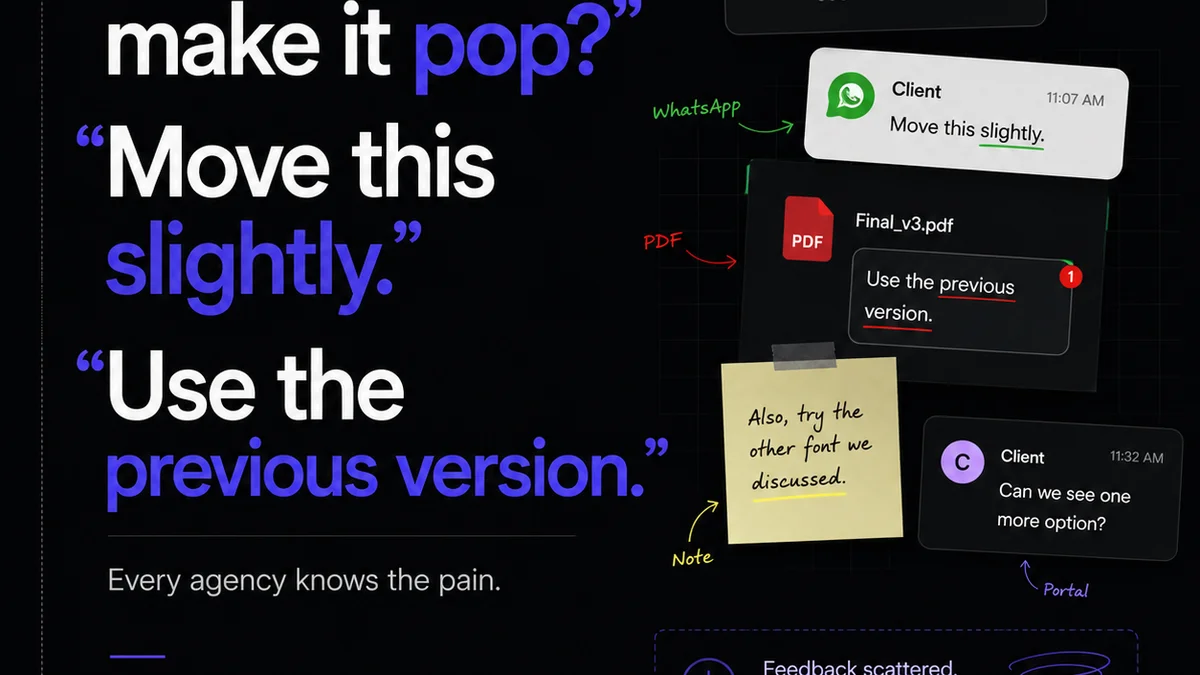
Everyone thinks they know good visual feedback when they see it. It’s about clarity, right? About being specific and constructive?
None of that is wrong. But it’s incomplete. Too often, “good feedback” is just a polite way of saying “I don’t hate this.” It lacks teeth. It doesn’t drive action. It certainly doesn’t guarantee better outcomes.
The hard truth? Most visual feedback is noise. It’s subjective, inconsistent, and ultimately, unhelpful. Agencies and creative teams drown in it, mistaking activity for progress. This isn’t about being mean; it’s about being effective. It’s about moving beyond gut feelings and toward actionable insights that actually improve creative work.
1. Define 'Good' Before You Ask for It
What does success look like for this specific piece of creative? Is it increased engagement? A clearer message? Brand consistency? Without a clear definition of the objective, feedback becomes a free-for-all of personal preference.
This isn't just about the final output. It's about the *purpose* of the output.
Set Clear Creative Briefs
Every project starts with a brief. Is it detailed? Does it outline:
- The primary objective of the creative?
- The target audience?
- Key messages to convey?
- Mandatory elements (logos, taglines, legal disclaimers)?
- Brand guidelines and tone of voice?
- Examples of what works (and what doesn't)?
If your brief is vague, your feedback will be too. A strong brief is the bedrock of effective feedback.
Establish Success Metrics
How will you measure if the creative is successful? Even if it's not a hard KPI, have qualitative measures. For a website, it might be ease of navigation. For an ad, it might be clarity of the call to action. For a brand identity, it might be distinctiveness and memorability.
2. Who Gets to Give Feedback? (And Who Listens?)
The more people involved, the murkier the water gets. Unsolicited opinions from stakeholders who weren't part of the initial strategy can derail a project.
It’s not about silencing people; it’s about channeling feedback effectively.
Identify Key Decision-Makers
Who has the final say? Who is accountable for the success of this creative? Limit the primary feedback loop to these individuals. Other stakeholders can provide input, but it should be filtered through the decision-makers.
Separate Input from Approval
Feedback is input. Approval is a decision. These are distinct stages. A client might provide feedback like, “I don’t like the blue.” The decision-maker (or creative director) then translates this into actionable direction, like, “Let’s explore warmer color palettes that align better with our autumn campaign theme.”
Establish a Feedback Cadence
When should feedback be given? At the end of a sprint? After a specific milestone? Trying to gather feedback constantly creates churn. Setting specific touchpoints ensures feedback is timely and relevant to the current stage of work.
3. Feedback Types: Objective vs. Subjective
This is where most teams stumble. They treat subjective opinions as objective truths.
“I don’t like it” is not actionable feedback. It’s a feeling.
Objective Feedback: The 'What' and 'Why'
This feedback is based on the brief, brand guidelines, or established best practices. It’s measurable and verifiable.
- Brand Alignment: “This logo doesn’t align with the new brand guidelines. The color palette is too muted.”
- Usability/Functionality: “The button is too small to tap easily on a mobile device. Users might miss it.” (WCAG guidelines offer a good benchmark here.)
- Clarity of Message: “The headline is ambiguous. It’s unclear what benefit the user receives.”
- Technical Issues: “This image resolution is too low for print. It will appear pixelated.”
Objective feedback focuses on *what* is wrong and *why* it’s wrong, referencing established criteria.
Subjective Feedback: The 'How it Feels'
This feedback is about personal taste, emotional response, or aesthetic preference. It’s valid, but it needs to be handled with care.
- Aesthetic Preference: “I prefer a more minimalist design.”
- Emotional Tone: “This feels a bit too serious for our target audience.”
- Intuition: “Something about this just doesn’t feel right.”
Subjective feedback needs context. Why does it feel too serious? What specific elements contribute to that feeling? Prompting for this deeper understanding is key.
4. The Art of the Constructive Critique
Giving feedback isn't just about pointing out flaws. It's about guiding the creative toward a better solution.
The goal is improvement, not just critique.
Be Specific and Actionable
Instead of “Make it pop,” try “Increase the contrast between the headline and the background to make it stand out more.”
Instead of “It’s boring,” try “The current imagery lacks emotional impact. Can we explore photos that convey more energy or dynamism?”
Focus on the Work, Not the Person
Feedback should never be personal. Frame comments around the design, the copy, or the concept itself. Use “the design” or “this element” instead of “you” or “your.”
Offer Solutions or Alternatives
If possible, suggest ways to improve. “Perhaps we could try a different font pairing here?” or “What if we reordered these sections to build the narrative more effectively?”
Use a Framework (Optional but Recommended)
Consider frameworks like:
- “I like… I wish… What if…”: A simple, positive-start approach.
- Situation-Behavior-Impact (SBI): Describe the situation, the behavior observed, and the impact it had. (Often used in performance reviews, but adaptable.)
The key is to make feedback a collaborative process, not an adversarial one.
5. Centralizing Feedback for Clarity
Scattered feedback across emails, Slack messages, and random documents is a recipe for disaster. It’s impossible to track, easy to miss, and leads to conflicting directions.
Having a single source of truth is non-negotiable.
The Problem with Email Chains and Slack DMs
Feedback gets buried. Revisions are missed. Different team members get different versions of the feedback. Stakeholders might see a comment in Slack that contradicts the official feedback logged elsewhere.
This chaos costs time and breeds frustration.
Where Revue Fits In
Revue provides a centralized platform specifically designed for managing creative feedback and approvals. Instead of sifting through endless messages, all feedback is logged directly against the visual asset.
- Consolidated Feedback: All comments, annotations, and discussions live in one place, linked to the specific version of the creative.
- Clear Revision History: Track every iteration and the feedback that led to it, providing context and accountability.
- Streamlined Approvals: Formalize the approval process, ensuring that stakeholders sign off on the work only after feedback has been addressed.
- Reduced Miscommunication: Eliminate the guesswork and ensure everyone is working from the same, up-to-date information.
This structured approach transforms feedback from a bottleneck into a catalyst for better creative.
6. The Feedback Loop: Iteration and Learning
Feedback isn't a one-time event. It's part of an iterative process. The goal is to refine the creative until it meets the objectives.
But iteration without learning is just repetition.
Review Past Feedback
Before starting a new round of revisions, take a moment to review the feedback given on previous versions. Are you addressing the core issues? Or are you just making surface-level changes?
Measure Against Objectives
After revisions, revisit the original objectives and success metrics. Did the changes move the needle? Or did they introduce new problems?
Learn and Adapt
Use the feedback process as a learning opportunity for both the creative team and the stakeholders. Understand what kind of feedback is most helpful and how to give it more effectively next time. This builds trust and improves future collaborations.
Final Thought
Effective visual feedback isn't about having a perfect eye. It's about having a structured process. It's about clear communication, defined objectives, and a shared understanding of what success looks like.
Are you collecting feedback, or are you cultivating clarity?
Frequently asked questions
What's the difference between subjective and objective feedback?
Objective feedback is based on measurable criteria like brand guidelines, usability standards (e.g., WCAG), or the project brief. It answers 'what' is wrong and 'why,' referencing facts. Subjective feedback is about personal taste or emotional response, like 'I don't like the color.' While valid, it needs further probing to become actionable.
How can I make feedback more actionable?
Be specific. Instead of 'Make it better,' say 'Increase the contrast on the call-to-action button to improve visibility.' Focus on the work, not the person, and offer concrete suggestions or alternatives whenever possible. Link feedback to the original project objectives.
Who should be involved in giving feedback?
Ideally, limit the primary feedback loop to key decision-makers who are accountable for the project's success. Other stakeholders can provide input, but it should be funneled through these individuals to avoid conflicting directions and maintain clarity.
How does a tool like Revue help with visual feedback?
Revue centralizes all feedback and revisions in one place, directly on the creative asset. This eliminates scattered communication across emails and chats, provides a clear revision history, streamlines approvals, and ensures everyone is working from the same information, reducing miscommunication and saving time.