Everyone thinks they know how to give and get feedback on creative work. You send a design, the client circles something, types a note, and you revise. Simple, right?
None of that is wrong. But it’s incomplete.
The hard truth is, a truly effective visual feedback workflow isn’t about the individual comments. It’s about the system you build around them. It’s about turning chaotic back-and-forth into predictable, productive progress. This is how you move beyond the endless 'just fix it' loop.
1. Defining the Brief: The Bedrock of Feedback
Before a single pixel is placed, the brief is your most critical tool. A vague brief guarantees vague feedback. A detailed brief sets clear expectations and provides a benchmark against which all feedback can be measured.
Think of the brief not just as a document, but as a contract of understanding.
The Essential Brief Components
- Clear Project Goals: What problem are we solving?
- Target Audience: Who are we talking to?
- Key Message(s): What MUST the design communicate?
- Mandatories & Constraints: Brand guidelines, legal requirements, technical limitations.
- Deliverables: Exactly what assets are needed?
- Success Metrics: How will we know if it works?
When feedback arrives, your first check should always be: Does this align with the brief? If not, it’s not a 'fix' – it’s a conversation about strategy.
2. Establishing the Feedback Loop: Who, When, and How
Who is authorized to give feedback? When should it be given? How should it be structured? These aren't minor details; they are crucial for maintaining momentum and preventing scope creep.
A common mistake is allowing feedback from anyone, at any time.
Key Questions for Your Feedback Process
- Feedback Providers: Identify primary stakeholders and secondary reviewers. Limit the number of decision-makers.
- Feedback Cadence: Define specific review points (e.g., concept, wireframe, high-fidelity, pre-launch).
- Feedback Format: Specify how feedback should be submitted (e.g., annotated directly on the asset, structured comments, video walkthrough).
- Response Time: Set expectations for how quickly feedback will be addressed.
This structure prevents subjective opinions from derailing objective progress.
3. Centralizing Feedback: The Single Source of Truth
Scattered feedback across emails, Slack messages, and random documents is a recipe for disaster. It leads to missed comments, conflicting instructions, and wasted time trying to piece together the client’s intent.
You need one place where all feedback lives.
Why Centralization Matters
- Clarity: All comments are visible and contextually linked to the asset.
- Accountability: It's clear who said what and when.
- Efficiency: Reduces time spent searching for information.
- Audit Trail: Provides a record of the entire revision process.
This is where a dedicated platform becomes indispensable.
4. Structuring Feedback: Actionable Insights, Not Vague Critiques
Not all feedback is created equal. Some is strategic, some is aesthetic, and some is just… noise. Your process should help filter and clarify.
Vague feedback like 'make it pop' or 'I don't like it' is useless.
Transforming Feedback into Action
- Be Specific: Instead of 'bad font', try 'The chosen sans-serif feels too corporate for this playful brand. Could we explore something with more personality, perhaps a rounded humanist style?'.
- Explain the 'Why': Connect feedback to the brief or user experience. 'This button placement might confuse users because it deviates from standard UI patterns for this type of action.'
- Offer Solutions (When Appropriate): Sometimes clients appreciate a suggested direction. 'If we move the CTA here, we can improve its visibility against the background.'
- Prioritize: Distinguish between 'must-haves' (critical to the brief) and 'nice-to-haves' (enhancements).
Encourage clients and internal teams to adopt this level of detail.
5. Managing Revisions: The Art of Iteration
Revisions are not failures; they are part of the creative process. The key is to manage them effectively, ensuring each iteration moves closer to the goal without introducing new problems.
Uncontrolled revisions can spiral into scope creep and budget overruns.
Best Practices for Revision Management
- Track Changes: Clearly document what was changed in each revision.
- Version Control: Maintain clear naming conventions for different versions of the work.
- Consolidate Feedback: Address all feedback for a given stage in one go, rather than piecemeal.
- Communicate Scope: If feedback clearly exceeds the original scope, flag it immediately and discuss potential adjustments to timeline and budget.
Each revision cycle should be a deliberate step forward, not a random shuffle.
6. Approval: The Clear Sign-Off
The end of the feedback cycle needs a definitive moment: approval. Without a clear sign-off, work can linger in a perpetual state of 'almost done'.
Ambiguous approvals lead to later disputes.
Ensuring Clear Sign-Off
- Formal Approval: Require explicit confirmation (e.g., email, signed document, platform confirmation).
- Define Approval Criteria: What constitutes 'approved'? Does it mean 'final' or 'approved for next stage'?
- Record Approval: Keep a timestamped record of the final approval.
This marks the completion of a stage and allows you to move forward with confidence.
7. Quality Assurance: The Final Polish
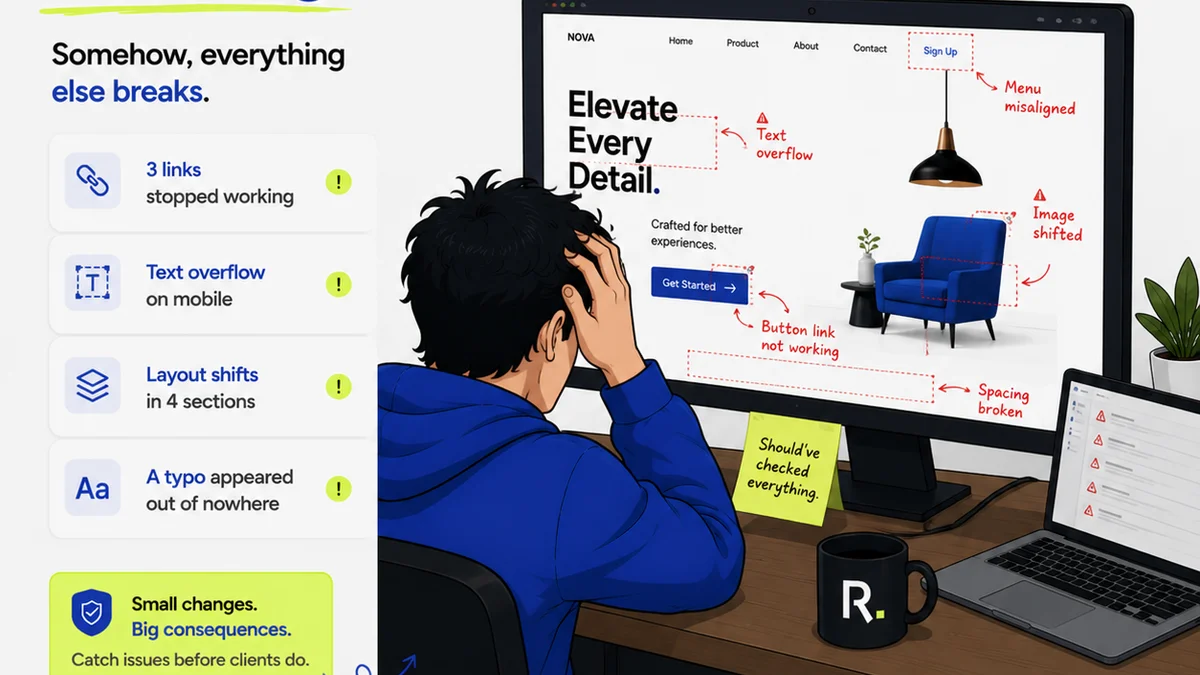
Before delivery, a final quality check is non-negotiable. This isn't just about catching typos; it's about ensuring the work meets all technical specifications and strategic objectives.
Skipping QA is a gamble you can't afford to take.
A QA Checklist Example
- Brief Alignment: Does it meet all original goals?
- Technical Specs: Correct file formats, sizes, resolutions?
- Brand Consistency: Adherence to guidelines?
- Usability/Accessibility: Is it functional and accessible? (WCAG standards are a good reference).
- Typographical Errors: Proofread all copy.
- Cross-Browser/Device Testing: If applicable.
- Link Verification: Do all links work?
A thorough QA process protects your agency's reputation and the client's investment.
Where Revue Fits In
Managing these stages manually is a drain on resources. You need a system that supports this structured approach.
Revue acts as your central hub for visual feedback and approvals. It streamlines the entire process:
- Centralized Feedback: Comments are attached directly to the visual asset, eliminating email chains and scattered notes.
- Revision Visibility: Track the history of feedback and revisions, providing clear context for every change.
- Approval Tracking: Formalize the sign-off process, ensuring clear project closure.
- Quality Check Support: Easily reference the brief and previous feedback during your QA phase.
By providing a single source of truth for all creative assets and feedback, Revue helps your team stay aligned and deliver exceptional work efficiently.
Final Thought
Is your visual feedback process a source of friction or a catalyst for better work? The difference lies not in the comments themselves, but in the systematic approach you take to manage them. Building a robust workflow checklist isn't just about efficiency; it's about elevating the quality of your creative output and strengthening client relationships.
Frequently asked questions
What is the most common mistake in visual feedback workflows?
The most common mistake is treating feedback as isolated comments rather than part of a structured system. This leads to scattered communication, missed instructions, and endless revision cycles. A clear process for who gives feedback, when, and how is crucial.
How can I ensure feedback is actionable and not just subjective opinion?
Encourage specificity and justification. Instead of 'make it better,' ask for 'what specifically needs improvement and why?' Linking feedback back to the original brief or user goals helps ground it in objective criteria.
What role does a brief play in managing feedback?
The brief is the foundation. A well-defined brief sets clear goals and expectations, acting as a benchmark against which all feedback can be evaluated. If feedback contradicts the brief, it prompts a strategic discussion rather than an immediate revision.
How does a centralized platform like Revue improve feedback management?
Centralized platforms consolidate all feedback, annotations, and approvals in one place. This eliminates confusion from scattered emails or messages, provides a clear audit trail, and ensures everyone is working from the same version of truth, leading to greater efficiency and clarity.
What are the key elements of a final approval stage?
A key element is requiring explicit confirmation from authorized stakeholders. This could be an email, a signed document, or a confirmation within a project management tool. It's crucial to define what 'approved' means (e.g., final, or ready for next phase) and to record this sign-off.