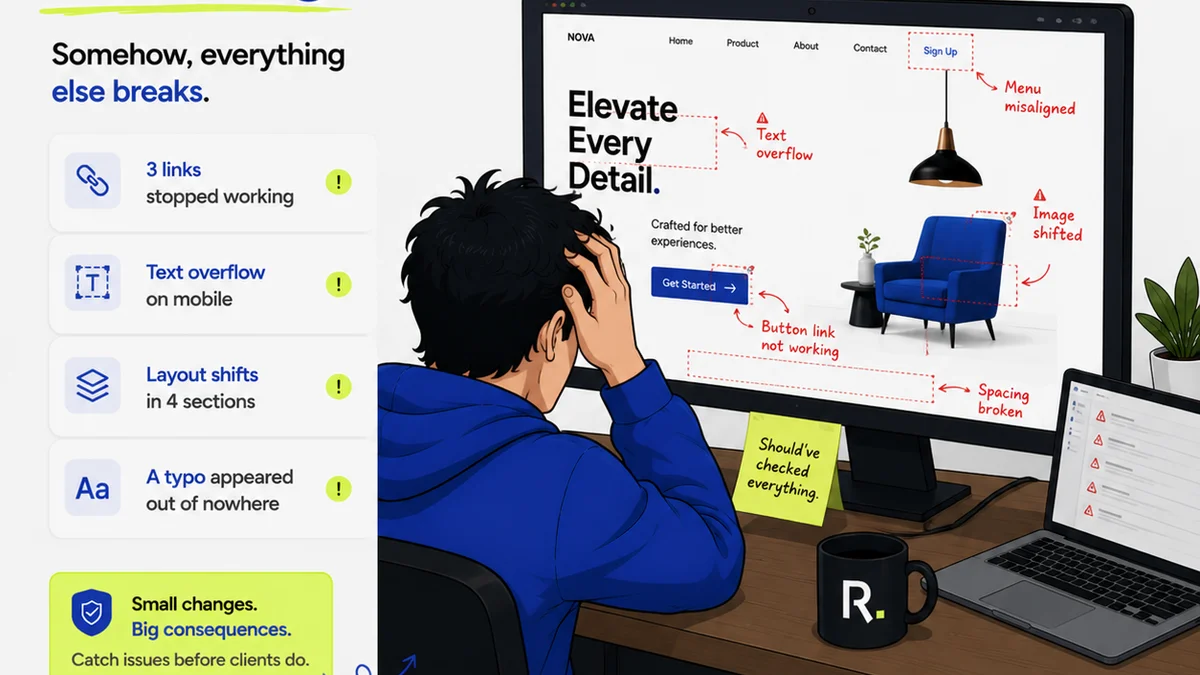
You’ve seen it. The email lands. The client is thrilled with the campaign creative. Then, their reply: “Love it! Just one small thing… there’s a typo in the headline.” Cue the collective groan. How does this happen? Are creatives suddenly allergic to proofreading? Not exactly. The real issue is a broken workflow. It’s not about laziness; it’s about a system that allows errors to slip through the cracks. We’re going to dive into why this happens and, more importantly, how to build a process that makes these embarrassing mistakes a thing of the past. Catching those typos before the client does is crucial for maintaining your agency’s reputation. It’s about professional pride and ensuring every piece of work you deliver is polished and perfect. The good news? It’s solvable with the right approach to creative review.
The Real Reason Typos Make It to the Client
It’s easy to blame the individual. “Someone wasn’t paying attention.” But that’s a cop-out. The truth is far more complex and lies in the chaotic reality of agency life. Deadlines loom, clients change their minds mid-revision, and communication gets garbled. In this environment, a final, meticulous proofread can easily become the lowest priority task, or worse, get completely forgotten.
Think about it. A designer finishes a social media graphic. They send it to the copywriter for a final check. The copywriter is buried in a proposal. They skim it, say it looks okay, and hit send. Then the account manager, juggling three other projects, forwards it to the client without a second look. The client, who is paying for perfection, is the first one to spot the glaring error.
This isn't a failure of talent; it’s a failure of process. We’re relying on individuals to be perfect in an imperfect system. The system needs to catch the errors, not the people.
Why Your Current Feedback Loop is Probably Failing
Most agencies operate on a chain of communication that’s more like a game of telephone than a structured workflow. Feedback is passed along, often verbally or through scattered email threads. Each handoff introduces risk. Someone misses a comment. Someone misinterprets feedback. Someone assumes another person already checked something. This is where the typos hide.
Consider the typical revision cycle:
- Creative Draft 1: Designer creates assets, copywriter writes text.
- Internal Review 1: Creative Director gives high-level feedback.
- Revision 1: Designer and copywriter implement feedback.
- Internal Review 2: Account Manager checks for client-readiness (maybe).
- Client Review: Client spots a typo.
At each step, the focus shifts. The initial creative concept, the client’s strategic goals, the technical specs – these all take precedence. The final polish, the tiny details like spelling and grammar, often get sacrificed in the rush to meet a deadline or appease a demanding client. We’re so focused on getting the big picture right that we forget the details that make the whole thing look professional.
The problem is amplified by:
- Version Control Chaos: "Final_V3_ClientApproved_USE_THIS_ONE.ai" – anyone who’s worked in an agency recognizes this nightmare. Different versions floating around mean the wrong file can easily be sent.
- Remote Work Challenges: With teams spread out, quick desk-side check-ins are impossible. Relying on Slack or email for critical feedback means things get lost in the noise.
- Client-Side Edits: Sometimes, clients make minor tweaks themselves, introducing errors that weren’t there before, and the agency never even sees the revised version.
This fragmented approach not only leads to typos but also breeds inefficiency, frustration, and ultimately, a lower quality of work delivered. It’s a recipe for disaster, and the client’s inbox is the final destination.
1. The Myth of the “Quick Glance” Proofread
The most common way typos survive is through the “quick glance.” Someone, usually an account manager or project manager, is tasked with a final check before sending to the client. They’re busy. They have a hundred other things on their plate. They open the file, scan it for maybe 30 seconds, and think, “Looks good enough.”
This isn’t a proofread; it’s a cursory glance. A true proofread requires focus, a fresh pair of eyes, and a systematic approach. It involves reading every single word, checking for consistency in tone and style, and verifying all the small details. Expecting someone to do this effectively while simultaneously managing client expectations and project timelines is unrealistic. They’re not proofreaders; they’re jugglers.
The pressure to deliver quickly often means cutting corners. And the corner most frequently cut is the thorough quality check. It’s seen as a “nice-to-have” rather than a “must-have” step, especially when budgets are tight or timelines are aggressive. This is a critical mistake that undermines the professionalism of the entire agency.
Why a “Quick Glance” Fails
- Cognitive Load: The person checking is likely multitasking or stressed, reducing their ability to focus on detail.
- Familiarity Breeds Blindness: The person reviewing has likely seen the work multiple times during development. They’re too familiar with it to spot errors they’ve “read” past before.
- Lack of Specific Criteria: Without a checklist or specific instructions, the reviewer doesn’t know *what* to look for beyond the obvious.
- Assumed Responsibility: Everyone assumes someone else has already checked it, leading to a gap where no one actually does a thorough job.
This is where a dedicated quality control step, separate from the project management and creative execution, becomes essential. It’s not about adding more work; it’s about structuring the work more intelligently.
2. The Information Silo Problem
Feedback lives in emails, Slack messages, meeting notes, and maybe even scribbled on sticky notes. This fragmentation is a breeding ground for errors. A crucial piece of feedback about a specific wording might be buried in a long email chain, and by the time revisions happen, it’s lost. Or, a client approves a specific layout, but the copywriter wasn’t part of that conversation and makes a change that conflicts with the approved visual.
When information isn’t centralized, assumptions are made. “I assumed the client was okay with that headline change because they approved the overall design.” This assumption is dangerous. Without a single source of truth for all feedback, revisions, and approvals, you’re essentially flying blind. Different team members are working with different information, leading to inconsistencies and, yes, typos.
This silo effect is particularly harmful for the final output. Imagine the designer has the final approved visual, but the copywriter is working off an older version of the brief or a misunderstood email. The copy they add might be grammatically perfect but completely wrong in context, or worse, contain a typo that no one caught because the copywriter wasn’t in the loop on the final visual approval.
Consequences of Information Silos:
- Inconsistent Messaging: Copy doesn’t align with the visual or the overall campaign strategy.
- Redundant Revisions: Work needs to be redone because feedback was missed or misinterpreted.
- Missed Details: Small but critical errors, like typos or incorrect product names, slip through because no one had the complete picture.
- Team Frustration: Team members feel like they’re constantly chasing information or fixing mistakes that weren’t theirs.
The solution isn't more meetings or more emails; it's a unified platform where all project communication and assets reside. This ensures everyone is on the same page, working from the most current information.
3. The “Good Enough” Mentality Driven by Urgency
Let’s be honest, agencies are often in a constant state of emergency. The client needs it yesterday. The scope creep is real. In this high-pressure environment, “good enough” starts to feel like a win. Getting the core message across, meeting the deadline – these become the primary objectives. The final polish, the meticulous check for typos, feels like a luxury we can’t afford.
This “good enough” mentality is insidious. It starts with small compromises, like letting a minor typo slide, and gradually erodes the agency’s commitment to excellence. Clients hire agencies not just for ideas, but for execution. Flawless execution builds trust and leads to repeat business. Mediocre execution, even with brilliant ideas, damages reputation.
When the focus is solely on speed and volume, quality inevitably suffers. We become order-takers rather than strategic partners. The client sees the typo and thinks, “If they can’t get this right, what else are they missing?” It’s a valid concern. A single typo can cast doubt on the agency’s attention to detail across the board.
The Cost of “Good Enough”:
- Damaged Client Trust: Clients lose faith in the agency’s ability to deliver polished work.
- Reputational Harm: Word gets around. Agencies known for sloppy work struggle to attract high-quality clients.
- Increased Revision Cycles: What seemed “good enough” often needs fixing later, costing more time and money.
- Lowered Team Morale: Creatives and account managers feel demoralized when their best efforts are undermined by avoidable errors.
Breaking free from the “good enough” trap requires a conscious effort to prioritize quality, even when time is tight. This means building in time for proper checks and balances, and empowering the team to push back when quality is being compromised for speed.
Where Revue Fits In
This is precisely why tools like Revue were built. They address the systemic failures that lead to work leaving the agency with errors. Revue centralizes the entire creative process, from initial brief to final approval, creating a single source of truth and a structured workflow.
Streamlined Feedback and Revisions
Instead of scattered emails and Slack messages, all feedback is captured directly on the asset within Revue. Team members and clients can leave contextual comments, ensuring no feedback gets lost. This clarity eliminates ambiguity and reduces the chance of misinterpretation during revisions.
Centralized Approvals
Revue provides a clear, auditable trail of approvals. When a client or stakeholder gives the green light, it’s recorded. This eliminates the “did they approve that?” confusion and ensures everyone is working with the final, agreed-upon version. No more hunting through email chains to confirm sign-off.
Built-in Quality Control
Revue facilitates a dedicated quality control (QC) stage. Before work is sent to the client, it can go through a mandatory QC review within the platform. This ensures a fresh set of eyes, following a defined checklist, can catch those pesky typos and other errors that might have been missed during the creative and revision phases. This step is crucial for ensuring professionalism and preventing embarrassing mistakes.
Version Control Made Easy
Forget the confusing file names. Revue manages versions automatically. Each revision is tracked, and you can easily compare versions side-by-side. This eliminates the risk of sending out an outdated or incorrect file, a common culprit for errors slipping through.
By implementing a platform like Revue, agencies can move away from a reactive, error-prone process to a proactive, quality-driven workflow. It’s about building a system that supports excellence, rather than one that accidentally allows mediocrity to creep in.
4. Establishing a Dedicated Proofreading Protocol
Simply telling your team to “proofread better” isn’t a strategy. You need a concrete protocol. This involves defining who is responsible for the final proofread, what criteria they should use, and when this step occurs in the workflow. It should be a distinct, non-negotiable phase.
Consider implementing a multi-stage proofreading process:
- Internal Creative Proofread: The copywriter and designer do a thorough self-check *after* all creative revisions are done, but *before* it goes to account management or the client.
- Account/Project Management Review: This isn’t just a glance. The PM checks for brand consistency, adherence to brief, and basic accuracy. They should have a checklist.
- Dedicated QC/Proofreading Step: This is the final gate. Ideally, this is done by someone *not* directly involved in the day-to-day creation of the piece, or by a dedicated proofreader if your agency has one. They should be looking *only* for errors – typos, grammatical mistakes, factual inaccuracies, formatting issues.
This structured approach ensures that multiple sets of eyes are looking at the work with the specific intent of finding errors, not just checking if the overall concept is there. It treats proofreading as a critical deliverable, not an afterthought.
Key Elements of a Proofreading Protocol:
- Defined Roles: Clearly state who is responsible for each proofreading stage.
- Checklists: Provide specific checklists for each reviewer, covering grammar, spelling, punctuation, brand voice, factual accuracy, legal disclaimers, and formatting.
- Time Allocation: Build adequate time into project schedules for these checks. Don’t let deadlines squeeze them out.
- Fresh Eyes: Encourage reviewers to take a break before proofreading or to read the material aloud to catch errors.
- Tools: Leverage grammar and spell-checking software, but don’t rely on them solely. Human review is essential.
This systematic approach elevates the perceived quality of your agency’s output and builds client confidence. It shows you care about every detail.
5. Leveraging Technology for Error Detection
While human review is indispensable, technology can be a powerful ally in the fight against typos. Spell checkers and grammar tools are basic, but advanced platforms offer more. Automated grammar checkers can catch more complex errors, suggest stylistic improvements, and ensure consistency.
Beyond basic word processing tools, consider platforms that integrate with your workflow. For example, some content management systems have built-in checks, and project management tools can flag inconsistencies. The key is to use technology not as a replacement for human judgment, but as a first line of defense.
Think about specialized tools:
- Grammar & Style Checkers: Tools like Grammarly or ProWritingAid go beyond basic spell check, analyzing sentence structure, tone, and clarity.
- Read-Aloud Features: Many applications have text-to-speech functions that can help you hear awkward phrasing or missed words.
- Consistency Checkers: For longer documents or campaigns, tools that check for consistent terminology, capitalization, and formatting can be invaluable.
- Plagiarism Checkers: While not directly for typos, they ensure originality and can sometimes flag formatting errors introduced by copy-paste.
Integrating these tools into your review process, especially within a centralized platform like Revue, can significantly reduce the number of errors that reach the final stage. It automates the detection of common mistakes, freeing up human reviewers to focus on more nuanced errors and the overall quality of the communication.
Final Thought
Typos aren’t just embarrassing; they’re a symptom of a larger problem in how agencies manage creative feedback, revisions, and approvals. Relying on individuals to catch every mistake in a chaotic system is a losing battle. The solution lies in building robust, structured workflows supported by the right technology. By centralizing communication, implementing clear review protocols, and leveraging tools designed for quality control, agencies can significantly reduce errors, build client trust, and deliver consistently polished work. It’s time to stop hoping for perfection and start building a process that guarantees it.
Frequently asked questions
Why do typos still appear in work sent to clients?
Typos often appear due to a broken workflow where final proofreading is deprioritized, communication is fragmented across emails and messages, and there's a reliance on 'quick glances' rather than thorough checks, especially under tight deadlines.
How can agencies prevent typos from reaching clients?
Agencies can prevent typos by establishing a dedicated proofreading protocol with clear roles and checklists, centralizing all feedback and approvals in one platform, leveraging technology for error detection, and building sufficient time into schedules for thorough quality control.
What is the role of technology in catching creative errors?
Technology, such as advanced grammar checkers, consistency tools, and centralized platforms like Revue, acts as a crucial first line of defense by automating the detection of common errors, freeing up human reviewers to focus on more nuanced quality issues.
How does a centralized platform like Revue help with quality control?
Revue centralizes all creative assets, feedback, revisions, and approvals in one place. This eliminates information silos, provides clear version control, and enables a dedicated quality control stage before client delivery, ensuring that errors like typos are caught systematically.