You probably think agency management is about keeping clients happy, hitting deadlines, and maybe squeezing a profit out of every project. That’s not wrong. But it’s incomplete.
The deeper truth is that the most damaging mistakes in agency management aren't about creative output or client relationships. They’re buried in your operational DNA. They’re the silent killers of profitability and peace of mind.
These aren't about a bad brief or a missed revision. They're about fundamental flaws in how you organize, communicate, and track work. They’re the hidden costs that eat your margins and the friction points that drain your team’s energy.
1. The Myth of the "Flexible" Workflow
Agencies pride themselves on agility. We’re supposed to pivot, adapt, and roll with the punches. This often translates into a workflow that’s anything but structured.
We assume flexibility means chaos is okay. That because we’re creative, we don’t need rigid processes. That every project is a unique snowflake that defies standardization.
The hard truth? Unmanaged flexibility breeds inefficiency. It creates confusion about who’s doing what, when, and why. It makes tracking progress a nightmare and quality control an afterthought.
Think about the common symptoms:
- Endless, undocumented email chains for feedback.
- Last-minute scrambles because a crucial piece of information was missed.
- Team members constantly asking for clarification on tasks or priorities.
- Difficulty in onboarding new hires because there’s no clear process to follow.
- Scope creep that’s impossible to quantify because the baseline is so fuzzy.
This isn't about stifling creativity. It's about creating guardrails so creativity can thrive without breaking the bank.
The Fix: Standardize What You Can, Document Everything
You don't need a 200-page SOP for every minor task. But you do need clear, repeatable processes for key stages of your work.
This means defining:
- Intake and onboarding for new clients and projects.
- The steps for briefing, concepting, and design.
- How feedback is collected, consolidated, and communicated.
- The revision and approval process, including number of rounds and sign-off points.
- Quality assurance checks before delivery.
- Project closure and archiving.
Every step should have a defined owner and a clear outcome. This isn’t bureaucracy; it’s clarity.
2. Treating Feedback as an Event, Not a Process
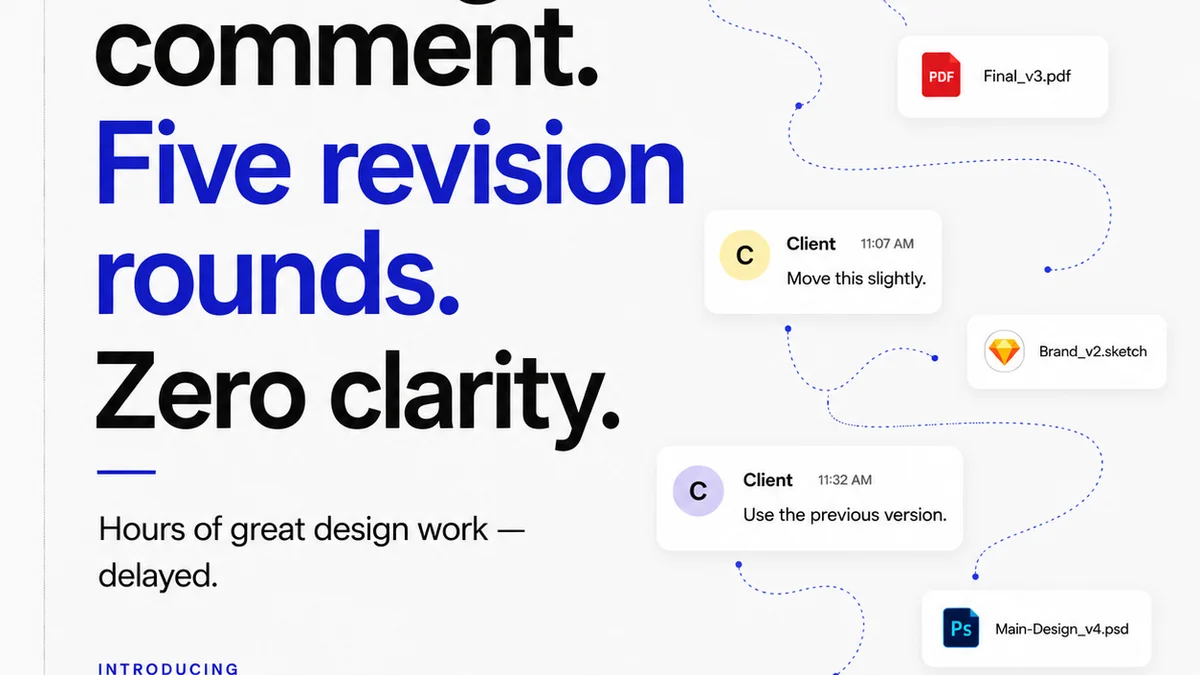
Most agencies collect feedback like a scavenger hunt. Emails fly, Slack messages ping, and comments are scribbled on PDFs. The assumption is that as long as we *get* the feedback, we’ve done our job.
This fragmented approach is a productivity killer.
The hard truth is that feedback is rarely a single, clear directive. It’s often a messy, iterative conversation. And managing it poorly means wasted time, misinterpretations, and endless revisions.
The cost of this chaos:
- Hours spent deciphering conflicting comments from different stakeholders.
- Revisions based on feedback that was misunderstood or incomplete.
- Frustration from designers who feel they’re constantly moving the goalposts without a clear target.
- Client dissatisfaction because they feel their input isn’t being heard or acted upon effectively.
- Projects that drag on, burning billable hours without clear progress.
You’re not just collecting notes; you’re managing a critical dialogue that determines the success of the project.
The Fix: Centralize and Contextualize Feedback
Feedback needs a home. A single source of truth where all comments, discussions, and decisions live.
This means moving away from scattered documents and inboxes.
Implement a system where:
- Stakeholders can leave feedback directly on the creative asset.
- All comments are time-stamped and attributed.
- Discussions can happen within the context of a specific comment.
- Clear approval and rejection statuses can be assigned.
- A consolidated version of feedback can be easily reviewed by the project team.
When feedback is centralized, it’s actionable. It reduces ambiguity and speeds up the revision cycle dramatically.
3. The Illusion of Time Tracking
Many agencies track time. They use timesheets, project management software, or even just educated guesses. The assumption is that if we track time, we understand our profitability.
This is where most agencies get it spectacularly wrong.
The hard truth is that simply *tracking* time is useless if you’re not *managing* based on that data. Most agencies track time reactively, not proactively. They use it to bill clients, not to optimize internal processes.
This leads to:
- Under-billing because hours are lost or not captured accurately.
- Over-servicing clients without realizing the true cost.
- Inability to accurately quote future projects because historical data is unreliable.
- Team members feeling micromanaged or that tracking is a chore, leading to inaccurate entries.
- A lack of insight into which projects or clients are actually the most profitable.
Your time tracking is only as good as your analysis and action plan.
The Fix: Analyze and Act on Time Data
Time tracking is a diagnostic tool. You need to use it to understand where your time and money are actually going.
Regularly review your time data to identify:
- Projects that consistently run over budget.
- Clients who require excessive revisions or communication.
- Tasks that take significantly longer than estimated.
- Team members who might be overloaded or struggling with specific tasks.
- Areas where your processes are inefficient and costing you time.
Use this data to:
- Improve quoting for future projects.
- Have data-backed conversations with clients about scope and budget.
- Identify training needs for your team.
- Streamline inefficient workflows.
- Make informed decisions about which clients or project types to pursue.
Time tracking without analysis is just data entry. Time tracking with analysis is strategic intelligence.
4. Neglecting the Approval Bottleneck
Approvals are the gatekeepers of project completion. Yet, agencies often treat them as a passive step. We send something off and wait. The assumption is that once it’s with the client, it’s out of our hands.
This passive approach is a major cause of project delays and revenue stagnation.
The hard truth is that the approval process is an active management challenge. It requires clear communication, defined expectations, and diligent follow-up.
When approvals languish, so does your cash flow:
- Projects get stuck in limbo for weeks, sometimes months.
- Your team is idle, waiting for the green light, unable to move forward.
- Invoices are delayed, impacting your agency’s cash flow.
- Client relationships can be strained by the perceived lack of progress.
- Opportunities for new work are missed because resources are tied up.
The bottleneck isn't just a delay; it’s a direct hit to your agency’s financial health.
The Fix: Proactive Approval Management
Treat approvals as a critical project milestone that requires active management.
This involves:
- Clearly defining the approval process and stakeholders upfront with the client.
- Setting realistic but firm timelines for feedback and final sign-off.
- Automating reminders for pending approvals.
- Having a designated point person on your team to chase approvals.
- Establishing clear consequences for delayed approvals (e.g., project pause, additional fees).
- Using a system that makes it easy for clients to review and approve work, reducing their friction.
Make it impossible for approvals to fall through the cracks. Your revenue depends on it.
Where Revue Fits In
Managing these operational pitfalls requires systems that bring order to creative chaos. That's where Revue comes in.
Revue is built to tackle these exact challenges head-on.
Instead of wrestling with scattered feedback across emails and chat, Revue provides a centralized platform. All comments, discussions, and decisions live in one place, directly on the creative asset. This eliminates ambiguity and ensures everyone is working from the same, up-to-date information.
Our revision and approval tools bring structure to the bottleneck. You can clearly track the status of feedback, manage multiple rounds of revisions, and get definitive sign-offs. This streamlines the approval process, reducing delays and getting your projects moving forward faster.
Furthermore, Revue helps maintain quality through clear revision history and feedback trails. You can see exactly how a piece evolved and why. This visibility is crucial for internal quality checks and for demonstrating value to clients.
By centralizing feedback and streamlining approvals, Revue helps you reduce wasted time, improve team collaboration, and ultimately, protect your project margins.
Final Thought
Are you managing your agency, or is your agency managing you? The difference lies in confronting the operational truths that most creative leaders prefer to ignore. It's time to build systems that support your creative ambitions, not hinder them.
Frequently asked questions
What is the biggest operational mistake agencies make?
The biggest mistake is assuming that flexibility means chaos is acceptable. Agencies often lack standardized processes for critical tasks like feedback collection, revisions, and approvals, leading to inefficiency, miscommunication, and lost revenue.
How can agencies improve their feedback process?
Agencies should move away from scattered feedback methods (email, chat) and adopt a centralized platform. This ensures all comments are contextual, attributed, and easily accessible, reducing misinterpretations and speeding up revisions.
Why is time tracking often ineffective for agencies?
Simply tracking time isn't enough. Agencies often fail to analyze this data to understand profitability, identify inefficiencies, or improve future quoting. Time tracking must be used as a strategic tool, not just for billing.
How can agencies speed up client approvals?
Proactive management is key. Clearly define approval processes and timelines with clients upfront, automate reminders, assign an internal point person to chase approvals, and use systems that make client review and sign-off easy.