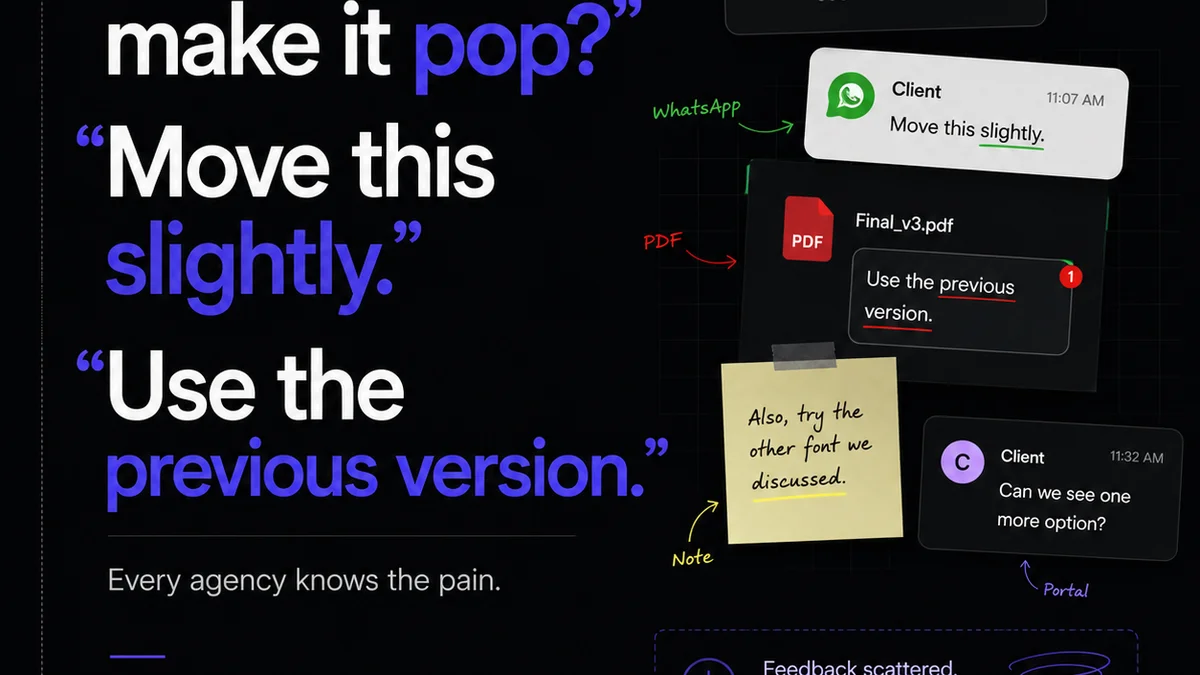
You're told agency owners need robust software. That it needs project management, time tracking, billing, client portals, and maybe even some CRM sprinkled in. None of that is wrong. But it’s incomplete.
The hard truth? Most agency software is a feature dump. It promises to solve problems by adding more complexity. The real need isn't more features; it's operational clarity. It's about seeing the whole picture, not just another dashboard.
1. The Illusion of Integration
Agencies often buy software because it *claims* integration. But what does that even mean? Usually, it means a few APIs talking to each other, often with friction.
Think about it. You have your design tools, your communication tools, your finance tools, your project management tools. Each with its own interface, its own learning curve, its own data silos.
The promise is seamless workflow. The reality is often a patchwork quilt of logins and data transfers. You spend more time managing the software than doing the work.
The Real Goal: Flow, Not Just Features
Integration isn't about connecting disparate systems. It's about creating a unified flow of information and approvals.
When feedback moves instantly from client to designer, from revision to approval, that's flow. When project status is visible to everyone without a status meeting, that's flow. When you can see the profitability of a project at a glance, that's flow.
- Does the software streamline communication?
- Does it eliminate redundant data entry?
- Does it provide a single source of truth for project status?
- Does it reduce the cognitive load on your team?
If the answer is no, you're just buying more complexity.
2. The Cost of Context Switching
Every time a team member switches between tools, there's a cost. It’s not just the time spent logging in or finding the right screen. It’s the mental overhead of re-orienting yourself.
This context switching kills productivity. It breeds errors. It frustrates good people.
Consider the designer waiting for client feedback. They're in their design tool. Then they get an email. They switch contexts. They read the email. Is it clear? Probably not. They switch back. Later, a Slack message. Another switch. They're trying to pull disparate pieces of information together.
Look for Unified Workspaces
The best agency software doesn’t just list features; it provides a unified workspace where key activities converge.
This means client feedback lives *with* the creative asset. Revisions are tracked directly against the original. Approvals are clear and documented.
This isn't about having one giant, monolithic piece of software. It's about having a central hub that intelligently connects the critical parts of your agency's workflow.
- Can clients provide feedback directly on the asset?
- Are revision histories automatically logged?
- Is the approval status always visible and up-to-date?
- Does the system prevent miscommunication about what’s been approved?
This is where operational clarity begins.
3. Approval Bottlenecks Are Revenue Blockers
Many agencies suffer from slow client approvals. This isn't usually a client problem; it's a process problem.
If feedback is scattered across emails, Slack messages, and random phone calls, how can anyone be sure what’s been approved? How can the client be sure they’ve seen everything? It’s a recipe for scope creep and missed deadlines.
Your software should actively *prevent* these bottlenecks. It needs to make the approval process transparent and efficient.
Visibility is Key
Tools that offer clear version control and explicit approval tracking are essential. This means:
- A clear trail of every piece of feedback.
- A definitive record of each approval, with timestamps and user attribution.
- The ability to compare versions side-by-side.
- Automated notifications for pending approvals.
When approvals are frictionless, projects move faster. Your team stays billable. Your clients stay happy.
4. The Hidden Cost of Bad Data
Bad data kills profitability. If your time tracking is inaccurate, your project estimates are useless. If your billing is based on guesswork, you leave money on the table.
Many agencies operate on a prayer and a spreadsheet for financial data. They *think* they know how profitable a project is, but they’re often wrong.
This isn't a fault of the finance team; it’s a fault of the tools.
Connect the Dots from Brief to Invoice
Agency software should connect the dots across the entire project lifecycle. This means:
- Accurate time tracking linked directly to projects and tasks.
- Automated invoice generation based on tracked time and project scope.
- Real-time reporting on project profitability, burn rate, and budget adherence.
- Clear visibility into which clients and project types are most profitable.
This level of data accuracy isn't a luxury; it's a necessity for sustainable growth.
Where Revue Fits In
Revue isn't just another project management tool. It's designed from the ground up to address the core operational challenges agencies face, particularly around client feedback and approvals.
We know that scattered feedback kills creativity and slows down delivery. You need a centralized system where feedback is contextual, actionable, and directly tied to the creative asset.
Revue provides a clear, visual workflow for client feedback and revisions. Clients can comment directly on designs, videos, and documents. Your team sees all feedback in one place, alongside the asset itself. Revision history is automatically managed, and approvals are explicit and documented.
This eliminates the guesswork and the endless email chains. It ensures everyone is on the same page, reducing errors and speeding up the approval process. By centralizing this critical part of the workflow, Revue helps agencies maintain project momentum, improve team collaboration, and ensure the final output meets client expectations with confidence.
5. Scalability Means Simplicity, Not More Options
The common wisdom is that as an agency grows, it needs more complex software. More features, more integrations, more customization.
That’s backward.
True scalability comes from simplicity. It comes from a system that is so intuitive and efficient that it handles growth without adding friction.
If your software requires extensive training for every new hire, it’s not scalable. If it creates more work for your operations team than it saves, it’s not scalable.
Focus on User Experience
The best agency software has a clean, intuitive user interface. It prioritizes ease of use for everyone—from junior designers to senior account managers to clients.
This means:
- Minimal training required.
- Easy navigation and clear task flows.
- A consistent experience across all modules.
- Reliable performance, day in and day out.
When the tool is easy to use, people actually use it. And when they use it correctly, you get the operational clarity you need to scale.
Final Thought
Stop looking for software that does *more*. Start looking for software that helps you do *better*. It’s not about a bigger feature list; it’s about a clearer workflow, more accurate data, and less friction for your team and your clients. Does your current toolset achieve that, or does it just add to the noise?
Frequently asked questions
What's the biggest mistake agencies make when choosing software?
Focusing solely on the number of features offered rather than how well the software integrates into and streamlines existing workflows. Many tools promise more features but deliver more complexity and context switching.
How can agency software improve client approvals?
By providing a centralized platform for feedback, clear version control, and explicit approval tracking. This eliminates scattered communication across emails and messages, making the process transparent and efficient.
What does 'operational clarity' mean in the context of agency software?
Operational clarity means having a clear, unified view of project status, client feedback, revision history, and financial data. It's about reducing ambiguity and cognitive load for your team, allowing them to focus on creative work and client delivery.
Is it better to have one all-in-one agency software or multiple specialized tools?
Neither is inherently better. The ideal is a central hub that intelligently connects critical functions, creating a unified flow of information and approvals, rather than just integrating disparate systems with friction.