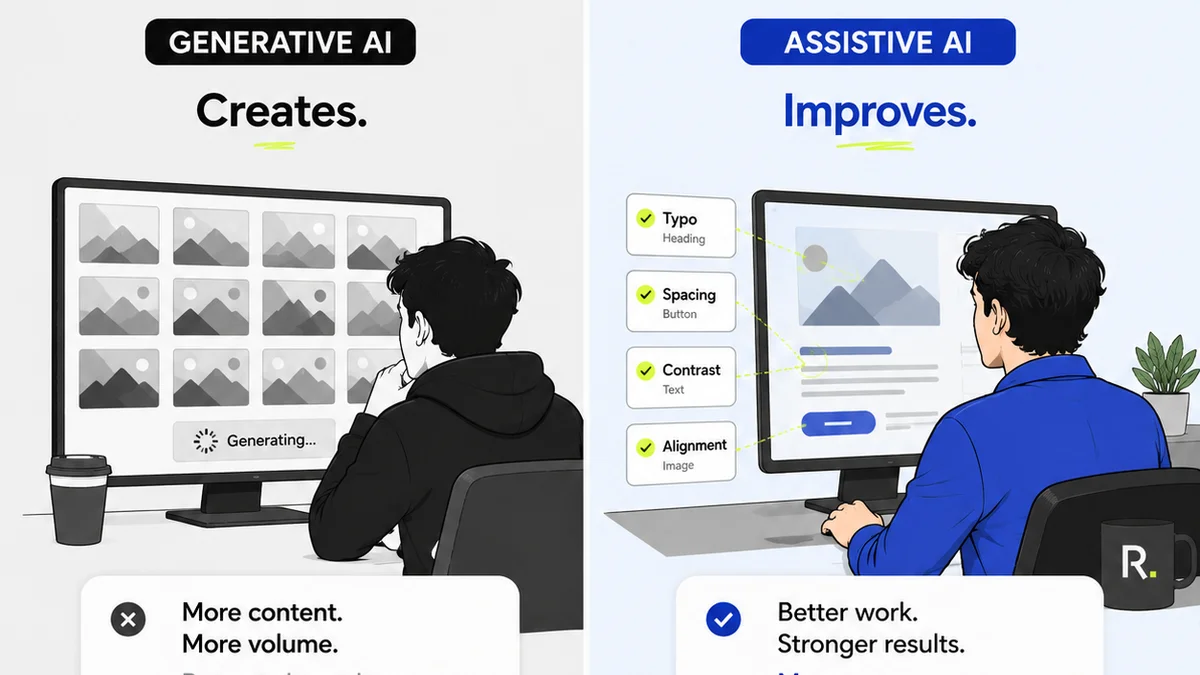
Everyone's talking about AI. Chatbots writing copy, image generators churning out visuals. It sounds like magic, or maybe just a fancy new toy for the marketing department. And sure, some of that is happening.
But the real story of AI in agencies isn't about the shiny new tools. It's about the deep, operational shifts that are already underway.
The assumption is that AI is here to automate repetitive tasks. That's only half the picture. The harder truth is that AI is forcing a fundamental rethink of agency management itself. It’s moving beyond task automation to strategic advantage.
1. The Myth of Full Automation: AI as Augmentation, Not Replacement
The fear is that AI will replace creatives and account managers. It's a valid concern, but it misses the point of how AI is actually being adopted in high-performing agencies.
AI is, and will continue to be, a powerful augmentative tool. It's not replacing strategic thinking or client relationships. Instead, it's freeing up human talent from the drudgery.
AI for Ideation and Research
Think about the hours spent on initial research, competitive analysis, or brainstorming variations of a campaign concept. AI can crunch data, identify trends, and generate initial concepts at speeds no human team can match. This isn't about AI *doing* the creative work; it's about AI *accelerating* the human creative process.
AI for Content Generation Support
Drafting initial copy, generating social media variants, or creating placeholder visuals can be time-consuming. AI tools can produce a solid first draft, allowing your writers and designers to focus on refinement, strategic messaging, and ensuring brand voice consistency. It’s about getting to the *good* work faster.
AI for Workflow Optimization
Beyond creative output, AI is streamlining internal processes. Project management tools are starting to predict bottlenecks, optimize resource allocation, and even flag potential scope creep before it becomes a major issue. This operational efficiency is where the real managerial impact lies.
2. The Data Deluge: From Gut Feel to Predictive Power
Agencies have always relied on experience and intuition. That's valuable, but it's also inherently limited. AI unlocks the power of data in ways previously unimaginable.
This isn't about collecting more data; it's about extracting actionable intelligence from the data you already have.
Client Performance Insights
AI can analyze campaign performance data across multiple channels, identifying what truly resonates with specific audience segments. This moves beyond simple reporting to predictive insights that inform future strategy. Which creative assets are likely to perform best? Which channels offer the highest ROI for a given client objective?
Project Profitability Forecasting
By analyzing historical project data – time spent, resources allocated, client feedback loops – AI can help predict the profitability of new projects with greater accuracy. It can flag projects that are trending towards lower margins, allowing managers to intervene proactively.
Resource Management and Forecasting
Which team members are best suited for specific tasks based on past performance and skill sets? When will key personnel be overloaded? AI can provide data-driven answers, optimizing team assignments and preventing burnout.
3. Redefining Client Communication and Collaboration
Client communication is the lifeblood of any agency. AI is poised to make this more efficient, transparent, and ultimately, more effective.
The goal isn't to replace human interaction, but to enhance it with data and speed.
Automated Reporting and Summaries
Imagine AI automatically compiling performance reports, summarizing key findings, and even drafting initial client updates. This frees up account managers to focus on strategic conversations and relationship building, rather than data compilation.
Intelligent Feedback Aggregation
AI can help sift through client feedback from various sources – emails, comments, meeting notes – identifying common themes, prioritizing actionable points, and flagging conflicting instructions. This reduces the ambiguity and time wasted trying to decipher feedback.
Personalized Client Experiences
By analyzing client communication history and preferences, AI can help tailor outreach, anticipate needs, and provide more personalized service. This can lead to stronger client relationships and increased loyalty.
4. The Evolving Role of the Agency Manager
If AI is handling more of the repetitive tasks and providing data-driven insights, what does that leave for the agency leader? It means a shift towards higher-level strategic thinking and operational oversight.
The manager becomes less of a taskmaster and more of a conductor.
Strategic Orchestration
With AI handling data analysis and initial content generation, managers can focus on setting the overarching strategy, defining client goals, and ensuring alignment across teams. They become the strategic architects, leveraging AI as their advanced toolkit.
Talent Development and AI Integration
A key role will be identifying which AI tools are most beneficial, training teams on their effective use, and fostering a culture that embraces augmentation. This requires understanding both the technology and the human element.
Ethical Oversight and Quality Assurance
As AI becomes more integrated, managers must ensure its ethical use, maintain data privacy, and uphold creative quality. The human touch remains critical for nuanced judgment, brand integrity, and client satisfaction.
5. Where Revue Fits In
The operational shifts driven by AI demand better tools for managing the creative workflow. This is where a platform like Revue becomes indispensable.
AI-generated insights and accelerated creative processes still need a central hub for management and execution.
Centralized Feedback and Revision Management
As AI helps generate more iterations or gathers feedback from more sources, a clear system is needed to consolidate it. Revue provides that single source of truth, ensuring feedback isn't lost in email chains or scattered documents, whether it's human-generated or AI-assisted.
Streamlined Approvals
The speed of AI-driven work requires equally efficient approval processes. Revue offers clear, visual tracking of revisions and approvals, allowing agencies to move projects forward without delay, even with complex AI-assisted workflows.
Ensuring Quality and Consistency
While AI can generate content, human oversight is crucial for quality and brand consistency. Revue’s structured review and approval stages ensure that every piece of work, no matter how it was initially generated, meets client standards and agency benchmarks.
Final Thought
AI isn't a distant future; it's a present reality reshaping agency operations. The agencies that thrive won't be the ones that simply adopt the latest AI tool, but the ones that fundamentally adapt their management strategies to leverage AI's power for efficiency, insight, and enhanced human creativity. The question isn't whether your agency will be impacted by AI, but how you will lead that change.
Frequently asked questions
Will AI replace creative jobs in agencies?
It's unlikely AI will replace creative jobs entirely. Instead, it's expected to augment human capabilities, automating repetitive tasks and freeing up creatives to focus on higher-level strategy, ideation, and refinement. The role may evolve, but human creativity and strategic oversight remain essential.
How can agencies leverage AI for client communication?
AI can enhance client communication through automated reporting, intelligent feedback aggregation, and personalized outreach. This allows account managers to spend less time on administrative tasks and more time on strategic client relationships and problem-solving.
What's the biggest operational shift AI is bringing to agencies?
The biggest shift is moving from intuition-based decision-making to data-driven, predictive insights. AI allows agencies to analyze performance data, forecast project profitability, and optimize resource allocation with greater accuracy than ever before.
How does a platform like Revue help agencies managing AI workflows?
Revue provides a centralized system for managing feedback, revisions, and approvals, which is crucial when AI accelerates content generation and data analysis. It ensures transparency, efficiency, and quality control across all project stages, complementing AI's capabilities.