Everyone’s talking about AI as the ultimate efficiency hack. Feed it prompts, get faster outputs. Automate the grunt work, free up creative minds. That’s not wrong.
But it’s incomplete.
The real, seismic shift AI is bringing to brand governance isn’t just about speed. It’s about redefining what consistency means and how we achieve it across an entire organization, at scale.
The hard truth is: AI is forcing us to confront the limitations of our existing brand governance models and build something far more dynamic and integrated.
1. The Myth of Static Brand Guidelines
For decades, brand governance has meant thick PDF manuals. Brand police enforcing rules. Static brand assets locked in DAMs.
This approach assumes brands are fixed entities, like sculptures carved in stone. You define them once, then you maintain them.
But brands aren't static. They evolve. They need to adapt to new platforms, new audiences, new cultural moments.
Trying to govern a dynamic brand with static rules is like trying to herd cats with a fence.
The Problem with the PDF Era
Static guidelines create bottlenecks. Every new asset, every campaign, every piece of content becomes a potential point of failure. Someone has to manually check it against the rules.
This is:
- Slow
- Expensive
- Prone to human error
- Impossible to scale globally
It’s a reactive process, trying to catch mistakes after they’ve happened.
2. AI as a Dynamic Enforcement Engine
AI changes the game by shifting governance from a static, rules-based system to a dynamic, data-driven one.
Instead of just telling people *what* the rules are, AI can help *enforce* them in real-time.
Think of it this way: traditional governance is a manual inspection at the end of the assembly line. AI-powered governance is embedded sensors and automated quality control *throughout* the line.
Real-Time Brand Audits
AI tools can analyze vast amounts of content – website copy, social posts, ad creatives, even video scripts – and flag deviations from brand voice, tone, visual style, and messaging frameworks.
This isn't about finding a misplaced logo. It's about identifying subtle shifts that erode brand equity.
Predictive Governance
AI can also analyze past performance and identify patterns that lead to brand drift. It can predict which types of content or which teams are most likely to stray, allowing for proactive intervention rather than reactive correction.
3. Redefining Brand Consistency in the Age of Generative AI
Generative AI tools (like ChatGPT, Midjourney, DALL-E) are fantastic at producing content at speed. But they are also potential brand consistency nightmares.
Without proper guardrails, AI can:
- Generate off-brand messaging
- Create inconsistent visual styles
- Invent facts or misrepresent the brand’s position
- Produce content that violates regulatory or ethical standards
This is where AI-powered governance becomes critical. It’s not about stopping AI; it’s about guiding it.
AI-Assisted Content Creation Guardrails
Imagine AI tools that don't just generate content, but ensure it aligns with your brand’s core principles, tone of voice, and factual accuracy *before* it’s even finalized.
This involves:
- Prompt Engineering with Brand Context: Training AI models with your specific brand voice, mission, and values so prompts inherently lead to on-brand outputs.
- Content Scoring: AI models that score generated content against a defined brand rubric.
- Automated Style Guides: AI that can access and apply visual style guides and messaging frameworks dynamically.
- Fact-Checking Integration: AI that cross-references generated claims with approved brand information.
This makes AI a partner in maintaining consistency, not an adversary.
4. The Human Element: From Gatekeepers to Strategists
Does AI make brand managers obsolete? Absolutely not.
It shifts their role. The tedious work of manual checks and asset hunting is reduced.
This frees up brand teams to focus on higher-level strategy:
- Defining the brand’s evolving narrative.
- Understanding audience sentiment and market shifts.
- Developing the AI prompts and parameters that guide content creation.
- Interpreting AI-driven insights to inform strategy.
- Handling the complex, nuanced situations where human judgment is paramount.
The human brand guardian becomes less of a rule-enforcer and more of a strategic conductor, orchestrating the brand’s presence across an increasingly complex digital ecosystem, now augmented by AI.
5. Where Revue Fits In
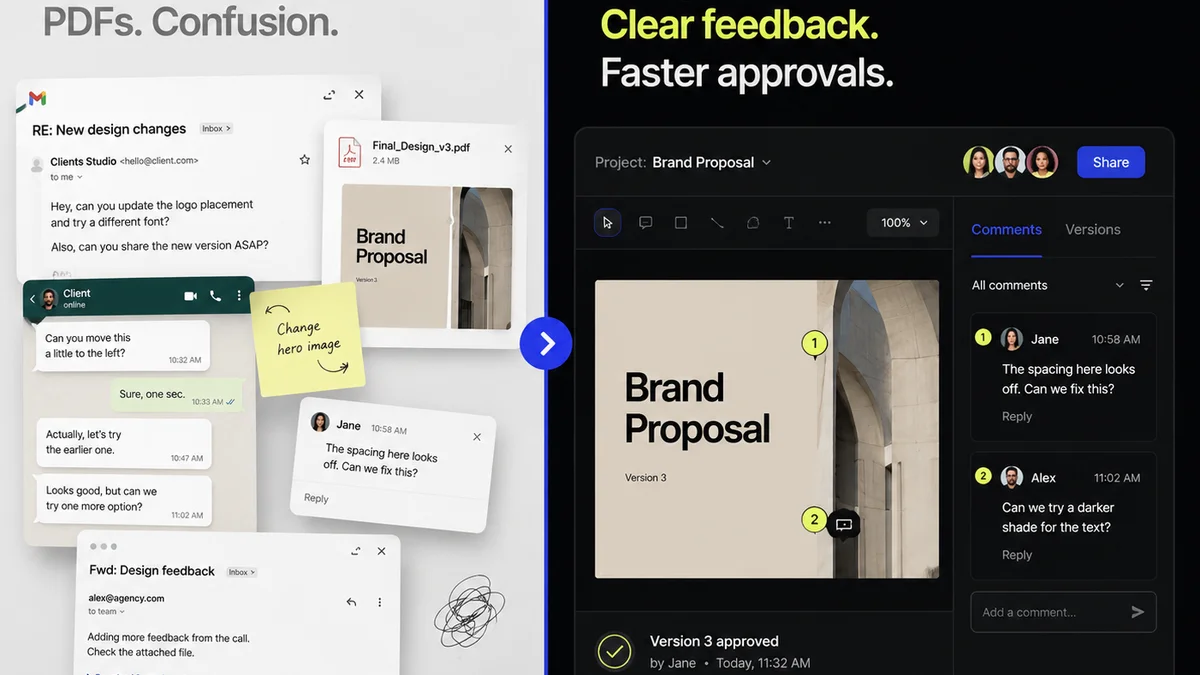
While AI can automate much of the *detection* and *guidance* of brand consistency, the practicalities of managing feedback, revisions, and approvals still require a robust system.
This is where tools like Revue become essential. Even with AI assisting content creation, the human review and approval loop remains critical for strategic sign-off, nuanced feedback, and ensuring final quality.
Revue centralizes client and stakeholder feedback, making it easy to track revisions and ensure that all creative output, whether AI-assisted or human-generated, meets the final approved standard.
It provides the visibility needed to manage the workflow, ensuring that the dynamic, AI-governed brand strategy translates into consistently executed creative work.
Revue helps bridge the gap between AI-driven governance and real-world creative production.
6. The Future: Adaptive Brand Ecosystems
The future of brand governance isn't about more rules; it's about smarter, more adaptive systems.
AI is the engine that can power these adaptive ecosystems. It allows brands to:
- Monitor their own health in real-time.
- Learn and adapt to changing environments.
- Scale consistency effortlessly across countless touchpoints.
- Empower creative teams with intelligent tools rather than restrictive policies.
This transition requires a fundamental rethink of how we approach brand management. It’s moving from a static, control-oriented mindset to a dynamic, intelligence-driven one.
Final Thought
Are you prepared to evolve your brand governance from a static rulebook to a dynamic, AI-powered ecosystem? The brands that embrace this shift will not only maintain consistency but will thrive with agility and relevance in the years to come.
Frequently asked questions
How does AI help maintain brand consistency?
AI can analyze content in real-time to flag deviations from brand voice, tone, and visual style. It can also be used to build guardrails around generative AI tools, ensuring their outputs align with brand guidelines.
Will AI replace brand managers?
No, AI is more likely to shift the role of brand managers. It automates tedious tasks like manual checks, allowing brand managers to focus on higher-level strategy, interpretation of insights, and nuanced decision-making.
What are the risks of using generative AI for brand content?
Generative AI can produce off-brand messaging, inconsistent visuals, factual inaccuracies, and content that violates ethical standards if not properly managed and guided.
How does a tool like Revue integrate with AI-powered brand governance?
Revue centralizes feedback and manages revisions, ensuring that creative output, whether AI-assisted or human-generated, meets final approved standards. It provides the necessary workflow visibility for executing an AI-governed brand strategy.