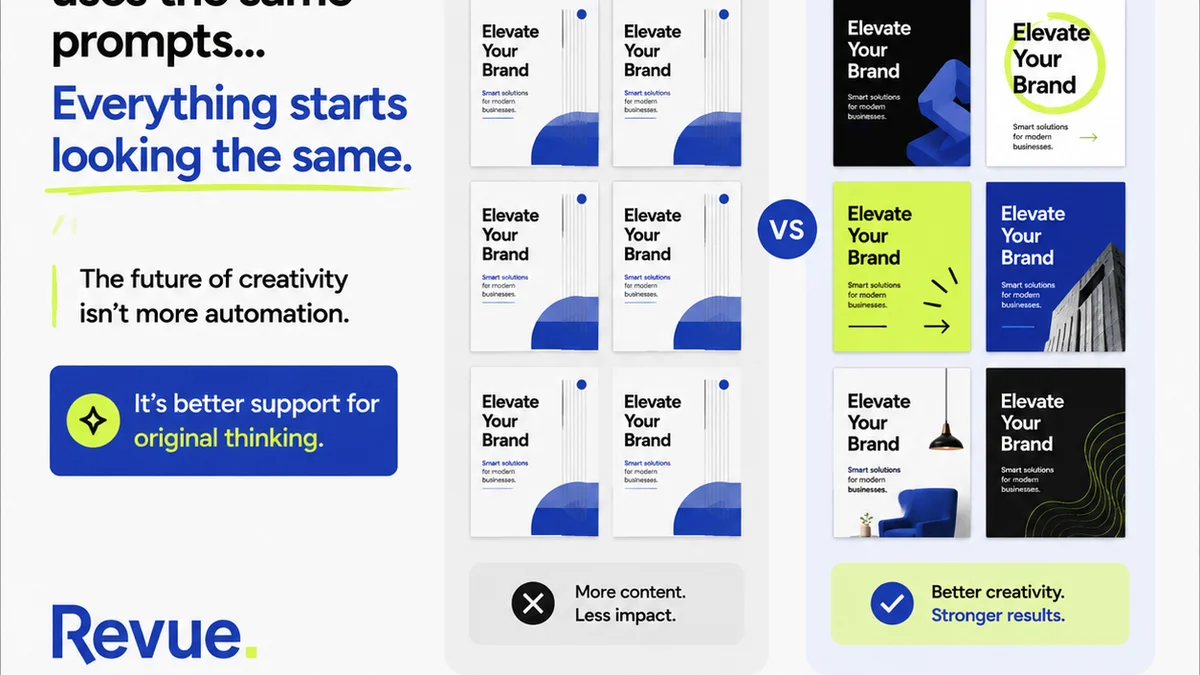
Everyone’s talking about AI in design. The latest image generators, the AI-powered assistants that can write copy or suggest layouts. It’s easy to get swept up in the hype, thinking the future is just about faster outputs and cooler visuals. None of that is wrong. But it’s incomplete.
The real seismic shift AI is bringing to design isn't just about the tools. It's about the fundamental operational changes it demands from agencies and in-house teams. It's forcing a hard look at workflows that haven't changed in decades.
The hard truth? AI isn't just another tool to add to the toolbox. It's a catalyst that’s exposing the cracks in our existing processes and demanding a smarter, more integrated approach to creative production.
1. The Myth of the Autonomous Designer
The narrative often paints AI as a magic wand, capable of conjuring brilliant designs from a simple text prompt. This implies designers will become mere curators, or worse, obsolete. That’s a fantasy.
The reality is far more nuanced. AI excels at pattern recognition, iteration, and generating variations at scale. It can handle the grunt work, the endless tweaking, the exploration of countless aesthetic avenues. But it lacks true strategic thinking, nuanced client understanding, and the gut-level creative intuition that defines great design.
The Human Element Remains Paramount
Great design is never just about aesthetics. It's about solving problems, communicating effectively, and connecting with an audience on an emotional level. These are inherently human skills. AI can assist, but it cannot originate the strategic 'why' behind a creative decision.
- Strategic Direction: AI can't define a brand's core message or understand a client's long-term business goals without significant human input and refinement.
- Empathy and Nuance: AI struggles with the subtle emotional cues and cultural context that inform truly impactful creative.
- Client Relationships: The collaborative dance between designer and client, built on trust and understanding, is something AI can't replicate.
Your role as a designer or creative director shifts. It becomes less about manual execution and more about strategic direction, critical evaluation, and skillful integration of AI-generated elements.
2. Workflow Overhaul: From Linear to Iterative Loops
Traditional design workflows are often linear: brief, concept, design, feedback, revision, approval, delivery. Each stage is distinct, and handoffs can be clunky. AI disrupts this.
AI tools thrive on iteration. They can generate dozens of options in minutes. This speed fundamentally changes how we should approach the design process. Waiting for a full round of feedback on a single static concept becomes inefficient when AI can present multiple directions almost instantly.
The Speed of AI Demands Agility
If an AI can generate 50 logo variations in the time it takes a human to sketch 5, how does your process adapt? You can't simply slot AI into the old linear model and expect magic. The pace requires a fundamental re-architecting of your workflow.
- Rapid Prototyping: Use AI to quickly generate multiple visual concepts, mood boards, or even basic layouts based on initial parameters.
- Continuous Feedback Integration: Instead of waiting for formal review stages, integrate feedback into shorter, more frequent iterative loops with AI assistance.
- Scenario Planning: Explore different stylistic directions or variations side-by-side, allowing for quicker decision-making based on a broader set of possibilities.
This isn't about abandoning structure; it's about making structure more dynamic and responsive. It’s about embracing a more fluid, iterative loop where AI handles the heavy lifting of variation, freeing humans for strategic refinement.
3. The New Skillset: Prompt Engineering Meets Critical Judgment
The idea of
Frequently asked questions
Will AI replace designers?
It's unlikely AI will completely replace designers. Instead, it's changing the role. AI can automate repetitive tasks and generate variations, freeing designers to focus on strategy, client relationships, and critical judgment. The skillset is evolving, not disappearing.
What is 'prompt engineering' in design?
Prompt engineering is the skill of crafting precise and effective instructions (prompts) for AI tools to generate desired outputs. In design, it means understanding how to communicate your vision to an AI to get the most relevant and useful results.
How can agencies adapt their workflows for AI?
Agencies need to move from linear to more iterative, agile workflows. This involves integrating AI for rapid concept generation, embracing continuous feedback loops, and focusing on strategic direction and critical evaluation rather than just manual execution.
Is AI useful for client feedback and revisions?
While AI can help generate variations based on feedback, it doesn't replace the need for clear, centralized client communication and project management. Tools that manage feedback and revisions remain crucial for ensuring everyone is aligned.