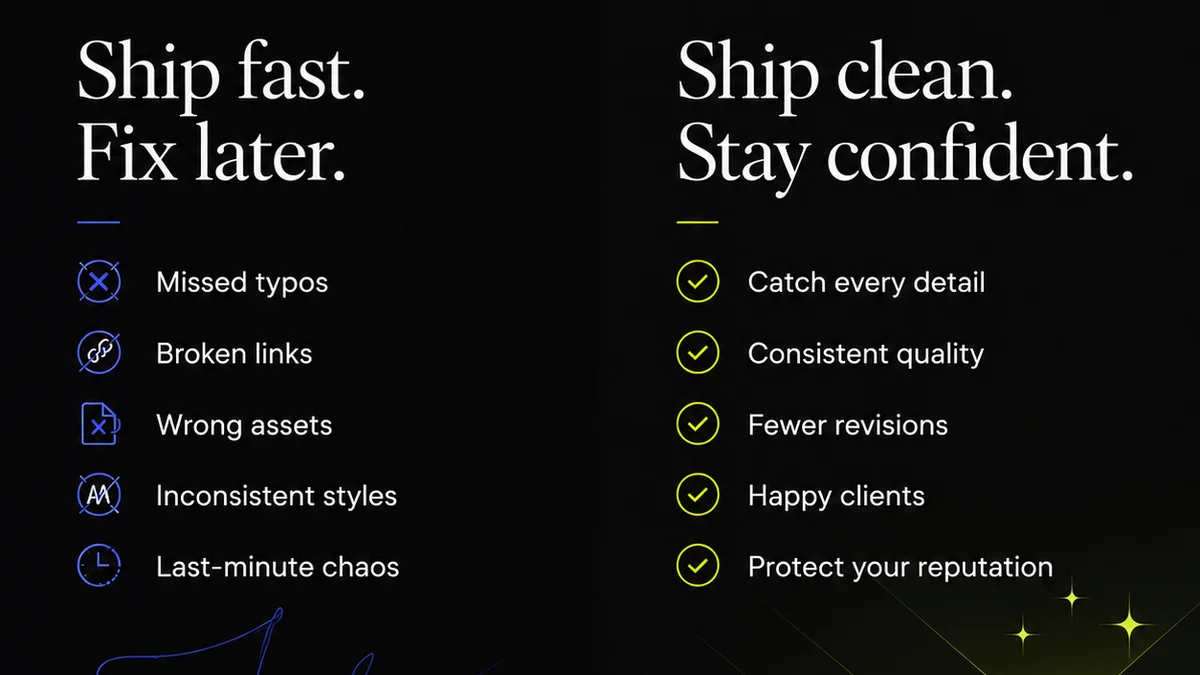
Everyone’s talking about AI generating art, writing copy, or even designing websites. It’s flashy. It’s exciting. It’s the future we were promised, right?
None of that is wrong. But it’s incomplete.
The real, operational revolution AI is quietly driving isn’t in creation, but in the unsexy, often painful world of creative compliance.
The Hard Truth: Compliance Is a Bottleneck, Not a Feature
Most agencies and in-house teams treat compliance as a hurdle. A necessary evil. A final sign-off gate that slows everything down.
This view is fundamentally flawed. Compliance isn't a gate; it's an integral part of the creative process. And when it’s handled reactively, it becomes a massive bottleneck.
Think about it.
- Endless rounds of legal review for a single ad.
- Brand police shutting down campaigns for minor logo placement errors.
- Platform-specific requirements missed until launch day.
- Accessibility standards ignored until an audit.
This isn’t just frustrating; it’s expensive. It kills momentum. It erodes client trust. And it’s a massive drain on creative director and account manager time.
The traditional approach – manual checks, endless email chains, and last-minute panic – is broken.
But AI is changing that. It’s shifting compliance from a reactive chore to a proactive, integrated part of the workflow.
1. AI as Your Pre-Flight Checklist
Imagine a world where your creative assets are automatically scanned for compliance *before* they ever reach a human reviewer.
This isn't science fiction. AI tools are already capable of:
- Brand Guideline Enforcement: Detecting incorrect logo usage, off-brand color palettes, and unapproved fonts.
- Legal & Regulatory Checks: Flagging claims that might violate advertising standards (e.g., unsubstantiated claims, prohibited language), or identifying missing disclaimers.
- Platform-Specific Formatting: Ensuring image dimensions, video aspect ratios, and character counts meet requirements for social media, websites, or ad networks.
- Accessibility Standards: Checking color contrast ratios, alt text presence, and other WCAG compliance elements.
This isn't about replacing human judgment entirely. It's about automating the tedious, repetitive checks that consume valuable human hours.
It means your legal team can focus on nuanced, high-risk issues, not on checking if a logo is the right shade of blue.
It means your brand managers can trust that assets hitting client review are already 90% compliant.
The Shift from Reactive to Proactive
The biggest win here is the shift from reactive to proactive.
Instead of finding out about a compliance issue at the eleventh hour, you’re alerted immediately when the asset is created or uploaded.
This allows for rapid iteration and correction, often within the design tool itself.
2. Streamlining Complex Regulatory Landscapes
Different industries have vastly different compliance requirements. Think financial services, healthcare, or food and beverage.
These aren't just about avoiding fines; they're about maintaining trust and reputation.
AI can be trained on specific regulatory frameworks.
For example:
- Financial Services: AI can scan marketing materials for adherence to FINRA, SEC, or GDPR regulations, ensuring proper disclosures and avoiding misleading statements.
- Healthcare: AI can help verify that claims about treatments or products comply with FDA or HIPAA guidelines, and that patient privacy is protected.
- Advertising Standards: AI can be trained on ASA (UK), FTC (US), or other regional advertising codes to flag potentially deceptive or unfair practices.
This level of specialized knowledge is difficult and expensive to maintain manually.
An AI trained on these regulations can act as a constant, vigilant auditor.
The Cost of Non-Compliance
The cost of getting compliance wrong is staggering.
Fines, lawsuits, brand damage, loss of licenses – the stakes are incredibly high.
AI offers a scalable, consistent way to mitigate these risks without ballooning compliance teams.
3. Enhancing Brand Consistency at Scale
Brand consistency is more than just using the right logo. It's about tone, voice, visual identity, and messaging across every touchpoint.
As organizations grow, and the volume of creative output increases, maintaining this consistency becomes exponentially harder.
AI can serve as the ultimate brand guardian.
Think about AI that can:
- Analyze Tone of Voice: Does this copy sound like our brand? Is it too casual? Too formal?
- Verify Visual Elements: Are the correct fonts, colors, and image styles being used consistently across different campaign assets?
- Detect Inconsistencies: Highlight where messaging or visuals deviate from established brand guidelines, even subtly.
- Automate Brand Asset Management: Ensure only approved, on-brand assets are available for use.
This is crucial for large enterprises, franchises, and agencies managing multiple brands.
It ensures that every piece of content, from a social media post to a multi-million dollar campaign, aligns with the core brand identity.
Beyond the Logo
True brand consistency is deep. AI is starting to understand that depth.
It’s moving beyond simple rule-based checks to more nuanced analysis of creative output.
4. Improving Review Cycles and Feedback Loops
The traditional creative review process is a black hole for feedback.
Clients, legal, brand managers – they all pile comments into a single document, often with conflicting advice.
This chaos leads to:
- Delayed approvals.
- Misinterpreted feedback.
- Wasted revision cycles.
- Frustrated creatives.
AI can bring order to this chaos.
By integrating with review platforms, AI can:
- Pre-categorize Feedback: Automatically tag feedback as
Frequently asked questions
Can AI completely replace human compliance officers?
No, AI is best used to automate routine checks and flag potential issues. Complex, nuanced decisions and final sign-offs still require human judgment and expertise, especially in highly regulated industries.
What types of creative work benefit most from AI compliance checks?
Any creative work with strict guidelines benefits, including marketing campaigns, advertising, website content, social media posts, and any materials requiring legal, brand, or platform adherence.
How can an agency integrate AI into its existing compliance workflow?
Start by identifying the most time-consuming and repetitive compliance checks. Look for AI tools that integrate with your current project management or creative review software, automating those specific tasks first.
Is AI compliance only for large enterprises?
Not at all. While large organizations have more complex needs, even small to mid-sized agencies can leverage AI to save time on basic checks, reduce errors, and provide a more efficient client experience.