Everyone’s talking about AI. It’s the new shiny object, promising to automate everything. You’ve heard the hype: AI will write your copy, design your graphics, and edit your videos. It’s going to free up all your time.
None of that is wrong. But it’s incomplete.
The real shift AI is bringing to creative productivity isn't just about speed or automation. It’s about the fundamental reshaping of creative roles, client collaboration, and the very definition of what “creative work” entails.
1. The Myth of the Fully Automated Creative
The assumption is that AI will replace creatives. That’s a Hollywood fantasy, not an operational reality.
What AI actually does is automate the *tasks* within a creative role, not the role itself. Think of it as a powerful, albeit sometimes quirky, junior assistant.
It can generate 50 headline variations in seconds. It can whip up a dozen mood board concepts based on a prompt. It can even draft initial video storyboards.
But it can’t strategize. It can’t deeply understand a client’s nuanced brand voice. It can’t anticipate market shifts or client objections with human intuition.
The hard truth? AI amplifies the human creative, it doesn’t replace them.
The Rise of the Creative Director as AI Orchestrator
Your job isn’t just about making cool stuff anymore. It’s about knowing which AI tools to use, how to prompt them effectively, and how to curate and refine their output.
This requires a new skill set:
- Prompt engineering: Crafting precise instructions for AI.
- Critical evaluation: Assessing AI-generated content for quality, accuracy, and brand fit.
- Strategic integration: Deciding where AI adds the most value in the workflow.
- Ethical oversight: Ensuring responsible AI use.
The creatives who thrive will be those who master these AI-augmented workflows.
2. From Iteration to Ideation Acceleration
Creative processes have always involved iteration. Draft, feedback, revise, repeat.
AI drastically shortens the *iteration* loop. But it also fundamentally changes the *ideation* phase.
Instead of spending hours brainstorming a few concepts, teams can now explore dozens, even hundreds, of directions rapidly.
This isn't just about speed; it's about breadth. AI can surface unexpected connections and visual styles you might never have considered.
Consider a branding project. AI can generate countless logo concepts, color palettes, and typography pairings based on initial strategic input. This allows the human team to move past the initial grunt work of generating options and focus on higher-level strategic decisions and aesthetic refinement.
The challenge? Managing this explosion of options. Without a clear process, you risk analysis paralysis.
The New Bottleneck: Decision-Making, Not Creation
When AI can generate options at scale, the bottleneck shifts. It moves from *producing* the options to *selecting* and *refining* the best ones.
This puts a premium on:
- Clear client briefs and strategic frameworks.
- Efficient feedback mechanisms.
- Strong internal creative direction and taste-making.
Your team needs to be adept at quickly identifying promising AI-generated directions and guiding them toward a final solution, rather than getting lost in the sheer volume of possibilities.
3. Redefining Client Collaboration and Feedback
Client feedback has always been the elephant in the room. It’s where projects often derail.
AI doesn’t magically fix bad feedback. But it can transform how feedback is solicited, managed, and acted upon.
Imagine using AI to generate multiple distinct creative directions for a campaign. Presenting these to the client, not as final options, but as starting points for discussion.
AI can help standardize the presentation of work, ensuring clarity and consistency. It can even assist in summarizing feedback or identifying conflicting comments from different stakeholders.
This speeds up the back-and-forth, reducing the time spent on misunderstandings and clarifying subjective preferences.
The AI-Powered Briefing Room
Think about the initial briefing. AI can help analyze existing brand assets, competitor campaigns, and market trends to provide a richer, data-informed foundation before any creative work even begins.
During the revision process, AI can:
- Track changes and compare versions automatically.
- Suggest revisions based on client comments and established brand guidelines.
- Flag potential inconsistencies across different creative assets.
The goal is to make the feedback loop tighter, more objective, and less prone to subjective interpretation or miscommunication.
4. Quality Assurance in the Age of Automation
Creative quality control is crucial. It’s the final gate before delivery.
AI introduces new dimensions to QA. It’s not just about checking for typos or broken links anymore.
AI tools can analyze visual consistency, check for accessibility compliance, ensure brand guideline adherence, and even predict potential user experience issues.
For example, an AI could scan a website design to ensure all buttons are consistently styled and clickable, or check an ad campaign to ensure all visual elements align with the approved brand colors and fonts.
This is about proactive quality assurance, catching potential issues before they become client problems.
The AI Auditor
This AI capability allows for a more rigorous and comprehensive QA process.
- Automated brand guideline checks.
- Accessibility compliance scans.
- Consistency checks across multiple assets.
- Performance prediction for digital assets.
This frees up human reviewers to focus on the subjective elements of quality – the strategic impact, the emotional resonance, the overall creative brilliance.
Where Revue Fits In
All this AI-powered acceleration and iteration creates a new challenge: managing the sheer volume and complexity of creative projects.
When AI can generate dozens of options, how do you keep track of them? How do you manage client feedback on these rapidly evolving assets? How do you ensure the final approved version is exactly what the client signed off on?
This is where a centralized platform becomes essential.
Revue helps you:
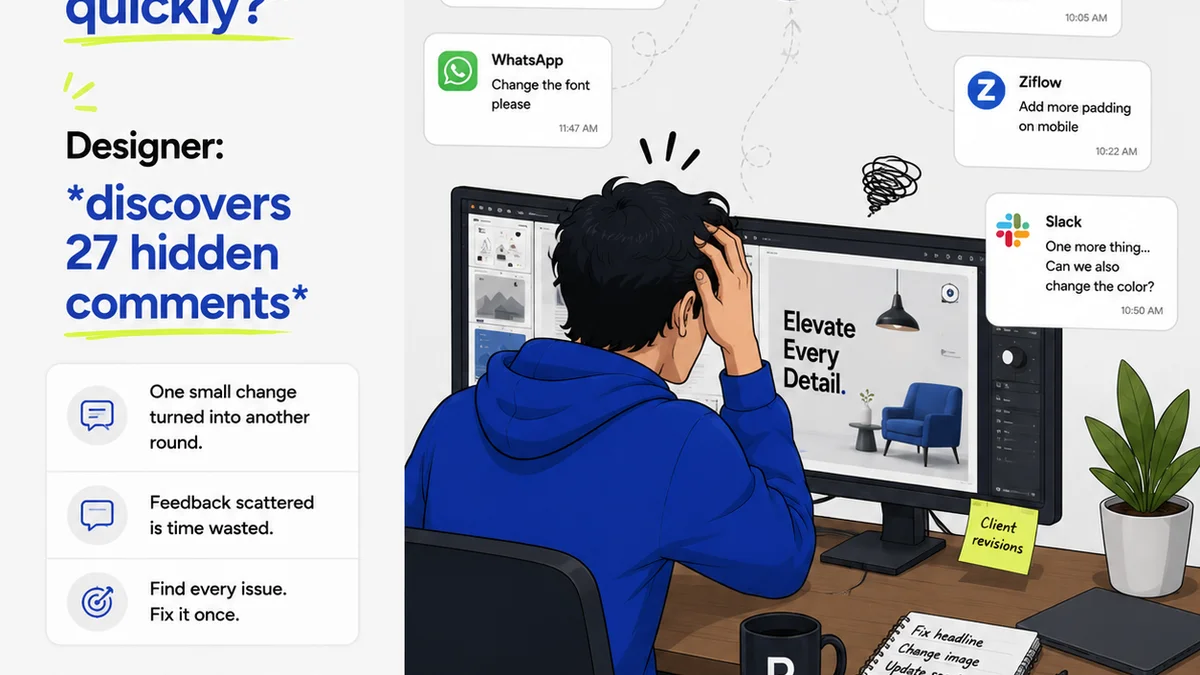
- Centralize Feedback: AI might generate options, but clients still need to provide input. Revue provides a single source of truth for all client comments, eliminating scattered email chains and Slack messages.
- Manage Revisions: Track every iteration. See exactly what changed, who approved it, and when. This clarity is vital when dealing with the rapid output AI can produce.
- Ensure Approvals: Formalize the sign-off process. Know with certainty that a piece of work has been approved, reducing the risk of scope creep or disputes.
- Maintain Quality: By having all assets and feedback in one place, you can conduct more effective quality checks, ensuring that the final output meets both client expectations and your agency’s standards.
AI handles the generation; Revue handles the organization, collaboration, and control.
Final Thought
AI is not a magic wand that makes creative work effortless. It's a powerful tool that demands a new level of strategic thinking, operational discipline, and human oversight.
The real productivity gains won't come from simply adopting AI tools, but from fundamentally rethinking how we integrate them into our workflows, how we manage client expectations in an AI-accelerated world, and how we empower our human creatives to do their best work.
Are you ready to move beyond the hype and build the AI-augmented creative operations of tomorrow?
Frequently asked questions
Will AI replace creative professionals?
It's highly unlikely. AI excels at automating repetitive tasks and generating variations, but it lacks the strategic thinking, emotional intelligence, and nuanced understanding of human creatives. AI is best viewed as a powerful assistant that augments, rather than replaces, human talent.
How does AI change the creative ideation process?
AI can accelerate ideation by rapidly generating a vast number of concepts, visual styles, and variations that humans might not have considered. This shifts the focus from generating initial options to evaluating, refining, and strategically selecting the most promising AI-assisted ideas.
What are the biggest challenges of using AI in creative workflows?
Key challenges include managing the overwhelming volume of AI-generated options, ensuring the quality and brand consistency of AI output, effective prompt engineering, and integrating AI tools seamlessly into existing workflows without disrupting collaboration.
How can agencies prepare for an AI-augmented future?
Agencies should focus on training their teams in AI tools and prompt engineering, developing clear strategies for AI integration, establishing robust quality control processes for AI-generated content, and investing in platforms that can manage the increased complexity of AI-driven workflows.