Everyone’s talking about AI in creative work. They say it’s going to automate tasks, speed up production, and maybe even replace some jobs. None of that is wrong. But it’s incomplete.
The real story of AI in creative productivity is far richer and more complex. It’s not just about doing things faster; it’s about doing things *better* and unlocking new levels of strategic thinking.
1. Beyond Automation: Augmenting the Creative Mind
The common narrative paints AI as a tireless worker, churning out drafts and assets on command. This is certainly part of the picture. AI-powered tools can generate initial concepts, draft copy, create basic visuals, and even suggest design variations at speeds that were unthinkable a decade ago.
The Efficiency Trap
But focusing solely on automation misses the point. If all AI does is make existing, less-than-optimal processes faster, you haven't truly gained anything. You've just automated mediocrity.
The deeper truth is that AI, when used strategically, augments human creativity. It frees up cognitive load, allowing creatives to focus on higher-order thinking: strategy, conceptualization, and refinement.
AI as a Creative Partner
Think of AI not as a replacement, but as a highly capable junior creative or a tireless research assistant. It can:
- Generate a dozen headline variations in seconds.
- Suggest color palettes based on brand guidelines and target audience psychology.
- Analyze existing content for SEO opportunities and suggest improvements.
- Create mood boards or initial visual treatments based on a brief.
- Summarize lengthy research documents or client feedback.
This doesn't diminish the creative role; it elevates it. The human creative then curates, refines, and directs, applying their unique insight and taste.
2. Streamlining Workflows: From Chaos to Clarity
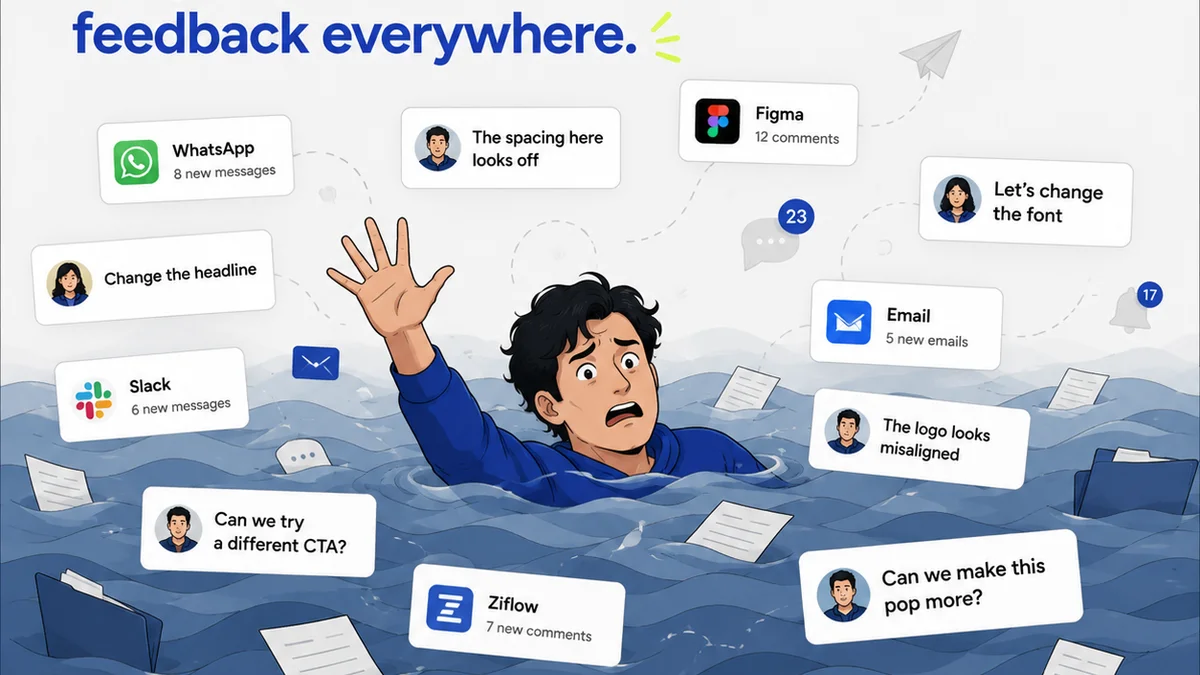
Creative agencies and in-house teams often struggle with fragmented workflows. Feedback gets lost, revisions are tracked inconsistently, and the final approval process can be a black hole.
The Bottlenecks You Know (and Don't Know)
Common bottlenecks include:
- Manual consolidation of feedback from multiple stakeholders.
- Difficulty tracking the history of revisions and decisions.
- Miscommunication leading to redundant work.
- Time spent hunting for the latest version of a file.
- Unclear approval chains.
These aren't just minor annoyances; they are productivity killers that directly impact project timelines and profitability.
AI's Role in Workflow Optimization
AI is starting to play a significant role in smoothing these rough edges. Beyond generative capabilities, AI can analyze project data to identify patterns and predict potential delays. It can assist in task allocation and resource management.
More immediately, AI can help manage the sheer volume of communication and assets inherent in creative projects. Imagine an AI that can:
- Categorize and summarize client feedback from various channels.
- Identify conflicting feedback points that require clarification.
- Automate the creation of revision summaries for internal teams.
- Flag assets that haven't been updated according to the latest brief.
This moves beyond just generating content; it’s about managing the *process* of creation more intelligently.
3. Enhancing Decision-Making: Data-Informed Creativity
Creativity has always been seen as an art, driven by intuition and inspiration. While that remains true, AI introduces a powerful data-driven layer to creative decision-making.
Gut Feel vs. Data
Many creative decisions are still based on a 'gut feel' or past experience. This is valuable, but it can also be biased or miss crucial audience insights.
AI can process vast amounts of data that are impossible for humans to sift through. This includes:
- Audience demographics and psychographics.
- Performance data from previous campaigns.
- Market trends and competitor analysis.
- User behavior on digital platforms.
AI-Powered Insights
This data can inform creative strategy in tangible ways:
- Personalization: AI can help tailor creative content to specific audience segments.
- A/B Testing: AI can predict which variations of an ad or landing page are likely to perform best.
- Trend Analysis: AI can identify emerging visual styles or messaging trends relevant to a brand.
- Risk Assessment: AI can flag creative elements that might violate brand guidelines or be perceived negatively by certain demographics.
This isn't about letting AI dictate creative output. It's about equipping creatives with better information to make more confident, effective decisions.
4. Quality Assurance and Consistency
Maintaining brand consistency and ensuring high quality across all creative output is a perpetual challenge, especially in large teams or complex projects.
The Cost of Inconsistency
Inconsistent branding erodes trust and dilutes a company's message. Minor errors in design or copy can undermine professional credibility.
Manual QA processes are time-consuming and prone to human error. Spotting every misplaced pixel or grammatical slip across dozens of assets is a Herculean task.
AI for Precision
AI excels at pattern recognition and rule-based checking, making it ideal for quality assurance.
- Brand Guideline Enforcement: AI can automatically check if logos, colors, fonts, and spacing adhere to established brand guidelines.
- Accessibility Checks: AI tools can help identify potential accessibility issues (e.g., insufficient color contrast, missing alt text) early in the process. WCAG guidelines are essential here.
- Grammar and Style: Advanced AI can go beyond basic spellcheck to ensure adherence to specific style guides and tone of voice.
- Visual Anomaly Detection: AI can spot visual inconsistencies or deviations from templates.
This frees up human reviewers to focus on the subjective aspects of creative quality – the impact, the emotion, the strategic alignment – rather than tedious rule-checking.
Where Revue Fits In
The transformation AI brings to creative productivity doesn't happen in a vacuum. It requires a robust system to manage the output, feedback, and approvals that AI helps generate more efficiently.
This is where a platform like Revue becomes critical. As AI accelerates content creation and iteration, the need for centralized, clear, and actionable feedback management becomes paramount.
Revue provides a single source of truth for client feedback, ensuring that AI-generated variations and human refinements are all tracked in one place. It streamlines the revision and approval process, making it easier to:
- Consolidate feedback from all stakeholders, regardless of AI-assisted or human-led creation.
- Maintain clear visibility into revision history and decision logs.
- Ensure that quality checks, including AI-assisted ones, are systematically applied.
- Reduce the communication overhead that can easily overwhelm even the most AI-enhanced workflows.
By integrating AI tools with a workflow management system like Revue, agencies can amplify their productivity gains, ensuring that speed translates into quality and strategic success, not just more busywork.
Final Thought
AI is not a magic bullet that will instantly solve all creative challenges. Its true power lies in its ability to augment human capabilities, streamline complex processes, and provide deeper insights.
The question isn't whether AI will transform creative productivity. It already is. The real question is: are you leveraging it to enhance human ingenuity, or just to speed up the old ways of working?
Frequently asked questions
How can AI help creative teams be more productive without sacrificing quality?
AI can automate repetitive tasks, generate initial concepts quickly, and assist in data analysis, freeing up human creatives to focus on strategic thinking, refinement, and subjective quality. Tools that manage feedback and revisions, like Revue, are crucial to ensure this speed doesn't lead to chaos.
Is AI going to replace creative jobs?
It's more likely that AI will change creative roles. Tasks that are highly repetitive or data-driven might be automated, but roles requiring strategic thinking, complex problem-solving, emotional intelligence, and unique artistic vision will remain essential. AI will likely become a powerful co-pilot for creatives.
What are the biggest workflow challenges AI can address for agencies?
AI can help with consolidating fragmented feedback, tracking revisions, identifying bottlenecks, ensuring brand consistency, and performing automated quality checks. This reduces manual effort and miscommunication, leading to smoother project execution.
How can agencies ensure AI tools integrate well with existing workflows?
Start by identifying specific pain points in your current workflow that AI could address. Choose AI tools that offer clear integrations or can be managed through a central platform like Revue. Focus on augmenting existing processes rather than trying to replace everything at once.