Everyone’s talking about AI. They say it's going to automate everything, make creatives obsolete, or create a utopia of instant design. None of that is wrong. But it’s incomplete.
The hard truth? AI’s real power for creative agencies isn't just about doing things faster. It’s about doing things *smarter*. It’s about unlocking new levels of insight and collaboration that were previously impossible.
1. AI for Smarter Briefing and Research
Think about the initial stages of any project. The brief. It’s often a mess of assumptions, vague desires, and conflicting goals. AI can help cut through that noise.
AI-powered tools can analyze vast amounts of data – market trends, competitor activity, audience sentiment – to provide a richer, more objective foundation for the brief. This isn’t about replacing human strategy; it’s about augmenting it with data that’s too voluminous for a person to process manually.
Automating Information Gathering
Imagine an AI that can:
- Scan competitor websites and social media for messaging and visual trends.
- Analyze customer reviews for pain points and desired features.
- Summarize industry reports and academic research relevant to the project.
- Identify emerging visual styles or design patterns.
This frees up strategists and creatives to focus on the *why* and the *how*, rather than getting bogged down in the *what*.
Uncovering Hidden Insights
Beyond just summarizing, AI can identify correlations and patterns that humans might miss. This can lead to a deeper understanding of the target audience and the competitive landscape, informing more impactful creative directions.
2. AI in Design and Content Generation
This is where most of the public hype sits. Generative AI tools are impressive, but they’re not a magic bullet for design.
The current narrative often focuses on AI spitting out finished logos or ad copy. That’s a narrow view. The real value lies in AI as a co-pilot, an idea generator, and a rapid prototyper.
Augmenting Creativity, Not Replacing It
AI can generate:
- Multiple visual concepts based on a text prompt.
- Variations on existing designs for A/B testing.
- Draft copy for different platforms and tones.
- Image assets based on specific style guides.
These outputs are starting points. They require human curation, refinement, and strategic direction to become effective solutions. A human creative is still essential for understanding nuance, brand voice, and emotional resonance.
Accelerating Iteration
The ability to generate variations quickly is a game-changer for iteration. Instead of spending hours tweaking a design or writing multiple copy options, AI can provide dozens in minutes. This allows teams to explore more creative avenues and reach a stronger solution faster.
The Importance of Prompt Engineering
Effectively using generative AI requires skill. “Prompt engineering” is becoming a critical competency. Learning how to communicate your vision to the AI in a way that yields useful results is key. This is a new skill, not a replacement for design thinking.
3. AI for Enhanced Feedback and Revision Management
This is a less glamorous, but arguably more impactful, area where AI is transforming agency workflows. Centralizing feedback and managing revisions is a perennial challenge.
AI can move beyond simple annotations to provide context, flag inconsistencies, and even predict potential issues before they arise.
Automated Feedback Analysis
Imagine AI that can:
- Categorize feedback by type (e.g., copy, design, technical).
- Identify conflicting feedback from different stakeholders.
- Summarize lengthy comment threads into actionable points.
- Flag comments that deviate significantly from the original brief or strategy.
This transforms feedback from a chaotic deluge into structured, actionable intelligence.
Predictive Quality Assurance
AI can analyze creative assets against established guidelines, brand standards, or even accessibility requirements. It can flag potential issues early, reducing costly rework later in the process.
This isn’t about replacing human QA, but about making it more efficient and comprehensive. AI can catch the obvious errors, allowing human reviewers to focus on subjective quality and strategic alignment.
Where Revue Fits In
The integration of AI into creative workflows doesn't diminish the need for robust project management and clear communication tools. In fact, it amplifies it.
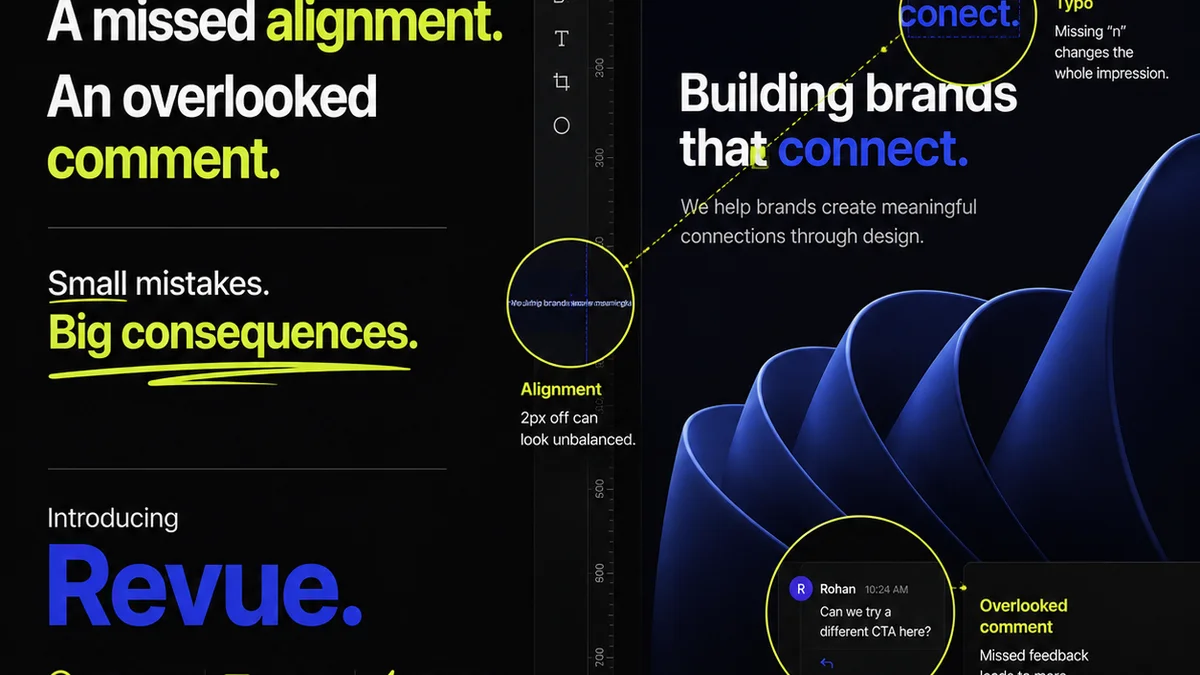
As AI generates more ideas, variations, and data points, the need for a central hub to manage these outputs becomes critical. This is where a platform like Revue becomes indispensable.
Revue helps agencies:
- Centralize Client Feedback: AI might help categorize feedback, but Revue provides the structure to ensure it’s seen, understood, and acted upon by the right people. No more lost emails or buried Slack messages.
- Manage Revisions with Visibility: When AI generates multiple versions, Revue offers a clear audit trail of changes, approvals, and versions. This transparency is crucial for accountability and project tracking.
- Streamline Quality Checks: While AI can flag technical issues, Revue ensures that strategic and brand alignment checks are systematically performed and documented. It acts as the final gatekeeper, ensuring AI-generated outputs meet client objectives.
AI provides the raw intelligence and rapid generation; Revue provides the operational framework to harness it effectively, ensuring that creativity translates into successful client outcomes.
4. The Human Element: Strategy, Empathy, and Judgment
Despite the advancements, AI is a tool. It lacks genuine creativity, emotional intelligence, and ethical judgment. These are uniquely human capabilities that remain at the core of successful agency work.
AI can generate beautiful images, but it can’t understand the subtle cultural nuances that make an ad resonate. It can write grammatically correct copy, but it can’t imbue it with authentic brand personality or empathy.
The Strategic Imperative
Strategic thinking – understanding the client’s business, the market, and the audience’s deepest needs – is a human domain. AI can provide data, but humans must interpret it, connect the dots, and formulate the overarching strategy.
The Empathy Gap
Creative work is often about connecting with people on an emotional level. AI can simulate emotion, but it cannot feel it. This empathetic understanding is crucial for crafting messages and experiences that truly resonate.
Ethical Considerations
AI raises complex ethical questions around data privacy, bias in algorithms, and intellectual property. Navigating these requires human judgment, ethical frameworks, and a commitment to responsible innovation.
Final Thought
AI is not coming for creative jobs. It’s coming for the tedious, repetitive, and data-heavy tasks that drain creative energy. The agencies and creatives who thrive will be those who learn to leverage AI as a powerful collaborator, augmenting their human strengths rather than fearing its capabilities.
The question isn't whether AI will transform creative work. The question is: How will *you* transform your agency to harness its potential?
Frequently asked questions
Will AI replace creative professionals?
No, AI is unlikely to replace creative professionals entirely. Instead, it's poised to augment their capabilities by automating tedious tasks, generating ideas, and accelerating iteration. Human creativity, strategic thinking, and emotional intelligence remain indispensable.
How can AI improve client feedback processes?
AI can analyze and categorize feedback, identify conflicting comments, and summarize lengthy discussions. This helps agencies process feedback more efficiently, ensuring key insights are captured and acted upon, reducing miscommunication and rework.
What is 'prompt engineering' in the context of AI for creatives?
Prompt engineering is the skill of crafting effective text-based instructions (prompts) to guide AI tools, particularly generative AI, in producing desired outputs. It's crucial for getting high-quality, relevant results from AI image or text generators.
How does a platform like Revue complement AI in creative workflows?
Revue acts as the operational hub, centralizing AI-generated insights and assets, managing feedback and revisions, and ensuring quality checks. It provides the structure needed to harness AI's power effectively, translating raw output into client success.