Everyone’s talking about AI. They say it’s going to automate everything in creative agencies. Clients will get work faster, cheaper, and with fewer revisions. None of that is wrong. But it’s incomplete.
The real story isn't just about AI replacing tasks. It’s about how AI fundamentally reshapes the *entire* creative workflow, from brief to final delivery. And that’s where the tools you use, like Monday.com and Revue, become critical.
1. The Automation Illusion: Beyond Simple Tasks
The first wave of AI hype focused on automating repetitive tasks. Think image resizing, basic copy generation, or even initial draft layouts. This is happening, and it’s valuable.
But this view misses the bigger picture. AI isn’t just a faster intern. It’s a new layer of intelligence that can augment decision-making, predict outcomes, and personalize experiences at a scale previously impossible.
This shift means your workflow needs to adapt. It's not just about plugging in an AI tool; it's about rethinking how your team collaborates and how feedback is managed.
The Real Impact: Augmentation, Not Just Automation
Consider these shifts:
- Predictive Analytics: AI can analyze past project data to forecast potential bottlenecks, budget overruns, or even client satisfaction levels.
- Personalized Content Generation: Moving beyond generic outputs, AI can tailor creative assets to specific audience segments based on real-time data.
- Intelligent Brief Analysis: AI can process client briefs, identify ambiguities, and even suggest clarifying questions before a project even starts.
- Smart Resource Allocation: AI can help match project needs with team member skills and availability, optimizing team efficiency.
This isn't science fiction. These capabilities are emerging and will soon be table stakes.
2. Monday.com: The Orchestrator of Tasks
Monday.com has built a reputation as a flexible work operating system. It excels at organizing projects, tracking tasks, and providing a centralized hub for team communication and status updates.
For many agencies, it’s the backbone of their operations. It helps manage timelines, assign responsibilities, and ensure that everyone knows what they should be doing and when.
AI integration into platforms like Monday.com is a natural progression. They are looking to imbue their existing structures with intelligence.
How AI Enhances Monday.com Workflows
Imagine:
- Automated Task Prioritization: AI analyzing deadlines, dependencies, and team workload to suggest which tasks need immediate attention.
- Intelligent Project Scoping: AI assisting in breaking down a project into manageable tasks based on historical data and project type.
- Proactive Risk Identification: AI flagging potential delays or resource conflicts before they become critical issues.
- Streamlined Reporting: AI summarizing project progress and generating status reports automatically.
These features leverage AI to make the *management* of creative work more efficient. They help keep the trains running on time.
3. The Creative Feedback Loop: Where AI Gets Tricky
This is where the conversation often gets complicated. Creative work isn't just about tasks; it's about subjective feedback, iterative refinement, and ensuring the final output meets strategic goals and aesthetic standards.
AI can assist in analyzing feedback for sentiment or identifying recurring themes. It can even help generate variations on a design. But it doesn't inherently *understand* the nuanced conversation between a creative director and a client, or the subtle shifts in brand perception.
This is the messy middle of creative production. It involves interpretation, negotiation, and subjective judgment. And this is precisely where many AI-first tools fall short when positioned as complete solutions.
The Limitations of Pure AI in Creative Feedback
- Subjectivity: AI struggles with the inherent subjectivity of creative taste and brand alignment.
- Contextual Nuance: Understanding the 'why' behind a client's comment requires deep contextual knowledge that AI often lacks.
- Relationship Management: Creative feedback is often tied to client relationships, which AI cannot replicate.
- Iterative Refinement: The back-and-forth of revisions is more than just applying changes; it's a collaborative dialogue.
Simply automating the *delivery* of feedback or the *application* of minor edits misses the core of the creative iteration process.
4. Where Revue Fits In: Centralizing the Human Element
This is where a tool like Revue becomes essential, especially when integrated into a broader workflow that might involve tools like Monday.com. Revue isn’t trying to replace the creative director or the client relationship. It’s built to manage and clarify the *communication* around creative work.
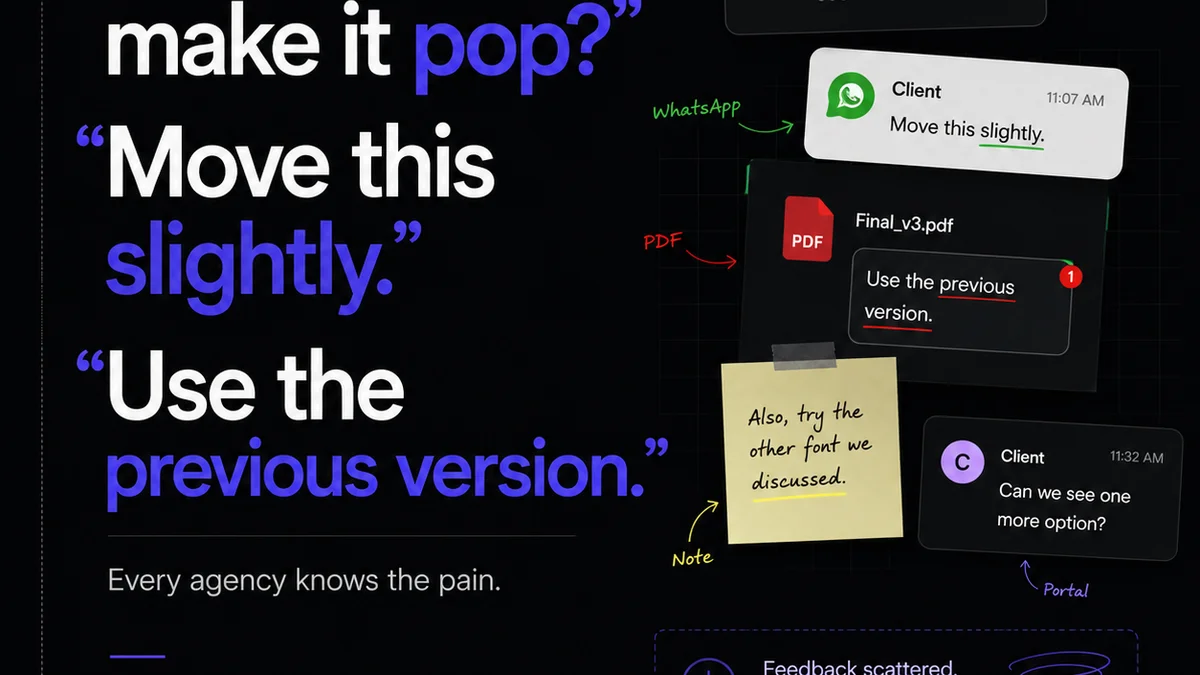
Revue excels at centralizing client feedback, making revisions visible, and streamlining the approval process. It brings order to the subjective, often chaotic, world of creative iteration.
Revue’s Role in an AI-Augmented Workflow
Think of Revue as the intelligent layer that organizes and clarifies the human-driven aspects of creative work, augmented by AI:
- Centralized Feedback Hub: All client comments, annotations, and discussions are in one place, linked to specific creative assets. No more hunting through emails or Slack threads.
- Clear Revision Tracking: Easily see what has been changed, by whom, and why. This provides an auditable trail and reduces misunderstandings.
- Streamlined Approvals: Define clear approval workflows, ensuring that work moves forward only when all stakeholders are aligned.
- Quality Assurance Support: By centralizing feedback and approvals, Revue helps ensure that creative output meets standards before final delivery.
When AI tools help generate assets or analyze data, Revue provides the structure to manage the human judgment, feedback, and approval that AI cannot replicate. It makes the subjective objective and trackable.
5. The Future: Integrated Intelligence
The most effective creative agencies won't rely on a single AI tool or a single project management platform. They will build integrated workflows that leverage the strengths of each.
AI will continue to automate more complex tasks, assist in analysis, and personalize outputs. Platforms like Monday.com will become smarter orchestrators of these AI-driven tasks and team efforts.
And tools like Revue will become indispensable for managing the uniquely human aspects of creativity: nuanced feedback, collaborative decision-making, and the final sign-off.
Key Considerations for Integration
- Data Flow: How will data move between your AI tools, project managers, and feedback platforms?
- User Experience: Does the integrated workflow feel seamless, or does it create more friction?
- Role Definition: Clearly define how AI, project management, and human oversight interact.
- Adaptability: The AI landscape is evolving rapidly. Your workflow must be flexible.
The goal is not just to use AI, but to use it to enhance human creativity and deliver better client outcomes more efficiently.
Final Thought
Is AI a threat to creative roles, or is it the most powerful tool creatives have ever had? The answer depends entirely on how you choose to integrate it into your workflow. Are you ready to move beyond the automation illusion and embrace true creative augmentation?
Frequently asked questions
How does AI specifically help with creative feedback?
AI can help analyze feedback for sentiment, identify recurring themes, and even summarize large volumes of comments. However, it struggles with the subjective nuances and contextual understanding crucial for true creative iteration. Tools like Revue are designed to manage this human element.
What's the main difference between Monday.com and Revue for creative teams?
Monday.com excels at orchestrating tasks, managing projects, and tracking team progress. Revue focuses on centralizing and clarifying client feedback, managing revisions, and streamlining approvals for creative assets. They serve complementary, rather than competing, functions.
Can AI truly automate the creative process?
AI can automate many repetitive tasks within the creative process, like asset resizing or initial drafting. However, it cannot fully automate the strategic thinking, subjective judgment, client relationship management, and nuanced iterative feedback that define high-level creative work.
How should agencies prepare for AI in their workflows?
Agencies should focus on integrating AI tools to augment, not just automate. This involves understanding how AI can enhance decision-making and efficiency, and ensuring that platforms for managing human-centric aspects like feedback and approvals are robust and integrated.