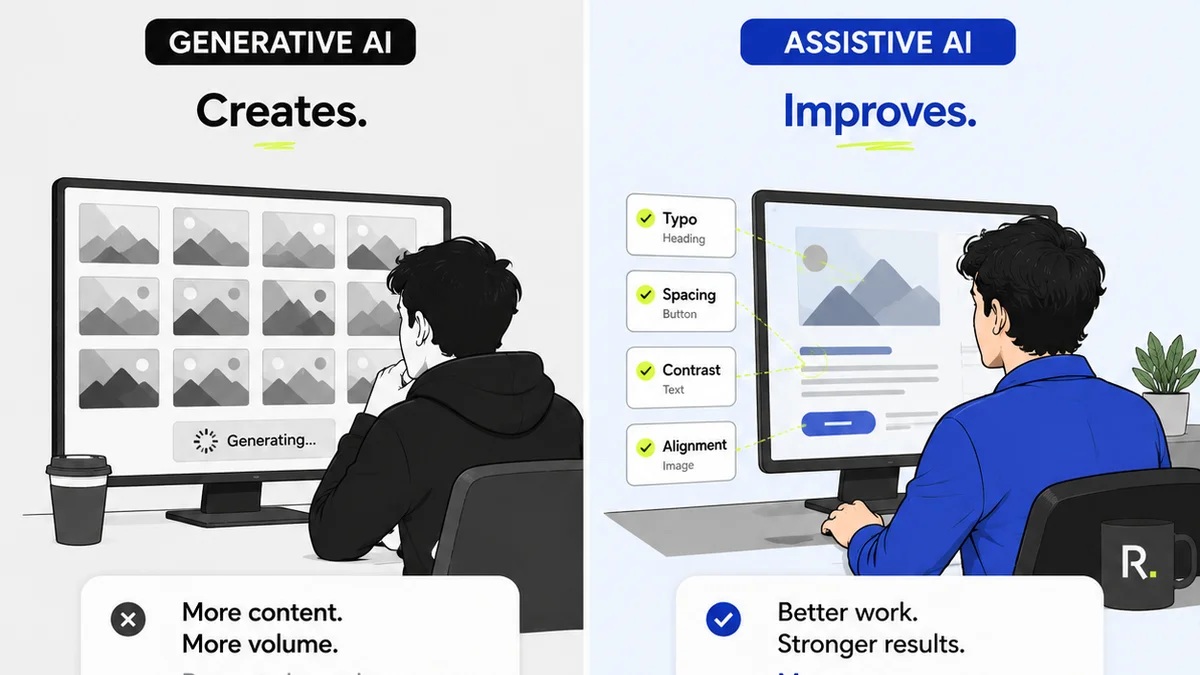
Everyone’s talking about AI. And in design, the narrative is often about disruption. Automation. The end of the designer as we know it. Generative tools spitting out logos, websites, and campaigns in seconds. It’s a compelling story.
None of that is wrong. But it’s incomplete. Dangerously so.
The hard truth? AI isn’t going to replace designers. It’s going to change what *being* a designer means. And the agencies and teams that understand this are the ones who will thrive. The rest will be left scrambling.
1. AI Will Automate Creative Strategy
The assumption: AI can analyze data, identify trends, and churn out a winning creative strategy better and faster than any human. Feed it a brief, and it delivers the perfect campaign concept.
This is where the myth really falls apart. Strategy isn't just about pattern recognition. It's about empathy. About understanding unspoken needs. About navigating complex client relationships and their inherent irrationalities. It’s about intuition honed by years of experience, not just data points.
AI can be an incredible *tool* for strategy. It can surface insights from vast datasets that a human might miss. It can identify emerging trends or test hypotheses at scale.
AI as a Research Assistant
- Analyzing market research reports in seconds.
- Identifying competitor messaging patterns.
- Simulating audience responses to different creative angles.
- Flagging potential cultural sensitivities in proposed concepts.
But it cannot, *yet*, grasp the nuanced human context that informs truly breakthrough strategy. It can’t read the room during a client pitch. It can’t feel the pulse of culture. That remains a deeply human endeavor.
2. AI Generative Tools Mean Faster Design Output
The assumption: With AI generating initial concepts, revisions, and even final assets, design production will become lightning fast. Turnaround times will shrink dramatically.
Yes, AI *can* speed up certain tasks. Generating variations of an image? Absolutely. Creating placeholder content? Easy. Drafting initial layout options based on parameters? Possible.
But this overlooks the core of design work: refinement. Iteration. Problem-solving. The messy middle where ideas are tested, broken, and rebuilt.
The Reality of AI-Assisted Design
- Prompt Engineering is a Skill: Getting the *right* output from AI requires significant skill and iteration. It’s not just typing a sentence.
- The “Good Enough” Trap: AI often produces output that is superficially correct but lacks strategic depth or true originality. It’s easy to get a “good enough” logo, harder to get one that truly represents a brand’s soul.
- Integration Challenges: AI-generated assets often need significant manual cleanup, adaptation, and integration into existing brand guidelines or workflows. This can take as long as starting from scratch.
- Client Feedback Loop: The real bottleneck isn't creation; it's feedback, revisions, and approvals. AI doesn't magically solve the communication gap between creatives and clients.
The danger isn't that AI is too slow. It's that it encourages a mindset of “good enough” and devalues the critical thinking and craft that define great design.
3. AI Will Democratize Design Skills
The assumption: Anyone can become a designer using AI tools. The barrier to entry is gone. You don't need years of training to create professional-looking visuals.
This one is partially true, but it misses the point of what design *is*. Yes, AI tools lower the barrier to producing *visuals*. Anyone can generate an image that looks decent.
But design is more than just making pretty pictures. It’s about understanding user needs, brand strategy, communication principles, usability, and so much more.
The Unseen Skills AI Can't Replicate
- Strategic Thinking: Connecting design to business objectives.
- User Empathy: Designing for real people and their problems.
- Brand Stewardship: Maintaining consistency and integrity over time.
- Problem Solving: Using design to overcome specific challenges.
- Critical Judgment: Knowing when something is truly effective, not just aesthetically pleasing.
AI can give anyone a paintbrush. It can’t give them the eye of a painter, the understanding of color theory, or the vision to create a masterpiece. It democratizes *output*, not *expertise*.
4. AI Eliminates the Need for Human Review
The assumption: AI can QA designs, check for brand compliance, and ensure everything is pixel-perfect. Human oversight becomes redundant.
This is a dangerous path. AI can be programmed to check for certain objective criteria. Is the logo present? Is the color hex code correct? Is the image resolution sufficient?
But what about subjective quality? What about the *feel* of a design? Does it resonate with the target audience? Does it align with the brand's emotional tone? Does it subtly communicate the intended message?
Limitations of AI in Quality Assurance
- Subjectivity: AI struggles with aesthetic judgment and nuanced brand perception.
- Contextual Understanding: It can't grasp the strategic intent behind a design choice.
- Evolving Standards: Brand guidelines and design best practices change; AI needs constant retraining.
- Unforeseen Errors: AI might miss errors that a human eye, trained on specific project context, would catch.
Human review is still essential for ensuring that designs are not just technically correct, but strategically sound, creatively compelling, and emotionally resonant.
Where Revue Fits In
This is where tools like Revue become even more critical. As AI accelerates parts of the design process, the need for clear, centralized communication and management only grows.
AI might help generate variations, but it doesn’t manage the feedback on those variations. It doesn’t track which version was approved, or why.
Revue provides the essential human layer on top of whatever tools you use. It’s where you:
- Centralize Feedback: Gather all client comments, stakeholder input, and internal reviews in one place, attached directly to the creative asset. No more digging through emails or Slack threads.
- Manage Revisions Clearly: Track every iteration, understand the history of changes, and ensure everyone is working from the latest version.
- Streamline Approvals: Get explicit sign-offs on specific versions, reducing ambiguity and preventing scope creep.
- Maintain Quality Control: Use the structured workflow to ensure designs go through necessary checks before final delivery.
AI can augment the creation process, but managing the human element – the feedback, the decisions, the collaboration – requires a robust system. That’s Revue’s role.
Final Thought
AI is not a magic wand that eliminates the need for skilled designers. It's a powerful amplifier. It can make good designers better, and it can enable those with less experience to produce visuals more easily. But the core strategic, empathetic, and critical thinking skills that define great design? Those remain firmly in human hands.
The question isn't whether AI will change design. It already has. The real question is: Are you ready to adapt your process, your skills, and your team’s roles to leverage it effectively, or will you be left behind?
Frequently asked questions
Will AI replace graphic designers?
AI tools can automate certain tasks, like generating variations or basic layouts. However, they cannot replicate the strategic thinking, empathy, client management, and nuanced creative problem-solving that skilled human designers provide. AI is more likely to augment designer roles than replace them entirely.
Can AI handle creative strategy?
AI can be a powerful assistant for strategy by analyzing data and identifying trends. However, it lacks the human understanding, intuition, and ability to navigate complex client relationships required for true strategic development. Human oversight and interpretation remain crucial.
How does AI affect design revision and approval processes?
AI doesn't inherently streamline feedback or approvals. In fact, managing AI-generated outputs often requires more structured communication. Tools like Revue are essential for centralizing feedback, tracking revisions, and ensuring clear approvals on AI-assisted projects.
Is AI making design faster?
AI can speed up specific asset generation tasks. However, the overall design process, especially refinement, iteration, and client communication, remains a significant part of the workflow. The 'good enough' output from AI often requires substantial human effort to reach strategic goals.