Everyone’s talking about AI for design. You see the flashy generative art, the tools that whip up logos in seconds. It’s easy to dismiss it as a novelty, a shortcut for amateurs, or a threat to creative jobs.
None of that is wrong. But it’s incomplete.
The real story of AI in design isn’t about replacing creatives. It’s about supercharging operations. For agencies looking to scale, to handle more complex projects, and to deliver faster without sacrificing quality, AI is becoming less of a 'nice-to-have' and more of a 'must-have'. It’s an operational upgrade, not just a creative tool.
1. The Myth of the 'Purely Creative' Agency
Many agency owners pride themselves on being purely creative. They believe their value lies solely in the unique ideas and artistic output. This often leads to a resistance to adopting anything that feels too 'technical' or 'process-driven'.
But here’s the hard truth: sustainable growth in the agency world is built on efficient operations as much as it is on brilliant creative work. Without a solid operational backbone, even the most talented teams will hit a ceiling.
What does this look like in practice?
- Projects get delayed due to bottlenecks.
- Client feedback gets lost in email chains.
- Revisions spiral out of control.
- Team members burn out managing tedious tasks.
- Profit margins shrink because time is wasted.
AI can address these operational cracks. It automates the mundane, streamlines communication, and frees up your team to do what they do best: create.
2. From Tedium to Throughput: AI's Operational Edge
Think about the sheer volume of repetitive tasks that bog down a design agency. Generating multiple image variations. Resizing assets for different platforms. Creating mood boards from scratch. Even basic copy generation or initial wireframing.
These aren't the tasks that inspire your best designers. They’re the necessary evils that eat up hours. AI excels here.
Automating Asset Creation & Variation
Generative AI tools can produce dozens of visual assets based on a single prompt. This is invaluable for A/B testing visuals, creating social media content at scale, or simply exploring a wider range of creative directions faster.
Streamlining Workflow Steps
Consider tasks like:
- Image upscaling and enhancement: Improving the quality of existing assets.
- Background removal: Quickly isolating subjects for product shots or composites.
- Color palette generation: Suggesting harmonious color schemes based on an image or brand.
- Content ideation: Brainstorming headlines, taglines, or initial copy drafts.
These aren't creative replacements; they are accelerators. They take the grunt work out of the process, allowing designers to focus on strategic thinking and refinement.
Intelligent Research & Inspiration
AI can sift through vast amounts of data to identify trends, analyze competitor visuals, or even suggest design styles based on project requirements. This dramatically cuts down on manual research time.
3. Enhancing Client Communication & Feedback Loops
One of the biggest operational drains in any agency is inefficient client communication, especially around feedback and revisions. The assumption is that direct client interaction is always best, but the reality is often messy.
Emails get missed. Ambiguous feedback leads to wasted cycles. Tracking changes across multiple versions becomes a nightmare.
AI-Powered Summarization and Analysis
Imagine feeding all client communication for a project into an AI tool. It could summarize key decisions, highlight action items, and even flag conflicting feedback. This ensures everyone is on the same page, reducing misinterpretations.
Proactive Issue Identification
AI can analyze feedback patterns. If a client consistently requests similar changes, it might indicate a misunderstanding of the brief early on, or a flaw in the initial design direction. This allows you to course-correct proactively, not reactively.
Automated Status Updates
For larger projects, AI could potentially generate automated, concise status updates for clients based on progress tracked in project management tools, ensuring transparency without requiring constant manual reporting.
4. Quality Control and Consistency at Scale
As agencies grow, maintaining consistent quality across all projects and deliverables becomes a significant challenge. The risk of human error increases, and ensuring every piece of work meets brand guidelines or technical specs requires rigorous checks.
AI offers a powerful layer of automated quality assurance.
Brand Guideline Enforcement
AI tools can be trained to check designs against brand guidelines. Are the logos used correctly? Is the typography consistent? Are colors within the approved palette? This catches errors before they reach the client.
Accessibility Checks
Ensuring digital designs are accessible (WCAG compliance) is crucial. AI can automate checks for color contrast, alt text suggestions, and other accessibility factors, making compliance more manageable.
Technical Specification Compliance
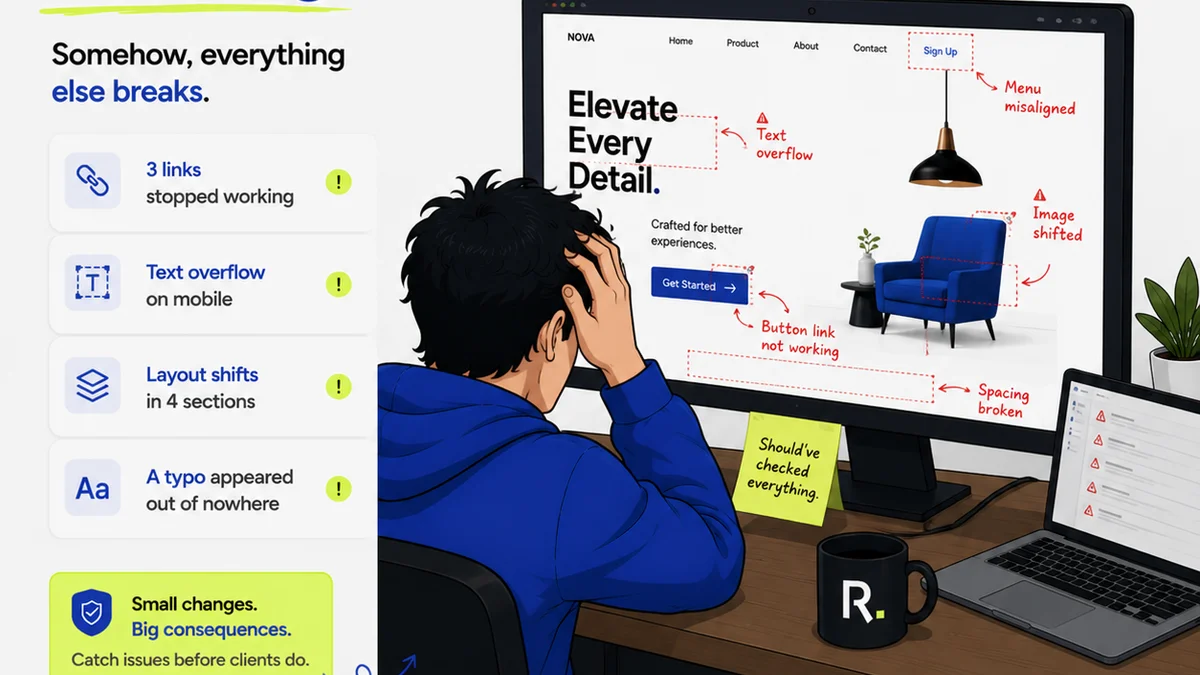
For web or app design, AI can help verify that designs meet technical requirements, such as correct spacing, alignment, and adherence to platform-specific design patterns.
5. Where Revue Fits In
While AI tools can revolutionize specific tasks, managing the entire creative workflow still requires a centralized system. This is where platforms like Revue become indispensable.
AI can generate options, but it can't manage the structured review and approval process. It can't ensure clear communication trails or provide a single source of truth for client feedback.
Revue bridges that gap. It provides the essential framework for:
- Centralized Client Feedback: Consolidating all comments, annotations, and approvals in one place, eliminating the chaos of scattered emails and messages.
- Revision Management: Clearly tracking each version of a design, understanding what changed, and seeing the history of revisions. This clarity prevents confusion and scope creep.
- Quality Assurance Workflows: Building structured checkpoints for internal reviews and client approvals, ensuring that work is vetted at critical stages.
AI tools can feed into this process, automating parts of asset creation or analysis, but Revue ensures that the human oversight, strategic decision-making, and clear client collaboration remain at the core of your agency's operations.
Final Thought
The question for growing agencies isn't *if* you should adopt AI, but *how* you can integrate it strategically to enhance your operational capacity and creative output. Are you viewing AI as a threat, or as the next evolution of your agency's toolkit?
Frequently asked questions
Can AI replace designers in an agency?
No, AI is not designed to replace human creativity and strategic thinking. Instead, it acts as a powerful assistant, automating repetitive tasks and accelerating parts of the design process, freeing up designers to focus on higher-level creative work and client strategy.
What are the biggest operational benefits of AI for agencies?
AI significantly boosts operational efficiency by automating tedious tasks like asset variation, image manipulation, and research. It also enhances client communication through summarization and proactive issue identification, and improves quality control with automated checks against brand guidelines and accessibility standards.
How does AI help with client feedback and revisions?
AI can analyze client feedback to identify patterns or potential misunderstandings, summarize lengthy communication threads, and flag action items. While AI doesn't manage the feedback process itself, it provides insights that make managing revisions more efficient and less prone to error.
How can platforms like Revue complement AI tools in an agency?
Platforms like Revue provide the essential structure for managing client feedback, revisions, and approvals. While AI can automate tasks within the workflow, Revue ensures a centralized, organized, and transparent process for human collaboration and decision-making, creating a complete operational solution.