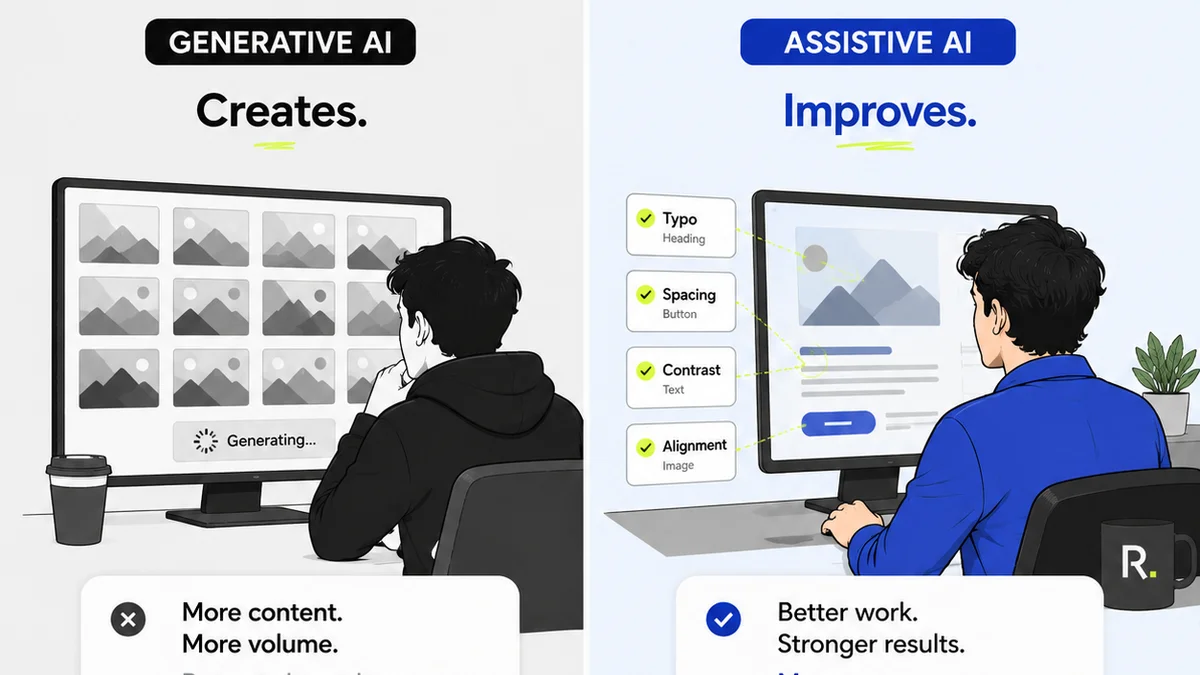
Everyone’s talking about AI in design. Generative tools creating images from text, AI assisting with tedious tasks, automating workflows. It sounds like a silver bullet, a shortcut to better, faster, cheaper creative output.
None of that is wrong. But it’s incomplete.
The hard truth for enterprise creative teams isn't about *if* AI will change your work, but *how* you integrate it to deliver real business value, not just novelty.
1. The Myth of the Autonomous AI Designer
The biggest misconception is that AI will replace designers. It won't. Not entirely. AI is a powerful assistant, an amplifier of human creativity, not a substitute for it.
Enterprise environments demand more than just pretty pictures. They require strategic thinking, brand consistency, understanding complex stakeholder needs, and navigating internal politics. AI can help with the *execution* of design, but it can't replicate the strategic foresight and nuanced judgment of a seasoned creative professional.
Focus on Augmentation, Not Automation
Think about AI as a highly skilled intern who can churn out drafts, variations, and handle repetitive tasks at warp speed. Your job as a designer or creative lead is to guide that intern, refine its output, and ensure it aligns with strategic goals.
This means:
- Upskilling your team to prompt effectively.
- Training them to critically evaluate AI-generated outputs.
- Integrating AI into existing workflows, not as a replacement for them.
- Understanding the limitations and potential biases of AI tools.
The real power lies in augmenting your team’s capabilities, freeing them up for higher-level conceptual work and client strategy.
2. Navigating the Enterprise AI Landscape
Enterprise creative teams operate under different pressures than freelancers or small studios. Scale, brand governance, compliance, and integration with existing systems are paramount. Simply plugging in a new AI tool without considering these factors is a recipe for chaos.
Security and Data Governance are Non-Negotiable
Your enterprise likely has strict policies around data security, intellectual property, and privacy. Many public AI tools operate on cloud infrastructure that might not meet these requirements.
Consider:
- Where is your data being stored?
- Who has access to it?
- What are the terms of service regarding the use of your prompts and generated assets?
- Are there on-premise or private cloud solutions available?
This is where many cutting-edge AI tools hit a wall in enterprise. You need solutions that can be deployed securely and comply with internal regulations.
Brand Consistency at Scale
Enterprise brands are built on consistency. AI tools can be fantastic for generating variations, but ensuring those variations adhere to strict brand guidelines is a challenge.
This requires:
- Developing AI prompts that explicitly reference brand elements.
- Utilizing AI tools that allow for custom model training or brand kit integration.
- Implementing robust review processes to catch deviations.
AI can help accelerate the creation of campaign assets, but human oversight is critical to maintain brand integrity across thousands of touchpoints.
3. Strategic Integration: Where AI Delivers Value
So, where *does* AI shine for enterprise design teams? It’s in areas where speed, variation, and data analysis can significantly impact efficiency and effectiveness.
Accelerating Ideation and Moodboarding
Instead of spending hours searching for inspiration or creating initial mood boards, AI can generate a range of visual concepts based on a brief. This dramatically speeds up the early stages of a project.
Use AI to:
- Explore diverse visual directions rapidly.
- Generate placeholder imagery for mockups.
- Create initial style frames for presentations.
This isn't about replacing the creative director's vision, but about providing a broader palette of possibilities to choose from.
Automating Repetitive Tasks
Think about tasks like resizing assets for different platforms, creating simple graphic elements, or generating background textures. AI can handle these with incredible speed and accuracy.
This frees up designers to focus on:
- Complex problem-solving.
- Strategic campaign development.
- Client relationship management.
- The core creative concept.
The goal is to offload the grunt work, not the creative heavy lifting.
Personalization and Variant Generation
For large-scale campaigns, AI can generate thousands of personalized ad variations based on user data and campaign objectives. This level of customization was previously impossible or prohibitively expensive.
Consider AI for:
- Dynamic ad creative optimization.
- Personalized email graphics.
- Tailored website banner variations.
This moves design from a static deliverable to a dynamic, data-informed component of marketing.
4. Building an AI-Ready Enterprise Workflow
Integrating AI isn't just about adopting new software; it's about evolving your processes and culture.
Start Small, Scale Smart
Don't try to overhaul everything at once. Identify specific pain points where AI can offer a clear benefit. Pilot a tool with a small team, gather feedback, and iterate.
A good starting point might be:
- AI-powered image generation for internal mockups.
- AI writing assistants for copy variations.
- AI tools for summarizing research or feedback.
Success here builds confidence and provides lessons for broader adoption.
Invest in Training and Education
Your team needs to understand how to use these tools effectively and ethically. This isn't just about clicking buttons; it's about understanding prompt engineering, critical evaluation, and the limitations of AI.
Provide resources for:
- Workshops on prompt writing.
- Sessions on AI ethics and bias.
- Best practices for integrating AI outputs into final designs.
Empower your team to become masters of these new tools, not just users.
Establish Clear Guidelines and Review Processes
As mentioned, brand consistency and quality control are vital. Define clear guidelines for when and how AI should be used. Implement mandatory review stages specifically for AI-generated or AI-assisted work.
This includes:
- Defining acceptable use cases for AI.
- Establishing a human review gate for all AI outputs before client delivery.
- Creating checklists for AI-assisted deliverables to ensure brand compliance.
AI should enhance quality, not compromise it.
Where Revue Fits In
All this talk of AI-generated assets and rapid iteration highlights a critical challenge: managing the sheer volume and complexity of creative feedback and approvals. When your team is leveraging AI for faster asset creation, the feedback loop needs to be equally efficient.
Revue provides the centralized hub needed to manage this evolving workflow. Instead of scattered email threads or siloed chat messages, you get a single source of truth for all creative assets and client feedback.
- Centralized Feedback: AI-generated concepts or variations can be shared instantly, with all stakeholder comments consolidated in one place. No more hunting for that one crucial piece of feedback lost in an inbox.
- Revision Visibility: Track every iteration, whether AI-assisted or human-driven. See exactly what changed, who approved it, and when. This transparency is crucial when managing complex projects with multiple AI-generated options.
- Quality Assurance: Use Revue's structured review and approval workflows to ensure that AI outputs meet brand standards and project requirements before they go live. It’s the human check against AI’s rapid output.
As AI accelerates the *creation* of design assets, tools like Revue become indispensable for managing the *process* and ensuring strategic alignment.
Final Thought
AI in design is not a futuristic fantasy; it's a present-day operational reality for enterprise teams. The question isn't whether to adopt it, but how to adopt it strategically. Are you viewing AI as a tool to augment your team's expertise and drive tangible business outcomes, or are you chasing the shiny object?
Frequently asked questions
Can AI replace human designers in enterprise settings?
No, AI is best viewed as an augmentation tool. While it can automate repetitive tasks and accelerate ideation, it cannot replace the strategic thinking, nuanced judgment, and brand stewardship that human designers provide, especially in complex enterprise environments.
What are the biggest security concerns when using AI for design in enterprise?
Key concerns include data privacy, intellectual property protection, and compliance with internal security policies. Many public AI tools may not meet enterprise-level security standards, necessitating careful evaluation of data storage, access, and terms of service, or the exploration of private/on-premise solutions.
How can enterprise teams maintain brand consistency with AI-generated designs?
Maintaining brand consistency requires careful prompt engineering, using AI tools that support custom model training or brand kit integration, and implementing rigorous human review processes to catch any deviations from brand guidelines. AI can generate variations, but human oversight is critical for brand integrity.
What are the first steps for an enterprise creative team looking to adopt AI?
Start by identifying specific pain points where AI can offer clear benefits, such as accelerating ideation or automating repetitive tasks. Pilot AI tools with a small team, gather feedback, invest in team training, and establish clear guidelines and review processes before scaling adoption.