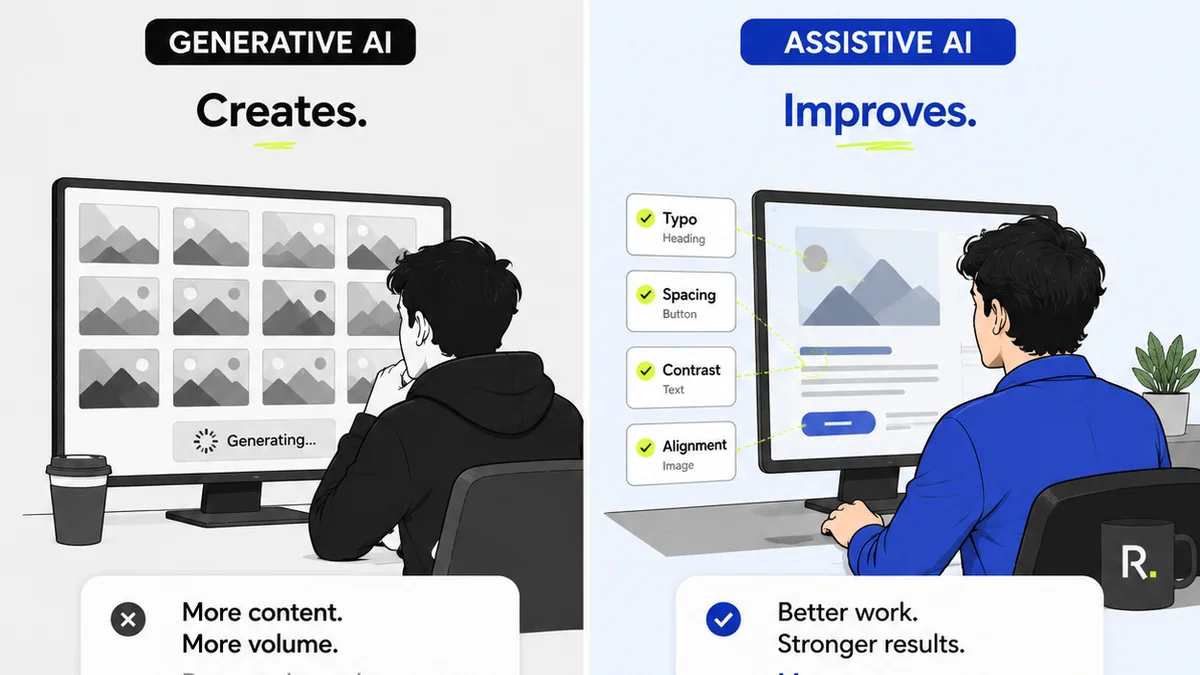
Will AI replace graphic designers? It’s the question on everyone’s mind, from junior designers to agency owners. You see AI generating images, logos, and layouts in seconds, and it’s easy to assume the human element is becoming obsolete.
None of that is wrong. But it’s incomplete.
The hard truth is that AI isn’t a replacement for graphic designers. It’s a tool, a powerful one, that’s fundamentally changing the design workflow and the skills required to succeed. The real question isn't *if* AI will replace designers, but *how* designers will adapt and leverage AI to do their best work.
1. AI as a Creative Co-Pilot, Not an Auto-Pilot
Think of AI image generators like Midjourney or DALL-E. They can produce stunning visuals from text prompts. This is fantastic for mood boards, concept exploration, or generating assets quickly. But they lack strategic intent.
AI doesn't understand your client's brand strategy. It doesn't grasp the nuances of user psychology or the precise emotional response you need to evoke. It can't conduct user research or interview stakeholders.
The Human Element Remains Critical
Graphic design is more than just making pretty pictures. It's problem-solving. It's communication. It involves:
- Understanding client briefs and business goals.
- Translating abstract concepts into visual language.
- Considering accessibility and user experience (UX).
- Iterating based on strategic feedback, not just aesthetic preference.
- Maintaining brand consistency across multiple touchpoints.
AI can assist with parts of this process, but it cannot replicate the strategic thinking, empathy, and judgment that a human designer brings.
2. Redefining the Design Process: Speed vs. Strategy
AI excels at speed. It can generate variations, fill templates, and perform repetitive tasks at a pace humans can’t match. This will undoubtedly streamline certain parts of the design process.
For instance, generating multiple banner ad sizes from a single design or creating a series of social media graphics could be significantly faster with AI assistance.
The Bottleneck Shifts
If AI handles the grunt work, where does the designer's value lie? It shifts from pure execution to higher-level strategy and oversight.
The bottleneck will no longer be the time it takes to create a draft. It will be the time it takes to:
- Define the problem accurately.
- Develop a strong creative brief.
- Critique AI-generated options strategically.
- Refine and polish AI outputs to meet exacting standards.
- Integrate designs into larger systems and campaigns.
Designers who embrace AI as a tool to accelerate the mundane will free up more time for the strategic, conceptual, and client-facing aspects of their work.
3. The Rise of the Prompt Engineer and AI Curator
The skills needed to work with AI are evolving. Simply knowing Photoshop or Illustrator won't be enough. Understanding how to effectively communicate with AI—prompt engineering—will become a valuable skill.
This involves learning how to craft precise, descriptive prompts to guide AI tools toward desired outcomes. It's an art and a science.
Beyond Generation: Curation and Refinement
Equally important is the ability to curate and refine AI outputs. Not everything AI generates is good, let alone suitable for a client.
Designers will need a keen eye to:
- Identify the best AI-generated options.
- Recognize and correct AI's inherent biases or stylistic quirks.
- Adapt AI outputs to fit brand guidelines and specific project requirements.
- Ensure technical quality and file preparation.
This role is less about starting from a blank canvas and more about skillfully directing and enhancing AI's capabilities.
4. AI's Limitations: The Uncanny Valley of Design
Despite rapid advancements, AI still struggles with certain fundamental aspects of design.
It can produce technically perfect layouts, but they might lack soul. It can mimic styles, but it doesn't truly understand context or cultural relevance.
Where AI Falls Short
- True Originality: AI models are trained on existing data. While they can combine elements in novel ways, genuine, groundbreaking originality is still a human domain.
- Emotional Intelligence: AI cannot empathize with a target audience or understand the subtle emotional cues that resonate deeply.
- Ethical Considerations: AI doesn't grapple with the ethical implications of design choices, such as representation or potential misuse.
- Brand Nuance: Capturing the subtle, often intangible essence of a brand identity is beyond current AI capabilities.
These are areas where human designers will continue to provide indispensable value.
5. The Future: Hybrid Workflows and Evolving Roles
The future of graphic design isn't human vs. AI. It's human *with* AI.
Expect hybrid workflows to become the norm. Designers will use AI for ideation, asset generation, and repetitive tasks, while focusing their human expertise on strategy, complex problem-solving, client relations, and final polish.
Adaptation is Key
Agencies and design teams that embrace this shift will thrive. Those that resist will likely fall behind.
This means investing in training for your team, exploring new AI tools, and rethinking your internal processes.
The role of the graphic designer is evolving, not disappearing. It’s becoming more strategic, more collaborative, and perhaps, more interesting.
Where Revue Fits In
Managing client feedback and revisions is crucial, especially when incorporating new tools and workflows. AI can generate options, but getting clear, actionable feedback from clients and stakeholders is still a human-centric process.
This is where Revue becomes indispensable.
Revue provides a centralized platform for all your creative feedback. Instead of scattered email threads or confusing annotation tools, you get a single source of truth.
With Revue, you can:
- Streamline the feedback process: Ensure all comments are captured in one place.
- Improve revision clarity: Track changes and understand the evolution of a design.
- Gain approval visibility: Know exactly when a design is approved, reducing ambiguity.
- Maintain quality control: Ensure that feedback is addressed systematically before final delivery.
As AI accelerates design creation, the need for efficient, clear, and organized project management becomes even more critical. Revue ensures that the human element—the strategic direction, the client communication, and the final quality assurance—remains robust and manageable.
Final Thought
AI is a powerful amplifier. It can amplify human creativity, human strategy, and human efficiency. But it needs human direction. The designers and agencies who master this partnership will define the next era of visual communication.
Frequently asked questions
Can AI create original graphic designs?
AI can generate novel combinations of existing elements and styles, but true originality and groundbreaking concepts are still primarily human capabilities. AI models learn from vast datasets, meaning their outputs are derivative to some extent.
What skills will graphic designers need in the age of AI?
Designers will need strong strategic thinking, problem-solving abilities, client communication skills, and the capacity to curate and refine AI outputs. Prompt engineering—effectively communicating with AI tools—will also become a valuable skill.
How can agencies leverage AI in their design process?
Agencies can use AI for tasks like rapid ideation, generating design variations, creating initial drafts, and automating repetitive tasks. This frees up designers to focus on strategy, client relationships, and complex creative problem-solving.
Will AI make graphic design jobs obsolete?
It's unlikely AI will make graphic design jobs obsolete. Instead, AI is transforming the role, shifting the focus from manual execution to higher-level strategic and creative direction. Designers who adapt and integrate AI tools will remain in demand.