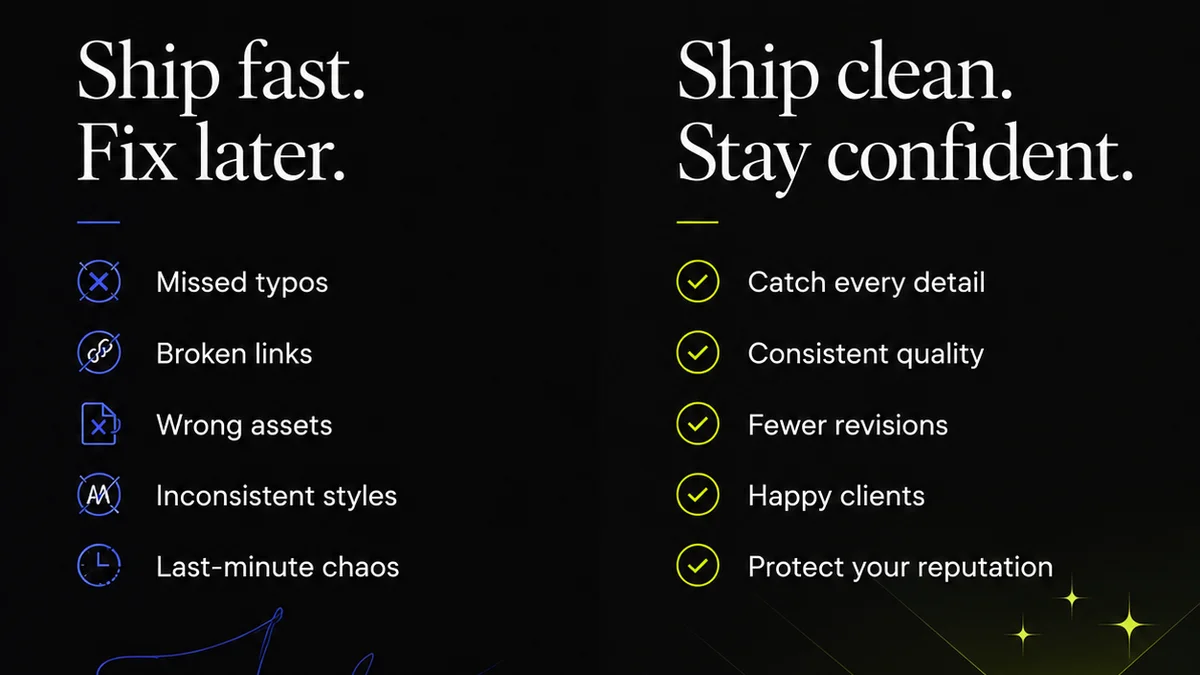
Everyone’s talking about AI in quality assurance. They paint a picture of automated perfection, where algorithms catch every bug, every typo, every misplaced pixel. It sounds like the holy grail for agencies drowning in revisions and client feedback.
None of that is wrong. But it’s incomplete.
The hard truth about AI in QA is that it’s not about replacing the human eye. It’s about supercharging it. It’s about freeing up your best creative minds from the drudgery of repetitive checks so they can focus on what truly matters: strategic oversight and creative excellence.
1. The Illusion of Full Automation
The common assumption is that AI will eventually handle 100% of QA. This is a fantasy. AI excels at pattern recognition and spotting deviations from established norms. It can be trained to detect specific types of errors with incredible speed and accuracy.
But creativity is inherently subjective. Nuance, brand voice, cultural relevance, and subtle aesthetic judgments are still firmly in the human domain.
What AI Does Well
- Detecting broken links and images.
- Identifying spelling and grammatical errors based on defined rules.
- Spotting inconsistencies in UI elements across different pages.
- Verifying that basic functional requirements are met.
- Flagging accessibility issues based on WCAG guidelines.
These are tasks that are time-consuming and prone to human error when done manually, especially at scale.
Where AI Falls Short
- Understanding the strategic intent behind a design.
- Evaluating the emotional impact or brand resonance.
- Judging the subjective “feel” of a user experience.
- Detecting errors that are context-dependent or require deep domain knowledge.
- Assessing the overall creative impact and originality.
Trying to automate everything is a fool’s errand. It leads to over-reliance on flawed systems and missed critical errors that only a human can spot.
2. Augmentation, Not Replacement
The real power of AI in QA lies in its ability to *augment* human capabilities. Think of it as a highly intelligent assistant, not a fully autonomous inspector.
AI can perform the initial, high-volume, rule-based checks. It can sift through mountains of data and flag potential issues, presenting them to a human reviewer.
This drastically reduces the time spent on the mundane, allowing your QA team or project managers to focus their attention on the more complex, subjective, and strategically important aspects of the work.
The New QA Workflow
- AI Pre-Scan: An AI tool runs an initial sweep, checking for common, quantifiable errors.
- Human Triage: The AI flags potential issues. A human reviewer quickly assesses these flags, dismissing false positives and prioritizing real problems.
- Deep Dive Review: The human reviewer then focuses on the subjective elements: brand alignment, creative impact, user experience nuances, and strategic fit.
- Final Approval: The human sign-off remains the ultimate gatekeeper.
This hybrid approach is faster, more thorough, and more cost-effective than relying solely on either humans or AI.
3. The Data Advantage
AI thrives on data. The more data it has, the smarter it gets. In the context of QA, this means AI can learn from past projects, feedback cycles, and common error patterns within your agency.
Imagine an AI that learns the specific stylistic preferences of your key clients. Or one that flags recurring issues specific to the CMS your developers use.
Leveraging AI for Smarter Feedback
- Trend Analysis: AI can identify patterns in client feedback across multiple projects, highlighting areas where communication or execution might be consistently misunderstood.
- Predictive Quality: By analyzing historical data, AI can potentially predict which types of projects or deliverables are more prone to specific issues, allowing for proactive measures.
- Feedback Categorization: AI can help sort and categorize incoming feedback, making it easier to identify critical issues versus minor tweaks.
This data-driven insight can refine your internal processes and even improve client communication strategies.
4. Beyond Bug Hunting: Strategic Insights
When AI handles the low-level checks, your human reviewers are freed up to provide higher-level strategic feedback. This is where the real value lies for a creative agency.
Instead of just checking if a button is the right color, your team can assess if that button is effectively guiding the user towards the desired action, aligning with the overall campaign goals.
Shifting Focus
- From pixel-pushing to strategic alignment.
- From grammatical correctness to brand voice consistency.
- From functional validation to user journey optimization.
- From error identification to creative impact assessment.
This elevates the role of QA from a gatekeeper of errors to a guardian of quality and strategic integrity.
Where Revue Fits In
AI tools can streamline the initial detection of issues, but managing the subsequent workflow – the communication, the revisions, the approvals – is where operational excellence truly shines.
Revue is built for this. It centralizes all client feedback, regardless of its source. AI might flag a typo, but Revue ensures that feedback from the client, the account manager, and the creative director all land in one place, clearly linked to the specific asset.
Our platform provides clear visibility into the revision history. You can see exactly what changed, who approved it, and when. This transparency is crucial, especially when AI is part of the initial review process.
Revue helps manage the human element of QA. It ensures that the insights generated by AI, and the critical judgments made by your team, are acted upon efficiently and are fully documented. It’s the bridge between automated detection and human-led creative quality control.
5. Implementing AI in Your QA Workflow
Adopting AI for QA doesn’t require a complete overhaul. Start small and iterate.
Practical Steps
- Identify Repetitive Tasks: What are the most time-consuming, rule-based checks your team performs?
- Research AI Tools: Explore tools that specialize in those specific tasks – grammar checkers, accessibility scanners, visual regression testing tools.
- Pilot Project: Implement an AI tool on a single project or for a specific type of deliverable.
- Train Your Team: Ensure your team understands how to use the AI tool and, more importantly, how to interpret its output and integrate it into their workflow.
- Measure and Refine: Track the time saved, the errors caught, and the overall impact. Adjust your process based on the results.
Don’t expect AI to be a magic bullet. It’s a tool. Like any tool, its effectiveness depends on how well it’s wielded.
Final Thought
The future of quality assurance in creative agencies isn't about handing over control to machines. It’s about a smarter, more strategic partnership between human expertise and artificial intelligence. Are you ready to leverage AI not just to catch errors faster, but to elevate the strategic quality of your creative work?
Frequently asked questions
Can AI fully automate creative quality assurance?
No. AI excels at rule-based, repetitive checks but cannot replicate human judgment for subjective elements like brand voice, creative impact, or strategic alignment. The most effective approach is a hybrid model where AI augments human reviewers.
What are the main benefits of using AI in QA for agencies?
AI can significantly speed up repetitive checks, reduce human error on mundane tasks, identify patterns in errors, and free up human reviewers to focus on higher-level strategic and creative quality assessments.
How can agencies start implementing AI in their QA process?
Begin by identifying the most time-consuming, rule-based tasks in your current QA workflow. Research AI tools that address these specific needs, pilot them on a small scale, train your team, and measure the impact before wider adoption.
Does AI in QA mean less work for human QA professionals?
Not necessarily. It shifts the focus from manual, repetitive tasks to more complex, strategic review. Human QA professionals become crucial for interpreting AI findings, making subjective judgments, and ensuring overall creative and strategic integrity.