Everyone’s talking about AI in creative. They’re focused on AI generating images, writing copy, or automating tedious tasks. And that’s all true. But it’s only part of the story.
The real revolution AI is bringing isn’t about *making* creative work. It’s about *measuring* it.
The Hard Truth About Creative Metrics
For decades, we've relied on a janky toolkit for measuring creative success. We’ve used:
- Client satisfaction surveys (often filled out by the person who approved the work, not the end-user).
- Post-campaign performance data (which can be influenced by a thousand factors besides the creative itself).
- Internal team gut feelings (valuable, but subjective and hard to scale).
- Simple approval rates (a binary yes/no that tells you nothing about *why*).
None of that is wrong. But it’s incomplete. Wildly incomplete.
We’ve been measuring the *symptoms* of good or bad creative, not the *causes*. We’ve been guessing at what makes creative resonate, hoping for the best.
AI changes that. It gives us the power to dissect creative performance at a granular level we’ve never had before.
1. Beyond Likes and Shares: Deep Engagement Analysis
The Vanity Trap
We’ve all been guilty of chasing vanity metrics. A million impressions? Great. 10,000 likes? Fantastic. But what does it actually *mean* for the client’s business goals?
This is where AI starts to pull back the curtain.
AI-Powered Sentiment and Emotion Tracking
AI can analyze user comments, social media chatter, and even video feedback at scale. It can identify sentiment (positive, negative, neutral) and, more importantly, specific emotions (joy, frustration, surprise, confusion) associated with creative assets.
Imagine understanding that your ad campaign didn't just get clicks, it genuinely *delighted* a specific demographic, or conversely, that a piece of web copy is causing significant user frustration.
Behavioral Pattern Recognition
AI can correlate creative elements with actual user behavior. Does a specific visual style lead to longer dwell times on a webpage? Does a particular call-to-action phrasing correlate with higher conversion rates, even when controlling for other variables?
This moves us from asking “Did people see it?” to “Did it *make people do* what we wanted, and *why*?”
2. Deconstructing Creative Elements with Precision
The Black Box of Design
Historically, understanding *why* a design worked (or didn’t) was an art form. Creative directors developed an intuition, but articulating it precisely was tough.
AI tools can now analyze visual and textual components with incredible detail.
Automated A/B Testing on Steroids
Forget testing two headlines. AI can test dozens of variations of images, color palettes, typography, and copy blocks simultaneously across different audience segments. It can identify not just which variation performed best, but *which specific element* drove that performance.
Predictive Performance Modeling
Based on past data, AI can predict how a new creative asset is likely to perform *before* it even launches. It can flag potential issues: a color combination that historically underperforms with a target audience, or copy that is too complex and likely to cause drop-off.
Audience Segmentation Accuracy
AI excels at identifying micro-segments within broader audiences. It can reveal that a creative asset resonates strongly with one niche group but completely misses another, allowing for hyper-targeted iterations.
3. The New Workflow: From Subjective to Data-Informed
The Old Way: Gut Feel and Guesswork
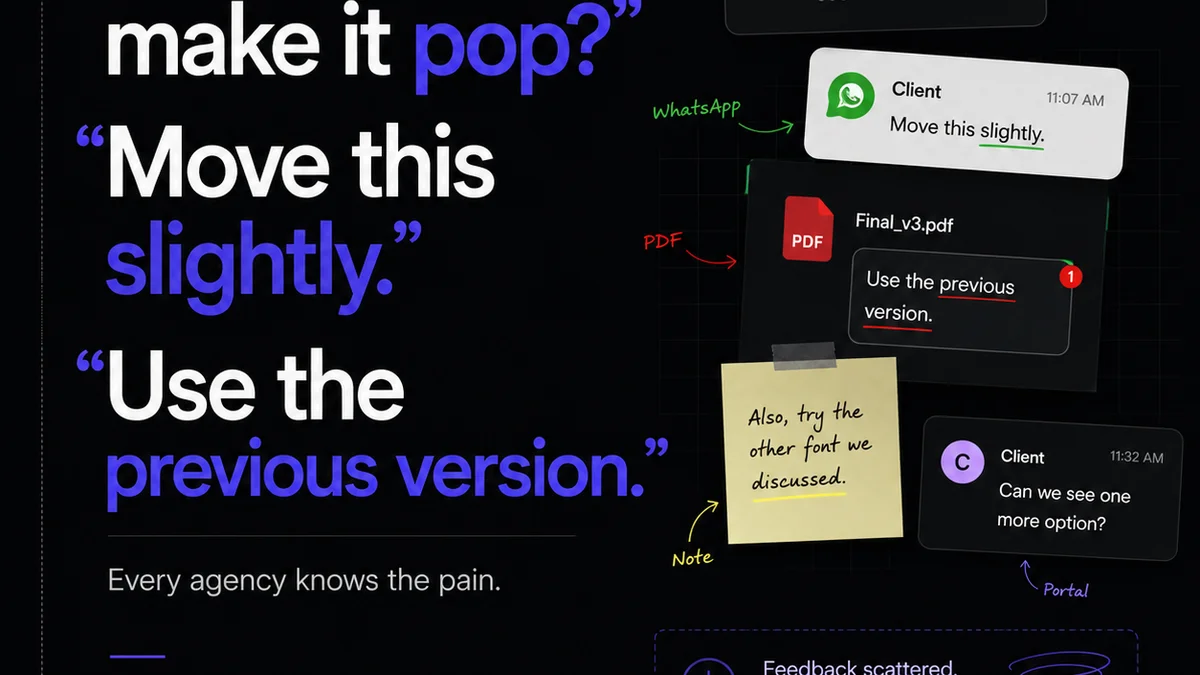
Creative briefs, client feedback rounds, internal reviews – they’re all heavily reliant on subjective interpretation. “Make it pop more.” “I don’t like that blue.” “Can we make it feel more premium?”
These aren't bad inputs, but they lack objective grounding.
AI as an Objective Co-Pilot
AI doesn't replace the creative director's vision. It augments it. It provides objective data points to inform subjective decisions.
Imagine a client saying, “I don’t like this headline.” Instead of debating personal preference, you can say, “Our AI analysis shows this headline has a 30% higher predicted engagement rate with your target demographic than the alternative. Let’s look at *why* it might be connecting better before we change it.”
Quantifying Qualitative Feedback
AI can help quantify qualitative feedback. If multiple stakeholders say a design feels “too busy,” AI can analyze layout density, element count, and visual hierarchy to identify objective reasons why that perception might be occurring.
Iterative Improvement Loops
AI enables much faster, more data-driven iteration cycles. Instead of weeks of guesswork, you can get AI-driven insights within hours or days, allowing you to refine creative much more efficiently.
Where Revue Fits In
This shift towards data-informed creative isn't just about fancy AI tools. It’s about having a robust system to capture, manage, and analyze the feedback and performance data.
Revue provides that essential layer.
- Centralized Feedback: Collect all client and stakeholder feedback in one place, tagged and organized. This creates a clean dataset for AI analysis, rather than scattered email threads and Slack messages.
- Revision Visibility: Track every version and every comment. AI can analyze which revisions led to positive or negative performance shifts, or correlate specific feedback with final outcomes.
- Approval Workflow Clarity: Understand not just *what* was approved, but the context and rationale behind it. This data, when combined with AI insights, builds a richer picture of creative effectiveness.
- Quality Assurance: Use AI to flag potential issues, and use Revue to ensure that the final approved asset meets all technical and brand guidelines, informed by performance data.
By centralizing your creative workflow, you’re not just streamlining processes; you’re building the foundation for smarter, AI-driven creative measurement.
Final Thought
The rise of AI in creative metrics isn't about removing human judgment. It's about empowering it with unprecedented clarity. Are we ready to move beyond the guesswork and embrace a more objective, data-driven future for creative evaluation?
Frequently asked questions
How does AI change traditional creative metrics?
AI moves beyond surface-level metrics like likes and shares. It enables deep analysis of user sentiment, emotion, and behavior, correlating specific creative elements with actual business outcomes and providing predictive performance insights.
Can AI replace a creative director's intuition?
No, AI augments intuition. It provides objective data to inform subjective creative decisions, highlighting *why* certain elements might work or fail, rather than dictating creative direction.
What are the practical benefits of AI in creative measurement for agencies?
Agencies can achieve more efficient iterations, better justify creative choices with data, identify micro-audience preferences, and ultimately deliver more effective creative work that aligns with client business goals.
How can a platform like Revue support AI-driven creative metrics?
Revue centralizes feedback, tracks revisions, and clarifies approval workflows. This creates a clean, organized dataset essential for AI analysis, turning scattered communication into actionable performance intelligence.