Everyone’s talking about AI for design agencies. You see the headlines: “AI will automate everything!” “Your job is obsolete!”
None of that is wrong. But it’s incomplete.
The real story isn’t about AI replacing creatives. It’s about AI amplifying the *effective* ones. The agencies that win with AI won’t be the ones with the most AI subscriptions. They’ll be the ones who understand how to integrate AI into their existing workflows to solve real problems.
That’s the hard truth.
AI isn’t a silver bullet. It’s a scalpel. You need to know exactly where to cut.
1. AI for Ideation & Concepting
The blank page is the enemy. AI can help you fill it, but not in the way you might think. It’s not about asking AI to “design a logo.” It’s about using it to break through creative blocks and explore avenues you might not have considered.
Mood Boarding on Steroids
Tools that can generate visual concepts based on text prompts can be invaluable for early-stage ideation. Think of it as a supercharged mood board generator.
- Feed it keywords: “cyberpunk, dystopian city, neon lights, rain.”
- See dozens of visual interpretations in seconds.
- Use these as springboards, not final assets.
This isn’t about AI creating the final concept. It’s about AI showing you ten directions you hadn't thought of, in the time it takes you to sketch one.
Unlocking New Styles
Stuck in a rut? AI can help you explore entirely new aesthetic territories. Generate variations on a theme, blend styles, or visualize abstract concepts.
It’s a way to rapidly prototype visual ideas before committing human hours.
The Pitfall: Over-reliance
The danger here is asking AI to do the *thinking* for you. If you’re just taking AI-generated concepts and running with them, you’re missing the point. The real value is in the *inspiration* and *exploration* it enables.
2. AI for Content Generation
This is where AI is making the biggest splash, and also where agencies need to be most discerning.
Copywriting Assistance
AI writing tools can draft social media posts, ad copy, website content, and even initial blog outlines. They’re fantastic for overcoming writer’s block and generating volume.
- Drafting initial website copy for a new client.
- Brainstorming headlines for an ad campaign.
- Summarizing long reports for internal briefs.
But AI copy isn’t ready for prime time out of the box. It lacks nuance, brand voice, and strategic insight. It needs human editing. Always.
Image Generation & Manipulation
Tools like Midjourney, DALL-E, and Stable Diffusion are revolutionizing asset creation. Need a specific, impossible-to-find stock photo? AI can create it.
- Generate unique background textures.
- Create placeholder imagery for mockups.
- Explore stylistic variations of existing graphics.
The key is understanding their limitations. AI-generated images can sometimes have tell-tale artifacts or lack a consistent style. They’re best used for supplementary assets or where unique, stylized visuals are the goal.
Video & Audio Tools
AI is also making inroads into video and audio. Tools can generate voiceovers, create simple animations from static images, or even edit footage based on transcripts.
This is still an emerging area, but expect rapid advancements in AI-powered video editing and asset creation.
The Pitfall: Generic Output
The biggest risk is churning out bland, uninspired content. AI is trained on existing data. If you don’t guide it with specific, creative prompts and then refine its output, you’ll end up with generic work that sounds and looks like everyone else’s.
3. AI for Workflow Optimization
This is arguably the most impactful area for agencies, yet often the least discussed. AI can streamline tedious, time-consuming tasks, freeing up your team for higher-value work.
Automated Reporting
Imagine AI tools that can pull data from your ad platforms, analyze campaign performance, and generate insightful reports automatically. This saves hours of manual data crunching.
Smart Scheduling & Project Management
AI can help optimize team schedules, predict project timelines, and even identify potential bottlenecks before they occur. Tools are emerging that can analyze task dependencies and resource allocation.
Client Communication Summaries
Feeding client meeting transcripts into AI can generate concise summaries, action items, and key decisions. This ensures everyone is aligned and reduces the risk of miscommunication.
Intelligent Asset Tagging & Organization
For agencies with large asset libraries, AI can automate the tagging and organization of files, making them easily searchable and reusable.
The Pitfall: Ignoring the Human Element
AI can optimize processes, but it can’t replace human judgment or client relationships. Don’t implement AI tools in a vacuum. Ensure they integrate seamlessly and enhance, rather than hinder, human collaboration.
4. AI for Market Research & Analysis
Understanding your client’s market is crucial. AI can accelerate this process significantly.
Trend Spotting
AI can analyze vast amounts of online data to identify emerging trends, consumer sentiment, and competitive landscapes far faster than manual research.
Audience Segmentation
AI can help identify nuanced audience segments based on behavior, demographics, and interests, allowing for more targeted campaign strategies.
Competitive Analysis
Tools can monitor competitor activities, analyze their messaging, and identify strategic opportunities or threats.
The Pitfall: Data Overload
AI can present you with an overwhelming amount of data. The challenge is to extract actionable insights. You still need strategic minds to interpret the data and translate it into effective client strategies.
5. AI for Quality Assurance
Ensuring every deliverable meets high standards is paramount. AI can act as an extra set of eyes.
Automated Proofreading & Grammar Checks
Beyond basic spellcheck, AI can identify stylistic inconsistencies, tone issues, and complex grammatical errors in copy.
Visual Consistency Checks
AI tools can be trained to identify deviations from brand guidelines in visual assets, flagging inconsistencies in color, typography, or spacing.
Accessibility Audits
AI can help scan websites and digital assets for accessibility issues, ensuring compliance with standards like WCAG.
The Pitfall: False Positives & Negatives
AI isn’t infallible. It can flag things that are perfectly fine or miss genuine errors. Human oversight is still essential to validate AI’s findings.
Where Revue Fits In
AI tools are powerful for creation and analysis, but managing the *process* of creative work remains critical. This is where a platform like Revue becomes indispensable.
AI can generate concepts, but how do you collect and organize feedback on those concepts from your team and client? Revue.
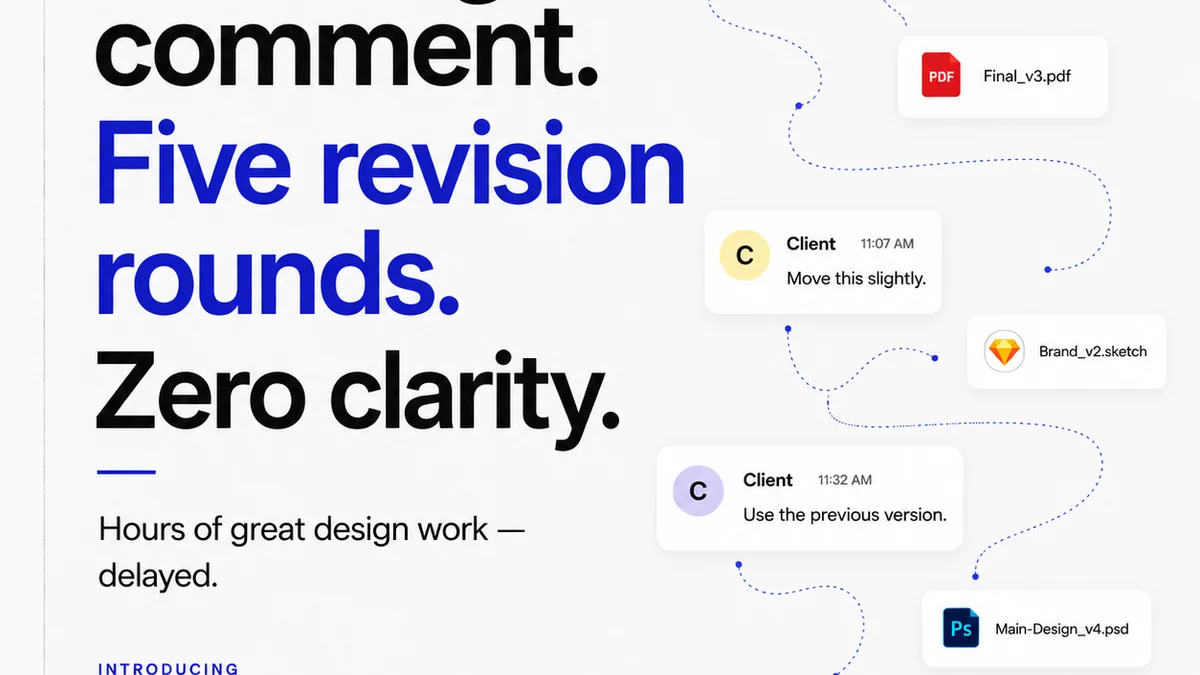
AI can draft copy, but how do you manage the revision rounds and get final client approval? Revue.
AI can create assets, but how do you ensure quality control and track every iteration? Revue.
Revue centralizes client feedback, streamlines revision and approval workflows, and provides a clear audit trail. It’s the human layer that ensures AI-generated outputs are managed effectively, iterated upon intelligently, and approved with confidence.
Final Thought
The agencies that thrive in 2026 won’t be those that simply adopt AI. They’ll be the ones that strategically integrate AI into their human-led processes, using it to augment creativity, efficiency, and insight. The question isn't whether you're using AI. It's how effectively you're using it to solve problems your clients actually care about.
Frequently asked questions
Can AI truly replace human creativity in design agencies?
No, AI is best viewed as an augmentation tool. It can accelerate ideation, automate repetitive tasks, and generate variations, but it lacks the strategic insight, emotional intelligence, and nuanced understanding that human designers bring to client projects.
What are the biggest risks of using AI in a design agency?
The main risks include over-reliance leading to generic or uninspired output, potential for AI errors or biases, data privacy concerns, and the challenge of integrating AI tools without disrupting existing, effective human workflows. Maintaining quality and brand voice requires careful human oversight.
How can AI improve efficiency for design agencies?
AI can significantly improve efficiency by automating tasks like initial copy drafting, image generation for mockups, market research data analysis, report generation, and even basic quality assurance checks. This frees up human team members for more strategic and creative work.
Which types of AI tools are most valuable for agencies right now?
Currently, AI tools for content generation (copywriting, image creation), ideation assistance, workflow automation (reporting, scheduling), and market analysis offer the most practical value. Emerging AI in video and advanced QA is also showing promise.
How does a platform like Revue complement AI tools for agencies?
Revue acts as the central hub for managing the creative process that AI tools initiate. While AI generates content or ideas, Revue provides the framework for collecting feedback, managing revisions, tracking approvals, and ensuring quality control, bridging the gap between AI output and client delivery.