Everyone’s talking about AI transforming client feedback. It’s the next big thing, the future of creative operations, the end of miscommunication.
None of that is wrong. But it’s incomplete.
The real story isn’t about flashy new tools replacing human judgment. It’s about AI quietly, systematically solving the operational headaches that have plagued agencies for decades. The messy, time-consuming, error-prone parts of managing feedback.
That’s the hard truth. AI isn’t just about smarter insights; it’s about leaner, more predictable workflows. It’s about reducing friction, not just adding features.
1. Taming the Feedback Deluge
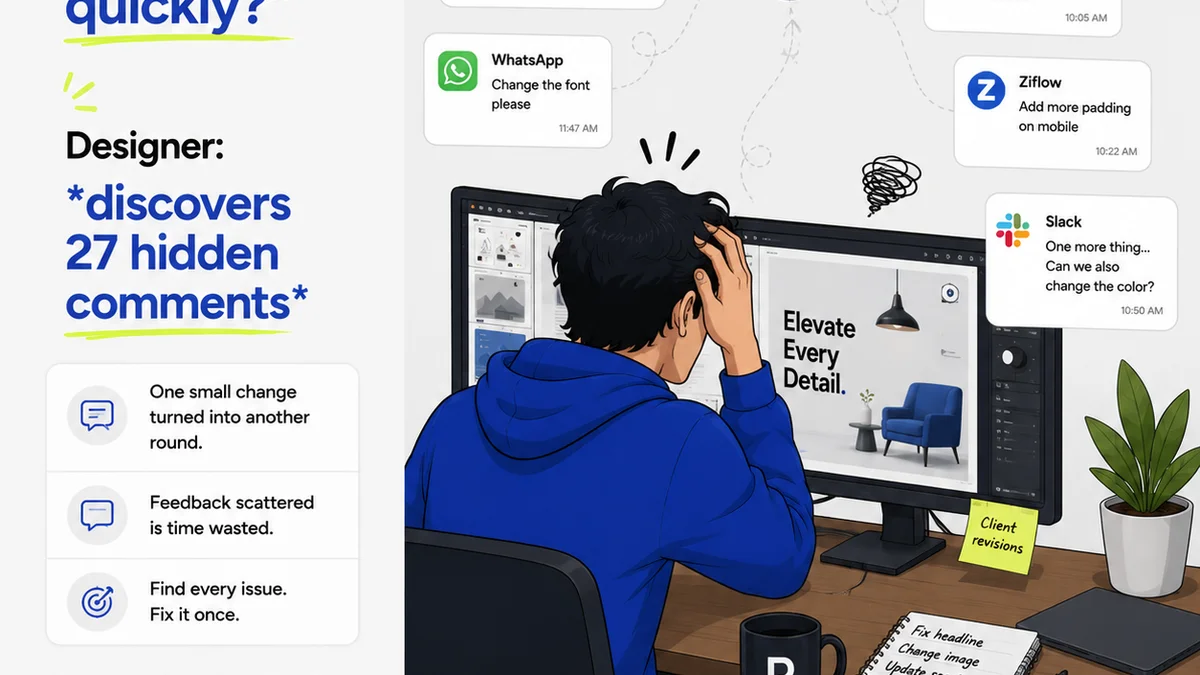
Client feedback is rarely a neatly packaged document. It’s emails, Slack messages, annotated PDFs, scribbled notes from a call, even verbal instructions that get lost in translation. This chaos is the enemy of efficiency.
AI offers a path out. Think intelligent aggregation and categorization.
Automated Triage and Tagging
Imagine an AI that can read an incoming email, identify it as client feedback, and automatically tag it by project, revision stage, or even sentiment.
This isn't science fiction. Natural Language Processing (NLP) is already capable of understanding context and intent.
- Identifying actionable comments versus general remarks.
- Flagging urgent requests or potential scope creep.
- Routing feedback to the correct team member or department automatically.
This drastically reduces the manual effort of sorting and distributing feedback. It means designers and developers see what they need, when they need it, without wading through irrelevant noise.
Sentiment Analysis for Nuance
“I’m not sure about this” can mean a hundred different things. AI can help decipher the underlying sentiment. Is the client hesitant, confused, or subtly dissatisfied?
Understanding this nuance early prevents misunderstandings down the line. It allows project managers to proactively address concerns before they escalate.
2. Extracting Actionable Insights from Raw Data
Clients often provide feedback that is vague, contradictory, or simply doesn’t align with the project goals. Sifting through this to find the actual work required is a major bottleneck.
AI’s strength lies in pattern recognition and data synthesis.
Summarization and Action Item Generation
Long feedback threads or lengthy meeting transcripts can be summarized by AI, highlighting the key decisions and required actions.
This frees up project managers from tedious note-taking and transcription. It ensures that critical action items aren’t missed.
Identifying Inconsistencies
Clients might approve one element on Monday and request a change to a similar element on Tuesday without realizing the contradiction. AI can flag these inconsistencies across different feedback points.
This proactive identification saves rework and prevents the client from having to backtrack, preserving project momentum and client satisfaction.
3. Enhancing Quality Assurance and Consistency
Ensuring that creative output meets client expectations and brand standards is paramount. Manual QA processes are prone to human error and can be time-consuming.
AI can augment QA by looking for patterns and deviations that might escape the human eye.
Automated Visual Inspection
For digital assets, AI can perform checks for common issues like broken links, incorrect image resolutions, or adherence to basic layout grids.
While not a replacement for human design review, it acts as a powerful first pass, catching the low-hanging fruit.
Compliance and Brand Guideline Checks
AI can be trained to recognize deviations from brand guidelines, such as incorrect logo usage, off-brand color palettes, or inconsistent typography.
This is particularly valuable for large organizations or projects with strict brand governance. It ensures consistency across all deliverables.
4. Streamlining Revision Cycles
Revision cycles are a necessary part of creative work, but they can easily spiral out of control. Unclear feedback, endless iterations, and difficulty tracking changes all contribute to project delays and budget overruns.
AI can bring much-needed order to this process.
Predictive Revision Time
By analyzing past projects and the nature of the feedback received, AI can help estimate the time and resources required for specific revision tasks.
This allows for more accurate project planning and expectation setting with clients. It moves from guesswork to data-driven forecasting.
Automated Version Control and Comparison
While version control is a standard practice, AI can enhance it by intelligently comparing revisions, highlighting not just what changed, but the *impact* of those changes.
This makes it easier for stakeholders to review specific updates and approve them efficiently. It reduces the cognitive load of comparing multiple design iterations.
Where Revue Fits In
The operational challenges of managing client feedback are precisely what Revue was built to solve. While AI provides powerful new capabilities, a centralized platform is essential to harness them effectively.
Revue acts as the central nervous system for client feedback and creative approvals. It brings structure to the chaos, allowing AI tools to work within a defined, manageable workflow.
- Centralized Feedback Hub: All client comments, from any source, land in one place. This eliminates scattered communication and provides a single source of truth.
- Contextualized Revisions: Feedback is tied directly to specific assets and versions. This clarity is crucial for AI to accurately interpret and process requests.
- Clear Approval Workflows: Revue visualizes the entire approval process, making it transparent for both the agency and the client. This visibility complements AI's ability to track progress and identify bottlenecks.
- Integrated Quality Checks: By providing a structured environment for feedback and revisions, Revue lays the groundwork for AI-powered QA tools to be implemented effectively.
Think of it this way: AI can analyze the ingredients and suggest recipes, but you still need an organized kitchen – Revue – to actually cook the meal.
5. Ethical Considerations and the Human Element
As AI becomes more integrated, it’s crucial to address the ethical implications and preserve the human touch that defines great creative work.
Bias in AI
AI models are trained on data, and if that data contains biases, the AI will perpetuate them. This could manifest in how feedback is interpreted or how suggestions are made. Agencies must be vigilant about the AI tools they adopt and understand their limitations.
Over-reliance and Deskilling
There's a risk of becoming overly reliant on AI, potentially leading to a decline in critical thinking and problem-solving skills within teams. AI should augment, not replace, human expertise.
Maintaining Client Relationships
The personal relationship between an agency and its clients is built on trust and understanding. While AI can streamline communication, it should never come at the expense of empathy and genuine connection. The goal is to free up human time for more meaningful client interaction, not to automate it away.
Final Thought
AI isn't a magic wand that will instantly eliminate all client feedback problems. It's a powerful set of tools that, when implemented thoughtfully within a structured workflow, can significantly improve efficiency, reduce errors, and ultimately lead to better creative outcomes.
The question agencies must ask themselves isn't *if* they should adopt AI for feedback management, but *how* they can integrate it intelligently to enhance their existing processes and empower their teams.
Frequently asked questions
Can AI replace human project managers in handling client feedback?
No, AI is designed to augment human capabilities, not replace them. It excels at automating repetitive tasks, analyzing data, and identifying patterns. Human project managers are still essential for strategic decision-making, building client relationships, and applying nuanced judgment that AI cannot replicate.
How does AI help in dealing with vague or contradictory client feedback?
AI uses Natural Language Processing (NLP) to analyze text and identify sentiment, key themes, and potential inconsistencies. It can flag contradictions, summarize lengthy feedback, and categorize comments, making it easier for humans to understand and act upon even unclear client input.
What are the main benefits of using AI for creative QA?
AI can automate visual checks for common issues like broken links or incorrect formatting, and perform compliance checks against brand guidelines. This speeds up the QA process, catches errors humans might miss, and ensures greater consistency across deliverables.
How can agencies ensure AI tools are used ethically in feedback management?
Agencies should be aware of potential biases in AI algorithms, ensure transparency with clients about AI usage, and prioritize maintaining the human element in client relationships. It's crucial to use AI to enhance, not replace, human judgment and empathy.