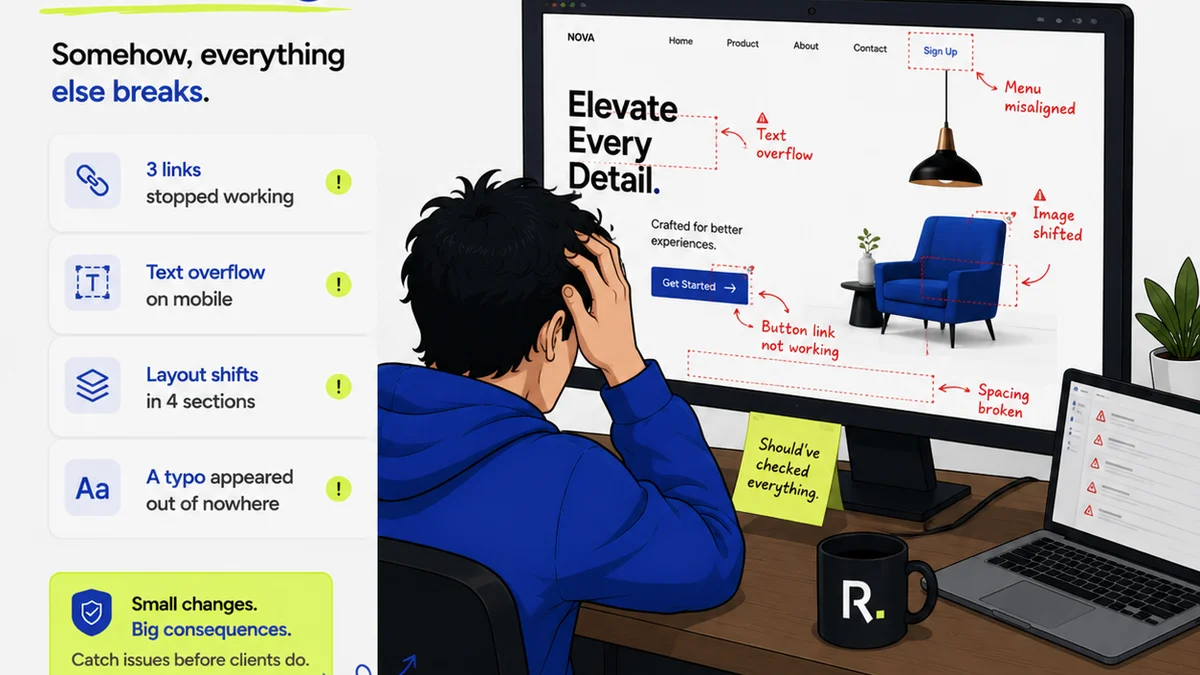
Everyone talks about AI transforming digital workflows. Design, development, marketing – it’s all getting the AI treatment. But what about print? Many assume print QA is a fundamentally analog process, immune to automation. That’s a mistake. A costly one.
The hard truth is that print quality assurance (QA) is ripe for disruption. Manual checks, while necessary, are slow, error-prone, and don't scale. AI offers a way to augment, not replace, human eyes, catching more issues faster and freeing up your team for higher-value tasks.
1. The Limits of Human Vision in Print QA
Think about a typical print QA process. A designer, a production manager, or a dedicated QA specialist meticulously compares a digital proof against a physical one. They’re looking for:
- Color shifts (CMYK vs. RGB, Pantone accuracy)
- Misaligned elements
- Incorrect typography (kerning, leading, font errors)
- Bleed and trim errors
- Resolution issues
- Text errors (typos, grammatical mistakes)
- Inconsistent spacing
- Missing elements
- Incorrect die-lines or fold-lines
This is painstaking work. It requires intense focus over long periods. Even the best QA professionals get fatigued. Small errors can slip through, especially on large print runs or complex collateral.
And what about the sheer volume? Agencies and in-house teams produce countless print assets: brochures, packaging, signage, direct mail, reports. Each needs rigorous checking.
The assumption that print QA is purely human-centric ignores the inherent limitations of human perception and endurance.
The Cost of Missed Errors
A single overlooked error can lead to significant downstream costs. Think:
- Reprint fees
- Wasted materials
- Shipping costs for corrected items
- Damaged client relationships
- Brand reputation hits
These aren't minor inconveniences; they directly impact profitability and client trust.
2. How AI Augments Print QA
AI’s power in print QA lies in its ability to perform rapid, consistent, and objective comparisons. It’s not about replacing human judgment but about providing a powerful first line of defense.
Image and Text Analysis
AI algorithms can be trained to:
- Compare pixel-perfect differences between a master digital file and a scanned physical proof. This goes beyond what the human eye can easily discern, especially for subtle color variations or minor alignment drifts.
- OCR (Optical Character Recognition) to verify text accuracy against the source document. This is far faster and more reliable than manual proofreading for large volumes of text.
- Detect anomalies in vector graphics, such as incorrect gradients, stroke weights, or missing paths.
- Analyze color deviations against specified color profiles (e.g., FOGRA, SWOP) with a precision humans can't match consistently.
These tools can process files in seconds or minutes, not hours.
Pattern Recognition for Consistency
For repetitive elements across a print job – think branding on multiple pages of a report or consistent packaging across a product line – AI excels at spotting inconsistencies. It can identify subtle shifts in logo placement, color, or typography that might vary slightly from one instance to another.
Automated Reporting
Instead of manually listing every issue, AI tools can generate detailed reports highlighting discrepancies, often with visual annotations. This streamlines the feedback loop to the print vendor or internal production team.
3. Practical AI Applications in Print QA
Where exactly are these AI capabilities being deployed?
Pre-flighting and File Preparation
While not strictly QA, AI is improving pre-flight checks. Tools can now predict potential issues before files even go to print, based on historical data and known problem areas. This catches problems earlier in the workflow.
Digital Proof Verification
Comparing a PDF proof to a final press-ready file. AI can flag differences in layout, text, and graphics with high accuracy, reducing the chance of human error in this critical step.
Physical Print Inspection (Emerging)
This is the cutting edge. High-resolution cameras integrated with AI can scan printed sheets as they come off the press. The AI analyzes these scans in real-time, comparing them to a perfect digital master. Alerts are triggered for immediate intervention if defects are found.
This technology is particularly valuable for high-volume, high-value print runs where even minor defects can be extremely costly.
Packaging and Label QA
The complexity of packaging – die-lines, foil stamping, embossing, intricate graphics, variable data – makes it a prime candidate for AI-assisted QA. AI can verify precise placement of design elements relative to die-cuts and ensure color consistency across different finishes.
4. AI Tools and Technologies
The landscape of AI in print is evolving rapidly. You'll encounter solutions that leverage:
- Machine Learning (ML): Models trained on vast datasets of print examples (both good and bad) to identify patterns and anomalies.
- Computer Vision: AI systems that interpret and analyze visual information from images or video feeds of printed materials.
- Natural Language Processing (NLP): Used for accurate text verification, comparing source text against printed output.
While dedicated, off-the-shelf AI print QA software is still maturing, many existing design and prepress tools are integrating AI features. Expect to see more AI-powered plugins and standalone solutions emerge.
5. Where Revue Fits In
While AI tackles the objective, data-driven aspects of print QA, human oversight remains crucial. This is where a centralized feedback and approval platform like Revue becomes indispensable.
AI tools can flag potential issues, but a human needs to interpret those flags in the context of the project goals and client expectations. Revue provides the perfect environment for this:
- Centralized Feedback: Consolidate all feedback – whether from AI-generated reports or human reviewers – in one place. No more hunting through emails or disparate documents.
- Version Control and Revision Tracking: Clearly see what has been checked, what issues were found, and how they were resolved across multiple revisions. This visibility is key when integrating AI findings.
- Clear Approval Workflows: Define who needs to review and approve at each stage, ensuring that AI-identified issues are addressed by the right people before final sign-off.
- Audit Trail: Maintain a complete history of feedback, revisions, and approvals, which is invaluable for accountability and process improvement.
Revue ensures that the insights from AI-driven QA are integrated seamlessly into your existing agency workflow, not lost in translation. It bridges the gap between automated analysis and actionable human decision-making.
6. The Future of Print QA: Human + AI Collaboration
The future of print QA isn't about AI replacing humans. It's about a powerful synergy.
AI handles the repetitive, data-intensive tasks, freeing up human experts to focus on nuanced judgment, creative interpretation, and strategic decision-making. Think of it as an AI co-pilot for your QA team.
This collaboration leads to:
- Faster turnaround times
- Reduced errors and reprints
- Improved consistency across print runs
- More efficient use of expert human resources
- Enhanced client satisfaction
Embracing AI in print QA isn't just about adopting new technology; it's about fundamentally improving the efficiency, accuracy, and profitability of your print production process.
Final Thought
Are you still relying solely on manual checks for your print projects? If so, you're likely leaving money on the table and risking client dissatisfaction. The question isn't *if* AI will change print QA, but *when* you'll leverage it to gain a competitive edge.
Frequently asked questions
Can AI completely replace human print QA specialists?
No, AI is best viewed as an augmentation tool. It excels at objective, repetitive tasks like pixel comparisons and text verification. Human specialists are still essential for interpreting nuanced issues, understanding project context, and making final judgment calls.
What types of print errors can AI detect?
AI can detect a wide range of errors, including color deviations, misalignments, text inaccuracies (via OCR), resolution issues, and inconsistencies in design elements. Its precision often surpasses human capabilities for subtle discrepancies.
How does AI improve the speed of print QA?
AI can analyze digital proofs and even scanned physical prints much faster than humans. This significantly speeds up the initial detection of errors, allowing human reviewers to focus on the most critical issues.
Is AI-powered print QA suitable for small print runs?
While the benefits are most pronounced in high-volume runs, AI can still offer value for smaller jobs by catching critical errors early, reducing the risk of costly reprints even for fewer items. Integration might be more complex for very small operations.
How can agencies integrate AI into their existing print QA workflow?
Start by identifying pain points in your current process. Explore AI features within existing prepress software or consider specialized AI QA tools. Use a platform like Revue to centralize feedback from both AI tools and human reviewers, ensuring clear communication and efficient resolution.