The conversation around AI in design is everywhere. Many assume AI will soon replace human designers or, at the very least, human oversight in design review. That’s not entirely wrong. AI can automate tedious tasks and spot patterns humans might miss.
But it’s dangerously incomplete. Relying solely on AI for design review misses the entire point of creative work: solving human problems for human audiences. The real operational truth is that AI is a powerful tool, not a replacement for critical human judgment, empathy, and strategic thinking.
1. Understanding AI's Strengths in Design Review
AI excels at objective, data-driven tasks. When it comes to design review, this means it can process vast amounts of information quickly and identify deviations from established rules.
Pattern Recognition and Anomaly Detection
AI algorithms can be trained to spot inconsistencies in branding, adherence to style guides, or even potential accessibility issues based on established guidelines. Think of it as an ultra-fast spell-checker for visual and functional rules.
Efficiency in Repetitive Checks
For large-scale projects or ongoing campaigns, AI can perform repetitive checks much faster than a human ever could. This includes checking image resolutions, color palette adherence, or font consistency across hundreds of assets.
Data-Driven Insights
AI can analyze user interaction data and identify patterns that might indicate design flaws. This is more about post-launch analysis but can inform future review cycles. For example, identifying which button colors lead to higher click-through rates.
Limitations of AI in Review
Where AI falters is in subjective evaluation, understanding context, and creative problem-solving. It can’t grasp nuance, cultural sensitivity, or the emotional impact of a design. It doesn't understand the *why* behind the design brief, only the *what* based on its training data.
2. The Indispensable Role of Human Design Review
Human review is where creativity, strategy, and user empathy converge. It’s about understanding the project's goals, the target audience, and the intended emotional response. This is something AI, in its current form, cannot replicate.
Strategic Alignment
Does the design solve the client's business problem? Does it align with the overall marketing strategy? Humans can ask and answer these critical questions. AI can only check if elements conform to predefined rules.
Audience Empathy and Cultural Nuance
A human reviewer understands the target audience on a deeper level. They can anticipate how a design will be perceived, whether it’s culturally appropriate, and if it evokes the desired emotional response. AI lacks this lived experience and emotional intelligence.
Creative Judgment and Problem-Solving
Great design often involves breaking rules or finding innovative solutions. Humans can assess if a deviation from a standard is a brilliant creative choice or a critical flaw. They can brainstorm alternative solutions when a design isn't working, something AI can't do creatively.
Contextual Understanding
A human reviewer understands the broader context of the project: the client's brand history, competitor landscape, and the specific project brief. This allows for a more holistic evaluation than AI’s rule-based approach.
3. Bridging the Gap: A Hybrid Approach
The most effective design review process isn't AI *or* human; it’s AI *and* human. The goal is to leverage AI for efficiency and objectivity, freeing up human reviewers to focus on strategy, creativity, and empathy.
Leveraging AI for Initial Scans
Use AI tools to perform the first pass: check for brand guideline compliance, accessibility errors, or basic usability issues. This catches the low-hanging fruit and ensures a baseline quality.
Human Review for Strategic and Creative Layers
Once AI has done its part, human reviewers can dive deeper. They assess the design's effectiveness against the brief, its creative merit, and its potential audience impact. This is where the real value is added.
Iterative Feedback Loops
AI can help track changes and ensure revisions are implemented correctly. Humans provide the strategic direction for those revisions. This creates a more dynamic and responsive feedback loop.
Defining Clear Review Criteria
Both AI and human reviewers benefit from clear, defined criteria. For AI, this means precise rules and parameters. For humans, it means understanding the project goals, target audience, and key performance indicators (KPIs) for the design.
4. Where Revue Fits In
Managing a hybrid AI-human review process requires robust tools. This is where a platform like Revue becomes critical for creative agencies and in-house teams.
Centralized Feedback Hub
Revue acts as a single source of truth for all client feedback, AI-generated reports, and internal team comments. This eliminates scattered emails and chat threads. Everyone sees the same feedback, in context.
Revision and Approval Visibility
Track every version of a design, every comment, and every approval. This transparency is essential when you have both automated checks and human qualitative feedback to manage. You can see exactly what was reviewed, by whom (or what), and when.
Streamlined Quality Checks
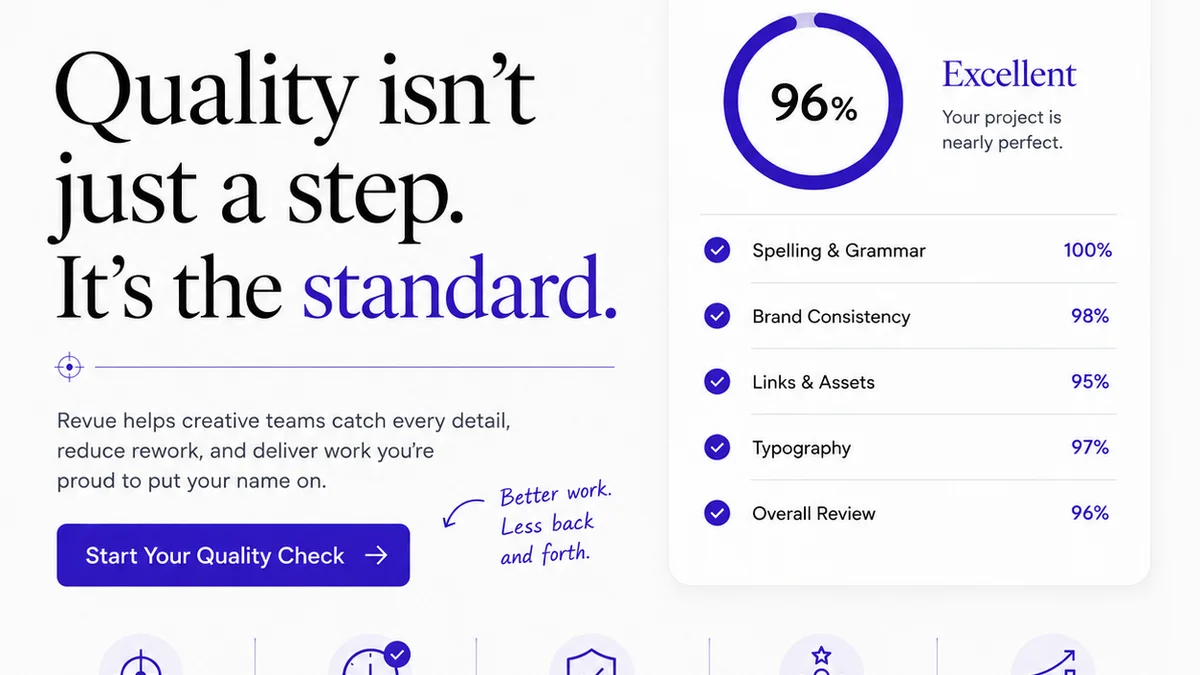
Integrate AI-generated quality reports directly into the workflow. Human reviewers can then act on these insights, add their own qualitative assessments, and move designs through the approval stages efficiently. It ensures that both objective and subjective quality standards are met.
Collaboration and Accountability
Revue facilitates clear communication between designers, reviewers, and clients. It ensures that feedback is actionable and that approvals are documented, making the entire review process more accountable and less prone to misinterpretation. This is vital when combining different types of review.
5. Practical Implementation Steps
Adopting a hybrid approach requires thoughtful planning. Don’t just throw AI at the problem and hope for the best.
Start Small
Identify one specific, repetitive part of your review process that AI can handle. Implement an AI tool for that task and measure the impact. Gradually expand from there.
Train Your Team
Ensure your team understands the strengths and limitations of AI in design review. Train them on how to interpret AI reports and how to integrate them into their human-led reviews.
Define the Workflow
Map out your ideal hybrid workflow. Where does AI scan? When do humans step in? What are the handoff points? Clear processes prevent confusion.
Choose the Right Tools
Select AI tools that integrate well with your existing design software and project management platforms. Revue, for instance, helps consolidate the outcomes of these various tools into one manageable workflow.
Continuously Evaluate
The AI landscape is evolving rapidly. Regularly review your process, the tools you’re using, and the effectiveness of your hybrid approach. Adapt as needed.
Final Thought
AI can scan for compliance, but it can’t judge intent or inspire emotion. The true art of design review lies in understanding the human element—the strategic goals, the audience's needs, and the creative spark. How will you ensure your review process amplifies, rather than diminishes, that human touch?
Frequently asked questions
Can AI fully replace human designers in the review process?
No. While AI can automate objective checks and identify patterns, it lacks the creativity, empathy, strategic understanding, and cultural nuance that human reviewers bring. AI is a tool to augment, not replace, human judgment in design review.
What are the primary strengths of AI in design review?
AI excels at efficiency in repetitive tasks, pattern recognition, anomaly detection (e.g., brand guideline adherence, accessibility issues), and processing large datasets for objective analysis. It can perform these checks much faster than humans.
What are the key advantages of human designers in the review process?
Human reviewers provide strategic alignment with business goals, audience empathy, cultural sensitivity, creative judgment, and contextual understanding. They can interpret subjective elements and solve complex creative problems that AI cannot.
How can agencies implement a hybrid AI-human design review process?
Start by identifying specific, repetitive tasks for AI automation. Then, define clear workflows where AI handles initial scans and humans focus on strategic, creative, and empathetic evaluation. Ensure clear communication and use tools like Revue to centralize feedback.
What is the role of a platform like Revue in AI-assisted design review?
Revue centralizes all feedback (AI-generated reports, client comments, team input), provides visibility into revisions and approvals, streamlines quality checks by integrating AI insights, and enhances collaboration and accountability throughout the review cycle.