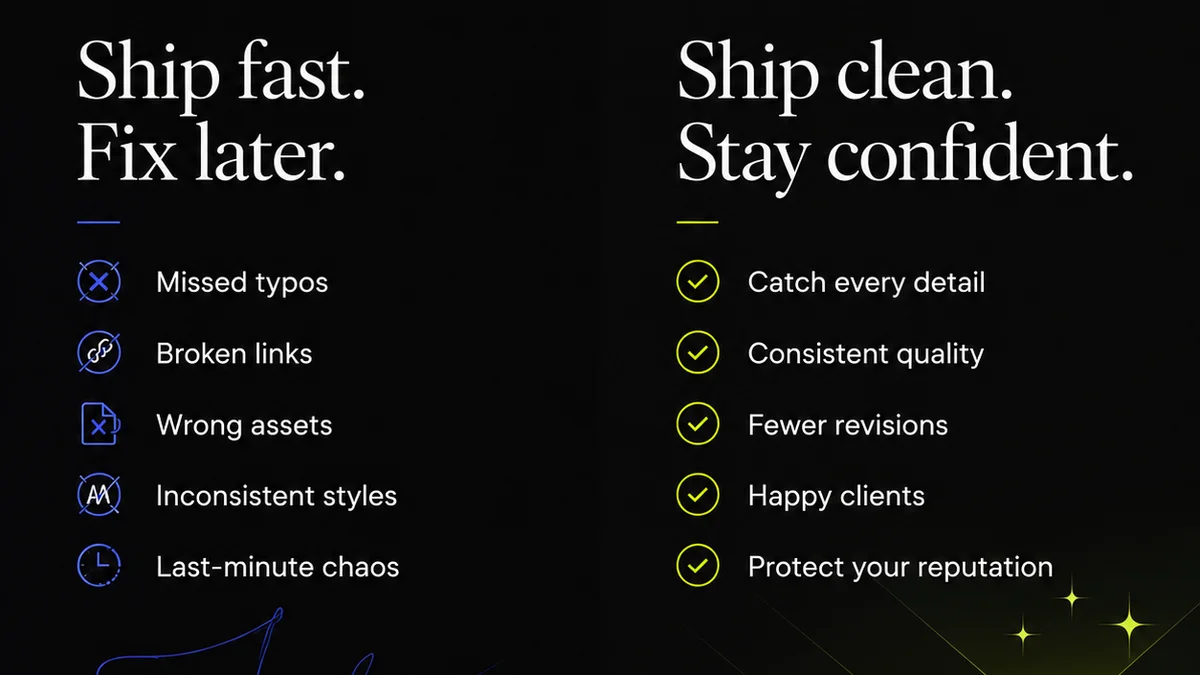
Everyone’s talking about AI in design. It’s supposed to automate everything, including reviews. They say AI will catch every typo, every pixel out of place, every broken link. It'll be faster, cheaper, and more accurate than any human reviewer.
None of that is wrong. But it’s incomplete.
The deeper truth? AI is a powerful tool for spotting *deviations*. Humans are essential for understanding *intent*. True design review excellence happens when you blend both.
1. What AI Design Review Actually Does
Let’s be clear. AI excels at objective, pattern-based analysis. Think of it as a super-powered spellchecker or a tireless pixel-pusher.
It can:
- Detect visual inconsistencies across a design system.
- Identify accessibility issues based on established guidelines (like WCAG).
- Flag broken links or missing assets.
- Check for adherence to brand guidelines (color palettes, typography).
- Spot repetitive or generic content patterns.
This is invaluable for catching the low-hanging fruit. The kind of errors that slip through when eyes are tired or rushed. It’s about technical correctness.
The Limitations of Algorithmic Eyes
But AI doesn’t understand context. It can’t grasp the *why* behind a design choice. It doesn’t know if a deliberate deviation from a brand guideline serves a strategic purpose.
It can’t tell you if a design feels right for the target audience. It has no concept of emotional resonance or strategic alignment.
2. The Irreplaceable Human Element
Human design review is about more than just spotting errors. It’s about critical thinking, strategic alignment, and audience empathy.
Humans bring:
- Strategic understanding: Does this design meet the project goals?
- Audience empathy: Will this resonate with the target user?
- Creative judgment: Is this aesthetically strong and conceptually sound?
- Contextual awareness: How does this fit into the broader campaign or brand narrative?
- Nuance: Does the tone and message feel authentic?
A human reviewer can see a slightly off-brand color and understand it’s a deliberate choice to evoke a specific emotion. An AI might just flag it as an error.
The 'Gut Feeling' is Data
That feeling that something is ‘off’? It’s often a subconscious synthesis of countless data points – brand knowledge, user research, market trends, past project successes and failures. AI is still a long way from replicating that.
This is crucial for high-stakes creative work. The kind that needs to connect, persuade, and perform.
3. The Workflow Collision: AI + Human
The real power isn’t AI *or* humans. It’s AI *and* humans working together. This is where the magic happens for agencies and in-house teams.
Imagine a workflow:
- Initial AI Pass: Run the design through an AI tool first. Catch all the obvious technical errors – typos, broken links, accessibility violations, basic brand standard breaches. This frees up human reviewers.
- Human Strategic Review: The design, now technically cleaner, goes to a human reviewer (Creative Director, Account Manager, Subject Matter Expert). They focus on strategy, messaging, audience fit, and overall creative impact.
- Targeted Feedback: The human reviewer can then focus their energy on the aspects AI can’t evaluate. They provide feedback that’s strategic, not just technical.
- Final AI Check: After revisions, a final AI pass ensures no new technical errors were introduced.
Benefits of the Hybrid Approach
This integrated approach yields significant benefits:
- Increased Efficiency: Humans don’t waste time on easily detectable errors.
- Higher Quality: Catches both technical flaws and strategic missteps.
- Faster Turnaround: Streamlined process reduces revision cycles.
- Better Client Satisfaction: Polished, strategically sound creative delivered on time.
- Reduced Risk: Catches critical errors before launch.
It’s about leveraging AI for what it does best – repetitive, data-driven tasks – and reserving human talent for complex, nuanced, strategic decision-making.
4. Where Revue Fits In
Managing this hybrid review process requires clarity and control. That’s where a platform like Revue comes in.
Revue centralizes all feedback, whether it originates from an AI tool's report or a human stakeholder's comment. You get a single source of truth for every piece of creative feedback.
Our platform provides visibility into:
- Revision History: Track every change, every comment, every approval. See who said what and when.
- Feedback Consolidation: All comments, annotations, and AI-generated reports live in one place, linked directly to the creative asset. No more scattered spreadsheets or email chains.
- Approval Workflows: Clearly define and manage the stages of review and approval, ensuring all necessary checks (AI and human) are completed.
- Quality Assurance: Maintain a clear audit trail for quality checks, ensuring compliance and consistency.
By bringing structure to the feedback loop, Revue ensures that both AI-driven insights and human expertise are captured, acted upon, and contribute to a more robust, efficient, and ultimately successful design process.
5. Building Your AI-Augmented Review Checklist
Ready to implement a smarter review process? Start with a checklist that incorporates both AI and human checkpoints.
AI Checklist Items:
- Automated accessibility scan (WCAG AA compliance).
- Link checker and asset validation.
- Brand guideline adherence (color, typography, logo usage).
- Grammar and spelling check (advanced).
- Visual consistency check across multiple screens/states.
Human Checklist Items:
- Strategic goal alignment: Does it solve the problem?
- Target audience resonance: Is it speaking their language?
- Brand voice and tone: Is it authentic?
- Creative impact and originality: Does it stand out?
- User experience flow: Is it intuitive and logical?
- Call to action clarity: Is it obvious what the user should do?
- Potential for misinterpretation: Could this be misunderstood?
- Emotional impact: Does it evoke the desired feeling?
Integrate these into your project management system. Make them non-negotiable steps.
Final Thought
The conversation around AI in creative fields often gets polarized: AI will replace humans, or AI is just a fad. Neither is true. AI is a powerful amplifier. It augments human capability, allowing us to focus on the strategic, creative, and empathetic aspects of our work that truly drive value. The future of design review isn't about choosing between AI and humans; it's about mastering their collaboration.
Frequently asked questions
Can AI completely replace human designers in the review process?
No. While AI can automate objective checks like grammar, broken links, and basic accessibility, it lacks the strategic understanding, creative judgment, and contextual awareness that human reviewers provide. The most effective approach is a hybrid one.
What are the main benefits of using AI for design reviews?
AI excels at catching technical errors quickly and consistently, such as typos, broken links, and deviations from brand guidelines. This frees up human reviewers to focus on more strategic and creative aspects, leading to increased efficiency and higher quality output.
How can agencies integrate AI into their existing design review workflow?
Start by using AI for an initial pass to catch objective errors. Then, have human reviewers focus on strategic alignment, audience resonance, and creative impact. Finally, use AI for a quick check after revisions. Platforms like Revue can help manage this integrated feedback process.
What human skills are still essential for design review?
Essential human skills include strategic understanding, audience empathy, creative judgment, contextual awareness, and the ability to assess nuance and emotional impact. These are areas where AI currently falls short.