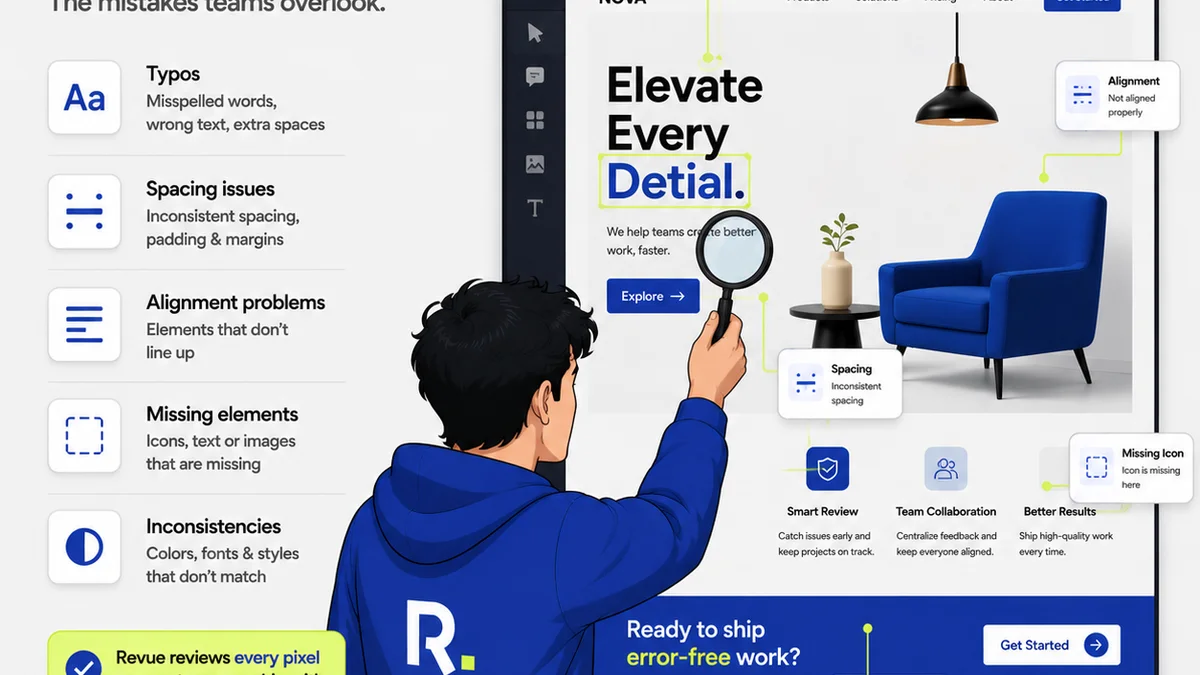
Everyone's talking about AI in design. It's going to automate everything, they say. Including design review. That’s the buzz. It's going to speed things up, cut costs, and eliminate human error. Sounds great, right?
None of that is wrong. But it’s incomplete.
The hard truth? AI isn't a replacement for human design review in enterprise settings. It's a powerful assistant. The real value lies in knowing how to combine AI's strengths with human oversight. Especially when stakes are high, brand reputation is on the line, and complex stakeholder needs must be met.
1. Understanding AI's Strengths in Design Review
AI excels at pattern recognition and data analysis. For design review, this translates to spotting inconsistencies at scale. Think about checking thousands of assets against brand guidelines, accessibility standards, or technical specifications. AI can do this faster and more consistently than any human team.
Automated Compliance Checks
AI can be trained to identify violations of rules. This includes:
- Brand guideline adherence (logo usage, color palettes, typography).
- Accessibility standards (WCAG contrast ratios, font sizes, focus states).
- Technical constraints (image dimensions, file sizes, format requirements).
This frees up human reviewers from tedious, repetitive tasks. They can focus on the nuances that AI misses.
Consistency Across Large Projects
Enterprise projects involve vast amounts of creative work. Maintaining a consistent look and feel across a global campaign or a complex product suite is a massive challenge. AI can act as a constant quality gate, ensuring uniformity that would be nearly impossible to achieve with manual checks alone.
Identifying Visual Anomalies
While AI might not grasp aesthetic intent, it can detect visual oddities. This could be anything from a misaligned element to a jarring color combination that deviates from established patterns. It's like having a super-powered spell-check for visuals.
2. The Indispensable Role of Human Judgment
Design is not just about rules and patterns. It's about communication, emotion, and strategic intent. This is where human reviewers remain critical.
Strategic Alignment and Brand Voice
Does the design *feel* right for the brand? Does it resonate with the target audience? Does it effectively communicate the intended message? These are subjective questions that require human understanding of context, culture, and brand strategy.
An AI might flag a color as outside the brand palette. A human knows if that specific deviation serves a strategic purpose, like highlighting a limited-edition product or evoking a specific emotion for a campaign.
Nuance, Context, and Empathy
Human reviewers understand the 'why' behind a design. They can interpret stakeholder feedback, understand the business goals, and empathize with the end-user's experience. AI operates on data; humans operate on understanding.
Consider feedback like: "It needs to feel more premium." An AI can't interpret "premium." A human can translate that into specific design adjustments related to typography, imagery, or layout.
Creative Problem-Solving
Design is inherently about solving problems. Sometimes, the best solution isn't obvious. Human designers and reviewers can brainstorm, iterate, and apply creative thinking to overcome challenges. AI can identify problems; humans devise solutions.
Ethical Considerations and Cultural Sensitivity
AI models are trained on data, and that data can contain biases. Human reviewers are essential for identifying and mitigating potential ethical issues or cultural insensitivities in designs that an AI might overlook. This is especially crucial for global enterprise brands.
3. The Synergy: AI-Augmented Human Review
The most effective approach isn't AI *or* human. It's AI *and* human. This partnership amplifies the strengths of both.
Pre-screening with AI, Deep Dive with Humans
Use AI to perform initial checks. It can flag potential issues related to brand compliance, accessibility, or technical specs. This creates a prioritized list of items for human reviewers to investigate.
This dramatically reduces the time spent on mundane checks. Reviewers can then dedicate their cognitive energy to the subjective and strategic aspects of the design.
AI for Data-Driven Insights, Humans for Strategic Decisions
AI can analyze performance data from previous campaigns or user testing. It can identify patterns in what works and what doesn't. This data can inform human reviewers, giving them objective insights to guide their subjective evaluations.
For example, AI might report that certain CTA button colors have historically led to lower conversion rates. Human reviewers can then assess if the current design aligns with this data or if there's a strategic reason to deviate.
Iterative Feedback Loops
AI can help track revisions and ensure that feedback from previous rounds has been addressed. It can automatically verify if a specific element has been changed according to instructions. Humans then confirm the *quality* and *appropriateness* of that change.
4. Implementing AI-Assisted Design Review in Enterprise
Adopting AI for design review requires a strategic approach, not just a technological one.
Define Clear Objectives
What problems are you trying to solve? Faster turnaround? Improved brand consistency? Reduced accessibility errors? Clearly defined goals will guide your AI implementation and help measure success.
Choose the Right Tools
Not all AI tools are created equal. Look for platforms that integrate with your existing creative workflows. Consider:
- AI-powered proofing tools.
- Brand compliance checkers.
- Accessibility auditing software.
- Design systems with integrated validation.
The goal is seamless integration, not adding more friction.
Train Your Team
Your team needs to understand how to use the AI tools and, more importantly, how to interpret their outputs. Training should cover:
- How AI flags issues.
- When to trust AI's findings.
- When to override AI based on human judgment.
- The workflow for AI-flagged items.
This is about augmentation, not automation of critical thinking.
Start Small and Iterate
Don't try to overhaul your entire review process overnight. Pilot AI tools on specific projects or for particular types of checks. Gather feedback, refine the process, and gradually scale up.
Focus on Data Quality
AI is only as good as the data it's trained on. Ensure your brand guidelines, accessibility standards, and technical specifications are up-to-date, clear, and accessible to the AI.
Where Revue Fits In
Managing feedback and approvals for large enterprise projects is complex. AI can help analyze the data, but coordinating the human element is where robust workflow tools shine.
Revue provides a centralized hub for all client feedback and stakeholder comments. This means no more hunting through endless email threads or scattered documents. All feedback, whether flagged by AI or entered by a human, can be managed in one place.
Our platform offers clear visibility into revision history and approval status. This transparency is crucial for enterprise teams juggling multiple stakeholders and complex project timelines. It ensures that every decision, every revision, and every approval is tracked and accounted for.
Ultimately, Revue helps bridge the gap between AI-driven insights and human decision-making. It ensures that the strategic, nuanced judgments made by your team are captured, acted upon, and approved efficiently, all while maintaining a clear audit trail.
Final Thought
The future of design review isn't about choosing between AI or humans. It's about creating a smarter, more efficient, and more effective process by leveraging the unique capabilities of both. The real question for enterprise teams isn't *if* they should adopt AI-assisted review, but *how* they can best integrate it to elevate their creative output and streamline their operations. Are you ready to build that synergy?
Frequently asked questions
Can AI fully replace human designers in the review process?
No, AI cannot fully replace human designers in the review process. While AI excels at pattern recognition, consistency checks, and identifying objective errors, it lacks the nuanced understanding of brand strategy, emotional resonance, cultural context, and creative problem-solving that humans bring.
What are the main benefits of using AI in design review for enterprise teams?
AI offers significant benefits such as increased speed and efficiency in checking large volumes of assets, ensuring consistent adherence to brand guidelines and technical specifications, automating tedious compliance checks, and identifying visual anomalies at scale, freeing up human reviewers for more strategic tasks.
How can enterprise teams best integrate AI into their existing design review workflows?
Integration should be strategic. Define clear objectives, choose AI tools that complement existing workflows, train teams on how to use and interpret AI outputs, start with pilot projects, and focus on high-quality data for AI training. The goal is augmentation, not complete automation of critical thinking.
What role does human judgment play in AI-assisted design review?
Human judgment remains crucial for strategic alignment, understanding subjective feedback (like 'premium feel'), interpreting context, ensuring cultural sensitivity and ethical considerations, and providing creative solutions to design challenges. Humans validate AI findings and make final strategic decisions.
How does a tool like Revue support an AI-augmented design review process?
Revue provides a centralized platform to manage all feedback, whether AI-flagged or human-generated. It offers transparency into revision history and approvals, ensuring that the strategic, human-driven decisions made in conjunction with AI insights are tracked and managed efficiently.