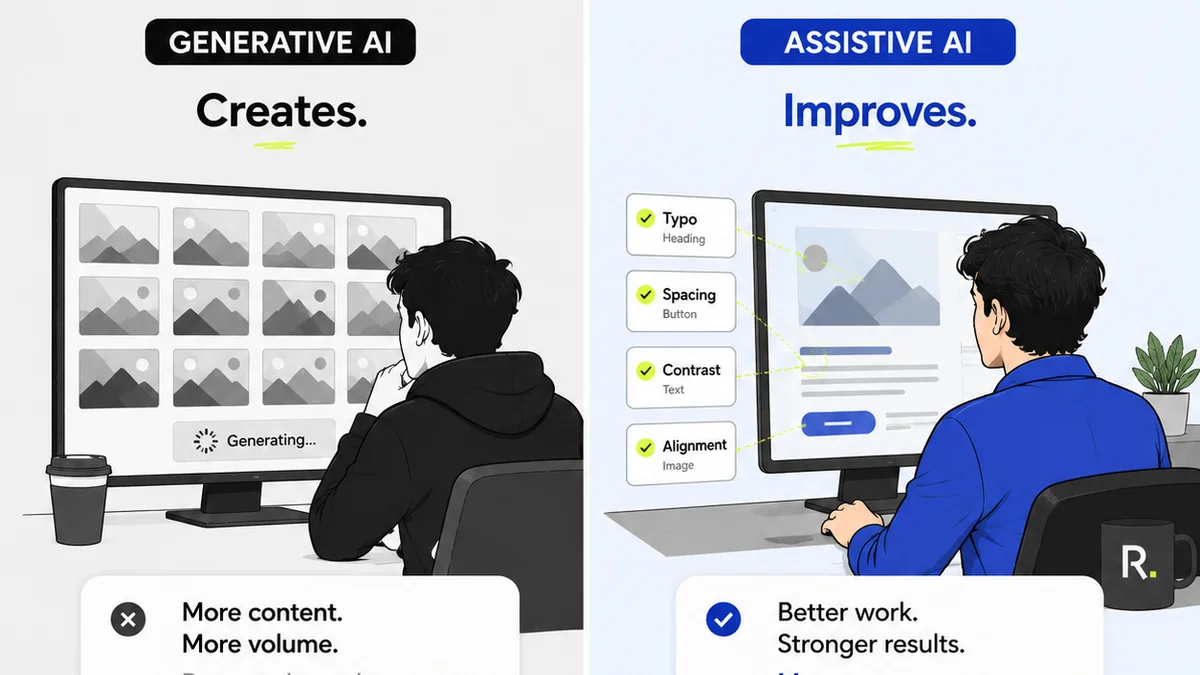
Everyone’s talking about AI in creative review. It’s the shiny new tool that promises to cut down on endless feedback rounds, catch errors humans miss, and generally make life easier for agencies and in-house teams. You’ve probably heard it all before: AI is the future, it’s faster, it’s more accurate, it’s the only way to stay competitive.
None of that is wrong. But it’s incomplete.
The hard truth? AI is a powerful assistant, not a replacement for human insight. Relying solely on AI for creative review is like asking a calculator to write a novel. It can do the math, but it misses the story.
1. The AI Advantage: Speed and Scale
Let’s be clear: AI brings undeniable benefits to the review process. Its ability to process vast amounts of data quickly is a game-changer for certain tasks.
Automated Error Detection
Think about the mundane stuff. AI can scan designs for:
- Incorrect image resolution.
- Missing alt text.
- Inconsistent font usage.
- Brand guideline violations (color palettes, logo placement).
- Basic copy errors (typos, grammatical slip-ups that a spellchecker might miss).
This frees up human reviewers to focus on what matters most: strategic thinking, emotional resonance, and client objectives.
Consistency Across Large Projects
For large-scale campaigns or product launches with hundreds of assets, maintaining consistency is a nightmare. AI can act as a tireless quality control layer, ensuring every banner ad, social post, and email template adheres to established rules.
Initial Triage
AI can act as a first pass, flagging potential issues. This doesn't mean the flagged items are definitively wrong, but they warrant a closer human look. It’s like a preliminary medical scan – it points to areas of concern.
2. The Human Imperative: Nuance and Judgment
While AI excels at pattern recognition and rule-following, it lacks the critical elements that define truly great creative work: understanding context, interpreting emotion, and exercising subjective judgment.
Strategic Alignment
Does this creative actually meet the business objective? Does it resonate with the target audience on an emotional level? AI can’t understand the subtle nuances of brand strategy or the cultural zeitgeist. That requires human experience and strategic acumen.
Creative Interpretation
Great creative often bends or breaks rules intentionally. An AI trained on existing patterns might flag an innovative design choice as an error, simply because it deviates from the norm. Human reviewers understand when a deviation serves a higher creative purpose.
Emotional Resonance
This is perhaps the biggest gap. Can AI gauge if a piece of work is genuinely moving, funny, or persuasive? It can identify sentiment in text, but it can't feel it. Human reviewers bring empathy and an understanding of human psychology to the table.
Client Relationship Nuances
Understanding a client’s history, their internal politics, and their specific communication style is crucial. AI offers no insight into building that trust or navigating complex stakeholder feedback. That’s pure human interaction.
3. The Workflow Collision: Where AI and Humans Intersect
The most effective creative review doesn’t pit AI against humans. It orchestrates them. The goal is to create a symbiotic workflow where each plays to its strengths.
Define AI’s Role Clearly
What specific tasks will AI handle? Automated checks for compliance? Initial typo detection? Be precise. Don’t ask AI to judge creative merit.
Establish Human Oversight
Every AI-flagged issue needs a human to review and validate. The AI flags, the human decides. This prevents false positives from derailing the process and ensures critical creative elements aren't overlooked.
Train Your AI (and Your Team)
If you’re using AI tools, understand their limitations and how to configure them. More importantly, train your team on how to interpret AI output and integrate it into their existing review habits. This isn’t about replacing workflows; it’s about augmenting them.
Focus on the *Why*
AI can check *if* a logo is the right size. Humans must determine *why* that size is effective (or not) in the context of the overall design and campaign goals.
4. Where Revue Fits In
The challenge with integrating AI into creative review isn't just about the technology itself. It's about managing the entire feedback loop effectively. This is where a centralized platform like Revue becomes essential.
AI can flag an issue, but where does that flag go? How is it communicated to the designer? How do you track its resolution? How does it get re-reviewed alongside human feedback?
Revue provides the central nervous system for creative feedback. It:
- Centralizes all feedback: Whether it originates from an AI tool or a client, all comments and issues live in one place.
- Provides visibility: Track the status of every piece of feedback, from initial flag to final approval. See who is responsible for what.
- Manages revisions and approvals: Streamline the process of iterating on creative based on feedback, ensuring nothing falls through the cracks.
- Facilitates quality checks: Integrate AI-powered checks as part of your defined QC process, with human oversight built-in.
When you combine AI’s efficiency with a robust workflow management system like Revue, you create a powerful engine for high-quality, on-time creative delivery.
5. The Future of Creative Review
The fear that AI will replace creative professionals is overblown. What’s more likely is that AI will change *how* creative professionals work.
Augmentation, Not Automation
Think of AI as a highly skilled intern who’s brilliant at repetitive tasks but needs constant direction and judgment. It’s there to support, not to lead.
Evolving Skillsets
Creative directors and reviewers will need to become adept at prompt engineering for AI tools, interpreting AI outputs, and integrating them seamlessly into human-led strategic and creative decision-making.
Focus on Higher-Order Thinking
By offloading the grunt work to AI, humans can dedicate more time to strategy, concept development, client relationships, and the kind of imaginative leaps that AI simply cannot replicate.
Final Thought
AI offers a compelling promise of efficiency in creative review. But efficiency without effectiveness is just busywork. The real opportunity lies in a thoughtful integration – using AI for what it does best, and humans for what only they can do. How are you ensuring your review process harnesses both the speed of machines and the soul of human creativity?
Frequently asked questions
Can AI replace human reviewers in creative agencies?
No. AI can automate repetitive checks and identify basic errors, but it lacks the nuanced judgment, strategic understanding, and emotional intelligence crucial for high-level creative review. Humans are essential for interpreting context and making subjective decisions.
What are the main benefits of using AI in creative review?
AI excels at speed and scale, automating tasks like error detection (typos, resolution issues), brand guideline compliance checks, and initial triage. This frees up human reviewers to focus on strategic and creative aspects.
How can agencies effectively integrate AI into their review process?
Define AI's specific role for automated checks, ensure human oversight for all AI-flagged items, and train your team on interpreting AI output. Centralizing feedback in a platform like Revue helps manage this integrated workflow.
What are the limitations of AI in creative review?
AI cannot understand strategic objectives, emotional resonance, cultural nuances, or subjective creative interpretation. It may flag innovative designs as errors and cannot replicate the human element in client relationships.