Everyone talks about design productivity. They’ll tell you it’s about faster turnaround times, more design iterations, or hitting aggressive deadlines. More tools, more software, more features. That’s the conventional wisdom.
None of that is wrong. But it’s incomplete.
The hard truth is that true design productivity isn't about speed alone. It's about the *efficiency* and *effectiveness* of your entire creative workflow, from brief to final delivery. It’s about minimizing wasted effort, reducing friction, and ensuring your team is focused on high-value work, not just busywork.
An audit of your design productivity process isn't about pointing fingers or finding fault. It’s about understanding the hidden bottlenecks and systemic issues that drain your team’s energy and impact your bottom line.
1. Mapping Your Current Workflow: The First Step to Clarity
Before you can improve anything, you need to see it clearly. Most teams operate on assumptions about how work gets done. An audit forces you to document the reality.
1.1 Document Every Stage
Grab a whiteboard or a shared document. Start at the very beginning: how does a project request come in? What happens next?
- Is there a formal brief?
- Who reviews and approves it?
- How are tasks assigned?
- What are the review and feedback loops?
- How are assets delivered?
- What’s the process for revisions?
- How are final approvals secured?
Be brutally honest. Don't document the ideal process; document what *actually* happens, day in and day out.
1.2 Identify Key Stakeholders and Handoffs
Who touches the project at each stage? Where do tasks move from one person or team to another? These handoffs are notorious friction points.
- Designer to Designer
- Designer to Account Manager
- Designer to Client
- Client to Internal Reviewer
- Internal Reviewer to Designer
Every handoff is an opportunity for miscommunication, delays, and lost information.
1.3 Time Tracking (The Unvarnished Truth)
This is where many teams balk. Time tracking feels like micromanagement. But a process audit isn't about watching individuals; it’s about understanding where time is *actually* spent across the workflow.
Use simple tools. Ask your team to log time against specific project phases or tasks for a defined period (e.g., two weeks).
- Time spent waiting for feedback
- Time spent clarifying briefs
- Time spent on administrative tasks
- Time spent on rework due to unclear feedback
- Time spent searching for assets or previous versions
The results might surprise you. You’ll likely find significant time is spent on non-creative, non-value-adding activities.
2. Analyzing Feedback Loops: The Engine of Iteration or the Brake Pedal?
Feedback is the lifeblood of creative work. But inefficient feedback can be a productivity killer.
2.1 The Nature of Feedback
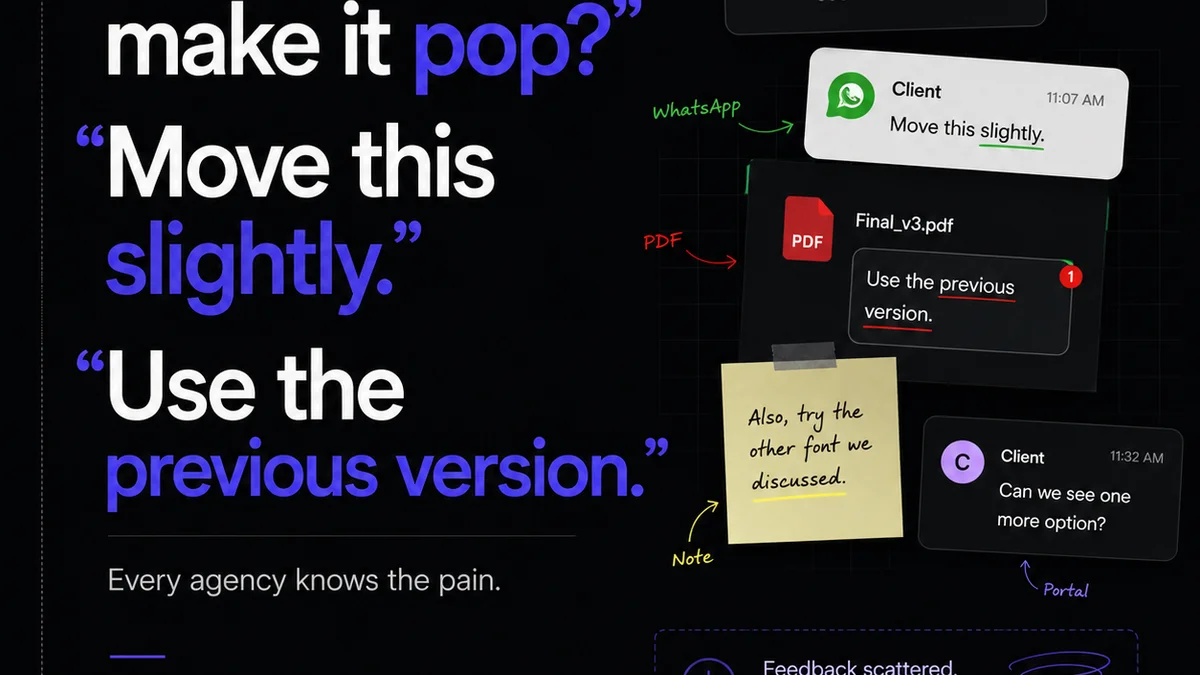
Is feedback specific and actionable, or vague and subjective? Generic comments like “make it pop” or “I don’t like it” require designers to guess, leading to wasted iterations.
An audit should categorize the quality of feedback received. Are comments tied to the brief and objectives?
2.2 The Channels of Feedback
How is feedback collected? Email chains? Slack messages? Random comments in video calls? A mix of everything?
Scattered feedback is impossible to track. It leads to missed comments, conflicting instructions, and endless back-and-forth.
- How many different channels are used for feedback on a single project?
- Is there a single source of truth for all comments?
- Can feedback be easily linked to specific design elements?
2.3 The Speed of Feedback
How long does it take for feedback to be provided after a deliverable is submitted? Delays here create idle time for designers and push back project timelines.
Are there established turnaround times for client or internal reviews? Are these times being met?
3. Evaluating Revision and Approval Processes: Where Projects Stall
This is often the biggest drain on design productivity. The path from draft to final sign-off can be a labyrinth.
3.1 Revision Cycles
How many rounds of revisions are typical? Are revisions clearly defined and tracked?
Uncontrolled scope creep disguised as
Frequently asked questions
What is a design productivity audit?
A design productivity audit is a systematic review of your team's creative workflow to identify inefficiencies, bottlenecks, and areas for improvement. It focuses on how work gets done, not just how fast.
Why is auditing design productivity important?
It helps you uncover hidden time-wasters, reduce costly rework, improve client satisfaction through clearer communication, and ensure your team is focused on high-value creative tasks rather than administrative overhead or confusion.
How can I measure design productivity accurately?
Accurate measurement involves looking beyond just output volume. Track time spent on value-adding tasks versus non-value-adding activities, the quality and speed of feedback, and the efficiency of revision and approval cycles.
What are common bottlenecks in design workflows?
Common bottlenecks include unclear briefs, delayed or vague feedback, scattered communication channels, inefficient revision rounds, manual approval processes, and poor asset management or version control.
How does centralized feedback help productivity?
Centralized feedback provides a single source of truth for all comments, making them specific, actionable, and easily trackable. This reduces miscommunication, speeds up revisions, and prevents tasks from falling through the cracks.