You’ve spent weeks, maybe months, crafting perfect brand guidelines.
They’re beautiful. Comprehensive. Every color, font, logo usage, and tone of voice rule is meticulously documented. You hand them off to your team, or your client’s team, and expect magic. You expect consistency.
And you probably get… some of it.
But not all of it. Not the kind of ironclad, across-the-board consistency that truly builds a powerful brand.
This is the common assumption: If the rules exist, and they’re clear, adherence will follow. Easy.
None of that is wrong. But it’s incomplete.
The hard truth? Brand guidelines are a map, not the journey itself. They lay out the destination and the best route, but they don’t account for the traffic, the detours, or the driver’s mood.
Real-world consistency is an operational challenge. It’s about process, communication, and accountability long after the PDF is downloaded.
Let’s unpack why those beautiful guidelines often fall short and what it *really* takes to achieve brand consistency.
1. The Illusion of Universal Understanding
You wrote the guidelines. You understand them implicitly. You know the *why* behind every rule.
Your team, or the client’s team, might not have that same depth of context.
They see rules. Sometimes, they see arbitrary ones.
The Problem: Interpretation Gaps
- A designer might push the boundaries on a headline font because they think it “looks better” in a specific context, not realizing the guideline was intended to prevent overuse that dilutes brand impact.
- A copywriter might use a slightly different tone, thinking they’re being “more conversational,” missing the nuanced instruction about maintaining a professional yet approachable voice.
- A junior team member might simply miss a crucial detail buried deep in a 100-page document.
This isn't willful disobedience. It’s human nature. We interpret information through our own lens, and without constant reinforcement, subtle deviations creep in.
2. The Workflow Black Hole
Brand guidelines live on a server, a cloud drive, or in an email attachment. They are static documents.
Your creative workflow is dynamic. It’s a messy, iterative process involving multiple people, multiple rounds of feedback, and multiple file versions.
Where do the guidelines intersect with this chaos?
Often, they don’t.
The Symptoms:
- Feedback is given verbally or in quick Slack messages, bypassing any formal check against guidelines.
- Revisions are made based on subjective client preferences, overriding established brand rules without documentation.
- There’s no easy way to flag a deviation during the review process and link it back to the specific guideline.
- The person responsible for final QA might not have the guidelines readily accessible or the mandate to enforce them strictly.
When the guidelines aren’t integrated into the workflow, they become an afterthought. A reference point that’s rarely consulted when the pressure is on to deliver.
3. The 'Good Enough' Syndrome
This is insidious. It’s the enemy of true consistency.
A piece of creative is 95% on-brand. The logo is the right color, the fonts are mostly correct, the tone is *almost* there. It gets approved because it’s “good enough” to move on.
The problem is, “good enough” compounds.
That 5% deviation becomes the norm for the next piece. And the next.
Why it happens:
- Tight deadlines leave no room for nitpicking small inconsistencies.
- Fear of pushing back on a client or a senior stakeholder who approved the deviation.
- Lack of a clear, objective standard for what constitutes “on-brand” at the granular level.
- No easy way to track these small deviations over time.
These aren’t catastrophic errors. They’re death by a thousand papercuts. Each small miss erodes the distinctiveness and memorability of the brand.
4. Lack of Accountability and Ownership
Who is ultimately responsible for ensuring every single piece of creative adheres to the brand guidelines?
If the answer is vague – “everyone,” “the creative director,” “the client” – then no one is truly accountable.
Accountability needs to be baked into the process, not an assumed outcome.
Where things break down:
- Handoffs: When work moves from strategy to design, or design to copy, or internal to client, accountability can get lost.
- Feedback Loops: If feedback isn't centralized and tracked, it's hard to know who made what change and whether it aligned with guidelines.
- Final Approval: Often, the person signing off isn't the one who deeply understands the brand rules or has the time to meticulously check them.
Without clear ownership and a system to enforce it, guidelines become suggestions, not requirements.
5. The Evolving Nature of Brands
Brand guidelines are not static artifacts. They are living documents.
Markets shift. Competitors evolve. Customer expectations change.
A brand that doesn’t adapt risks becoming irrelevant.
But updating guidelines is often a slow, cumbersome process.
The Challenge: Keeping Pace
- Guidelines might not be revisited for years, becoming outdated.
- New use cases or applications of the brand might arise that aren’t covered.
- The original authors may have moved on, leaving a knowledge vacuum.
When guidelines lag behind the reality of the brand’s application, they become a hindrance rather than a help.
Where Revue Fits In
This is where operationalizing your brand guidelines becomes critical. It’s not enough to *have* them; you need a system to *use* them, consistently.
Revue acts as that system, bridging the gap between static documentation and dynamic creative execution.
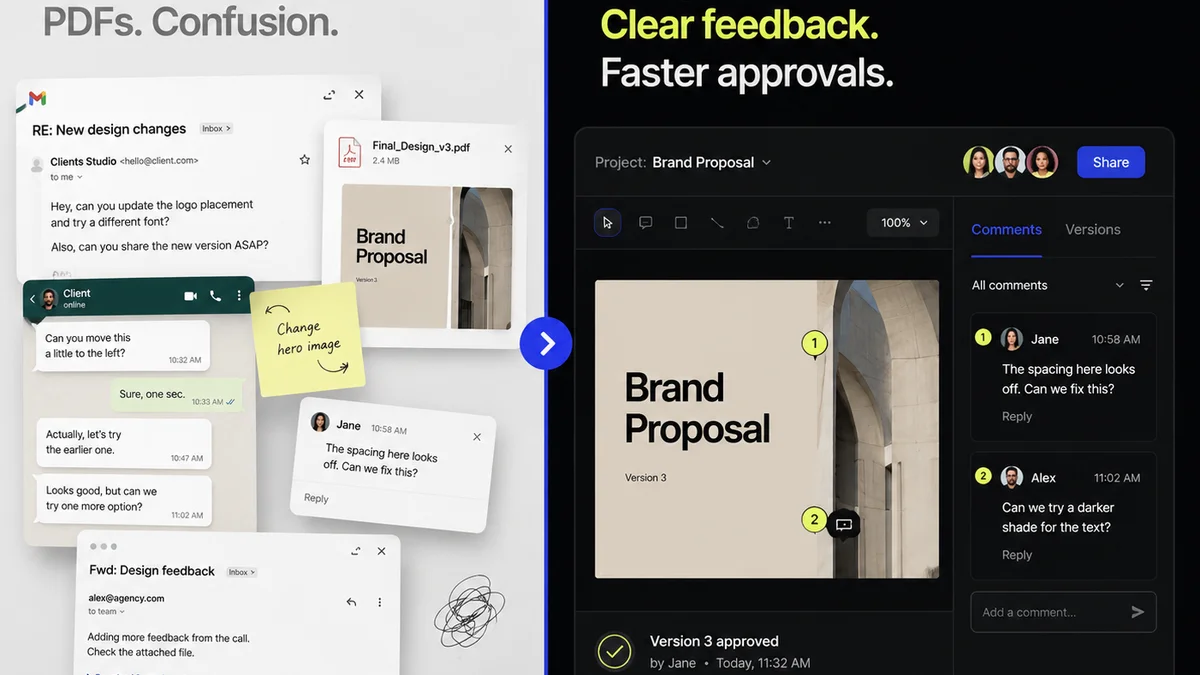
Centralized Feedback: Instead of scattered emails and Slack messages, all client and internal feedback lives in one place, attached to the specific creative asset. This allows reviewers to see feedback in context and ensures guideline adherence can be discussed and documented.
Revision & Approval Visibility: Every change, every revision, every approval is tracked. This audit trail makes it clear who approved what and why, fostering accountability. When a deviation occurs, it’s visible, not hidden in a long email chain.
Integrated Quality Checks: You can build checks and balances directly into your review process. Is the logo in the right place? Is the color palette correct? These aren’t just subjective calls; they can be objective checks against documented requirements, with clear accountability for sign-off.
By integrating brand governance directly into your creative workflow, you move beyond simply *stating* brand rules to actively *enforcing* them, project after project.
Final Thought
Brand guidelines are essential. They provide the foundation. But they are only one piece of the puzzle.
The real challenge of brand consistency lies in the day-to-day operations: how feedback is managed, how revisions are tracked, and who is accountable for upholding the standard.
Are your brand guidelines a beautiful document gathering dust, or are they a living, breathing part of your team’s daily workflow?
Frequently asked questions
What is the main reason brand guidelines often fail to create consistency?
The primary reason is that brand guidelines are often treated as static documents rather than integrated operational tools. They lack connection to the dynamic, iterative creative workflow, leading to interpretation gaps, missed details, and a lack of accountability during the feedback and revision process.
How can agencies ensure their brand guidelines are actually followed?
Agencies need to operationalize their guidelines. This involves integrating them directly into the creative workflow, centralizing feedback, tracking all revisions and approvals, and establishing clear accountability for adherence at each stage of the project. Tools that facilitate this process are essential.
What is the 'good enough' syndrome in relation to brand consistency?
The 'good enough' syndrome occurs when minor deviations from brand guidelines are overlooked or accepted because a creative asset is mostly on-brand. This creates a slippery slope where small inconsistencies accumulate over time, eroding the overall distinctiveness and strength of the brand.
How important is it to update brand guidelines?
It's crucial. Brands operate in dynamic markets. Guidelines that aren't regularly reviewed and updated risk becoming outdated and irrelevant, hindering rather than helping the creative team. A process for periodic review and adaptation is necessary to maintain their effectiveness.