Everyone agrees: brand guidelines are essential. They dictate fonts, colors, logo usage, tone of voice. They’re the rulebook for how a brand should look and sound.
And that’s the problem.
Treating them as the *entire* solution is where agencies and in-house teams stumble. You can have the most beautiful, comprehensive brand guidelines document in the world, but if your workflow is chaotic, consistency will still be a pipe dream. The hard truth? Guidelines are a map, but they don’t build the road. Operational processes do.
1. The Illusion of Control
Brand guidelines give the *illusion* of control. You hand them over to designers, marketers, and even clients, and assume the brand’s integrity is now protected. It’s a comforting thought.
But what happens when multiple people are working on a project? What happens when feedback comes from different stakeholders, potentially contradicting each other? What happens when a deadline is looming and corners get cut?
The guidelines sit there, pristine and largely ignored in practice. The real control comes from how you manage the creative process itself.
Feedback Chaos Is the Enemy
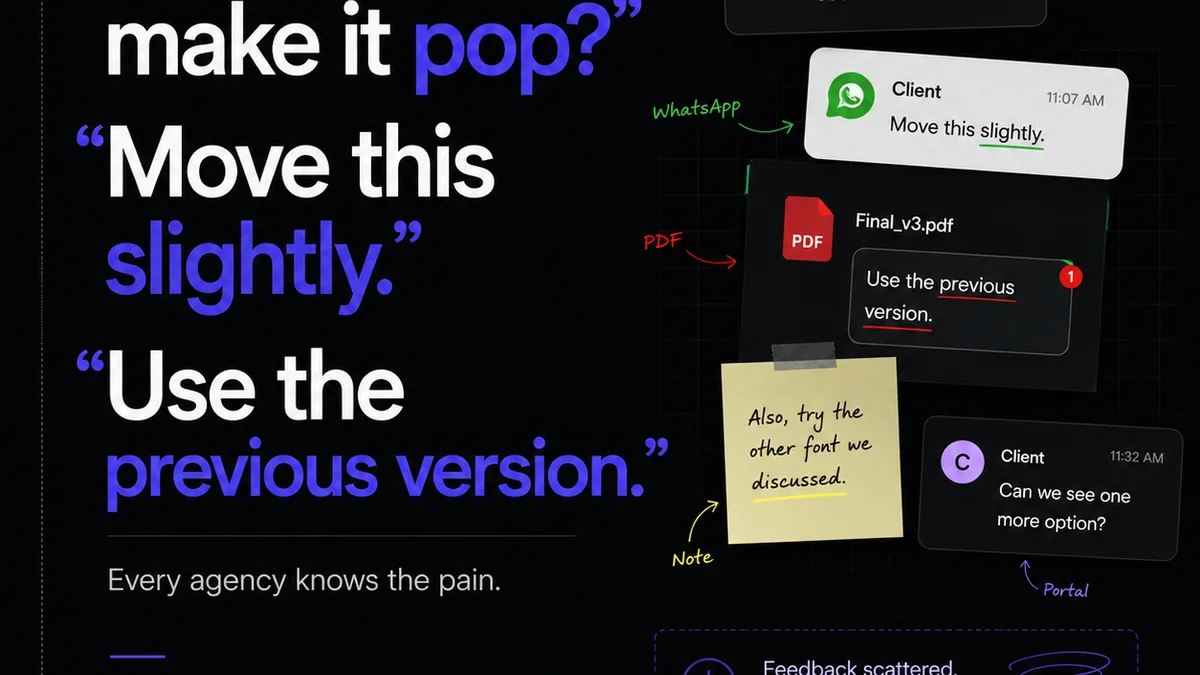
Think about a typical project. A designer creates a piece of collateral. It goes out for review. The client’s marketing manager says the blue is too dark. The sales director says it needs more text. The CEO says it doesn’t feel “premium” enough. The agency account manager tries to synthesize this.
Where do the brand guidelines fit into this messy, often emotional, back-and-forth?
Usually, they don’t. The focus shifts from adhering to established brand principles to simply appeasing the loudest voice or the most powerful stakeholder. The brand gets diluted, pixel by pixel, comment by comment.
Version Control Nightmares
Even with clear guidelines, managing revisions can devolve into chaos. “Here’s the latest version,” someone emails. But is it? Is it version 3.1, or 3.1 revision B? Did anyone actually check if the requested change violated a core brand principle?
Without a system to track changes, contextualize feedback, and ensure adherence to guidelines *during* the revision process, you’re setting yourself up for failure. The beautifully crafted guidelines become an artifact, not an active tool.
2. The Operational Gaps
The real battle for brand consistency isn't won in a PDF. It's won in the daily grind of project management, feedback loops, and quality assurance.
Consider these operational gaps:
- Unclear Feedback Channels: Feedback scattered across emails, Slack messages, and random documents.
- Lack of Centralized Source of Truth: Everyone referencing different versions of assets or guidelines.
- Manual Revision Tracking: Spending more time deciphering who said what than making the actual changes.
- Inconsistent Quality Checks: No standardized process to ensure final assets meet brand standards before delivery.
- Client Misunderstanding: Clients not fully grasping how their feedback impacts the brand, leading to subjective requests.
These aren't minor inconveniences. They are systemic flaws that undermine even the best-laid guideline plans.
The Subjectivity Trap
Brand guidelines aim to reduce subjectivity. But if the *process* for applying them is subjective, you’re back to square one. Who decides if a font choice is “too playful” or a color palette is “not bold enough”?
Ideally, these decisions are made against the backdrop of the guidelines. But if the feedback mechanism is broken, subjective opinions override objective rules. The brand becomes whatever the last person who commented wanted it to be.
The “Good Enough” Syndrome
Deadlines are real. Budgets are tight. Sometimes, the pressure to just *get it done* leads to compromises. A slightly off-brand color, a misused logo, a tone that’s a bit too casual.
These aren't malicious acts. They are the natural consequence of operational friction. When it’s easier to let something slide than to fight for adherence, the brand erodes. Guidelines become suggestions, not requirements.
3. Building the Road: Process Over Polish
So, if guidelines alone aren't enough, what is? It’s about building robust operational processes that *enforce* and *integrate* those guidelines.
Think of it less like a beautiful manual and more like a well-oiled machine.
Structured Feedback Loops
Instead of a free-for-all, implement structured feedback rounds. Define who provides feedback, when, and on what. Use a system where feedback is centralized, annotated directly on the work, and can be easily tracked.
This isn't about stifling creativity; it’s about channeling it effectively within brand parameters. It ensures that feedback is constructive, actionable, and, crucially, benchmarked against the guidelines.
Centralized Asset and Guideline Management
Your brand guidelines, logos, color palettes, and typography files need to be easily accessible in one place. Not buried in a shared drive or scattered across individual hard drives.
When everyone works from the same, up-to-date repository, you eliminate a huge source of error and inconsistency. This includes making sure the guidelines themselves are easily discoverable and referenceable *within* the workflow.
Integrated Revision Tracking
Every change, every revision, should be logged. Understand the history of a piece. See who requested what, why, and whether it was approved against the brand standards.
This transparency is key. It prevents subjective changes from slipping through and provides a clear audit trail if questions arise. It makes accountability a natural part of the process.
Automated Quality Assurance (Where Possible)
While human oversight is critical, some checks can be automated. Are the correct logo files being used? Are colors within the defined hex codes? Is the copy within a certain character count for a social post?
These automated checks, even simple ones, act as an early warning system, catching common guideline infractions before they become bigger problems.
Where Revue Fits In
This is precisely why tools like Revue exist. They aren’t just about collecting feedback; they’re about structuring the entire creative review and approval process.
Revue provides a centralized platform where:
- Feedback is contextual and actionable: Stakeholders can comment directly on specific elements of the creative, ensuring clarity.
- Revisions are tracked transparently: Every iteration is logged, making it easy to see the evolution of a project and the rationale behind changes.
- Approvals are clear and documented: No more ambiguity about who signed off on what, and when.
- Brand consistency is maintained: By integrating the review process, you create an environment where adhering to brand guidelines is a natural outcome, not an afterthought.
It bridges the gap between having great brand guidelines and actually *living* them day-to-day.
Final Thought
Brand guidelines are the DNA of your brand. But a robust, well-managed operational process is the circulatory system that keeps that DNA healthy and consistently expressed across every touchpoint.
Are your processes as strong as your guidelines?
Frequently asked questions
What is the main problem with relying solely on brand guidelines?
Relying solely on brand guidelines creates an illusion of control. While they provide rules, they don't dictate the chaotic human processes of feedback, revision, and approval, which often lead to inconsistencies despite the guidelines existing.
How can agencies improve brand consistency beyond documentation?
Agencies can improve consistency by implementing structured operational processes. This includes clear feedback channels, centralized asset management, integrated revision tracking, and automated quality checks to ensure guidelines are actively followed.
What role does technology play in enforcing brand guidelines?
Technology, like centralized feedback and revision management platforms, plays a crucial role by structuring the creative workflow. It makes feedback contextual, tracks changes transparently, and documents approvals, thereby embedding guideline adherence into the daily process.
How does subjective feedback impact brand consistency?
Subjective feedback can easily override objective brand guidelines if the feedback process is not managed. Without a system to benchmark opinions against established rules, personal preferences can dilute the brand's intended identity.