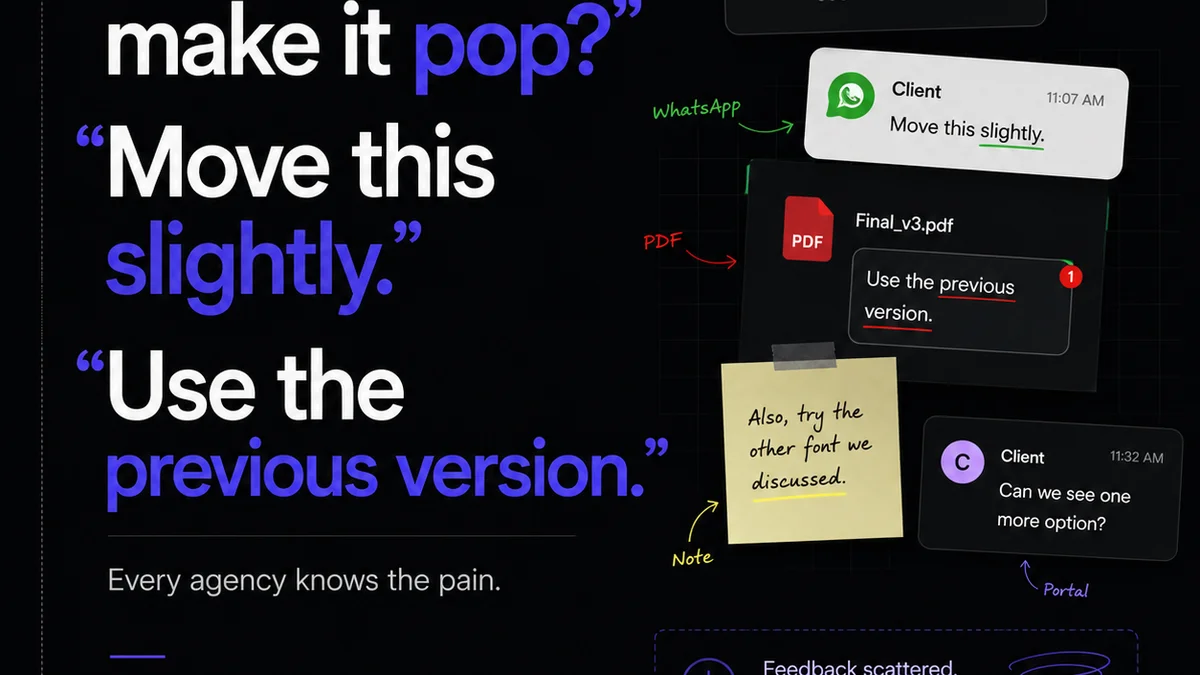
Everyone talks about the brand review process. They focus on the deliverables, the client’s subjective taste, and the inevitable back-and-forth. It sounds like a necessary evil, a box to tick before launch.
None of that is wrong. But it’s incomplete.
The hard truth? Your brand review workflow isn't just a stage in a project. It's a continuous, strategic process that defines your agency’s efficiency, client satisfaction, and ultimately, your profitability. In 2026, a clunky brand review process isn't just inefficient – it's a competitive disadvantage.
1. Beyond the Final Sign-Off: The Continuous Brand Audit
The traditional model treats brand review as a gate. A client sees the final designs, gives a thumbs up or down, and that’s that. Project done. The brand elements are ‘approved’.
This view is fundamentally broken. Brands aren't static entities approved once and then left to run wild. They evolve. They need constant tending. The ‘final’ review is just the beginning of a much longer conversation.
Consider this:
- Are brand guidelines consistently applied across *all* touchpoints, internal and external?
- Is the brand voice consistent in marketing copy, social media, and customer support emails?
- Are visual elements (logos, colors, typography) used correctly in new collateral, digital ads, and website updates?
- How are new team members onboarded to understand and apply brand standards?
- What happens when a new product or service needs to be launched – is the existing brand framework robust enough, or does it need a review?
These aren't questions for a one-off project review. They’re ongoing operational concerns.
The shift for 2026 is from a singular, project-based review to a continuous brand audit integrated into your agency’s daily operations and your client’s long-term strategy.
1.1. The Myth of 'Brand Guidelines' as a Static Document
Many agencies hand over a glossy PDF of brand guidelines and consider their job done. Clients might store it away, rarely to be consulted again.
This document is only as good as its implementation. A beautiful PDF means nothing if the marketing team is using the wrong font in their latest presentation or the social media manager is posting graphics with an outdated logo.
The guideline document itself needs to be a living entity, easily accessible and actionable. Think interactive platforms, not static PDFs.
1.2. Embedding Brand Consistency in Daily Work
True brand integrity comes from embedding these principles into the day-to-day execution of creative work. This means moving beyond just the final sign-off on a campaign.
It involves:
- Pre-production brand checks for new projects.
- Regular internal brand check-ins for ongoing client work.
- Tools that automate or flag potential brand deviations.
- Client training and empowerment, not just delivery.
Your brand review workflow in 2026 must proactively ensure that every piece of communication, no matter how small, aligns with the established brand identity.
2. The Feedback Loop: From Subjective Opinion to Objective Data
Client feedback is crucial, but it’s often treated as a black box of subjective opinions. ‘I don’t like it’ or ‘Make it pop more’ are common, unhelpful refrains.
A sophisticated brand review workflow in 2026 turns this subjective feedback into objective, actionable insights.
How? By defining clear criteria *before* feedback is given.
2.1. Defining Success Metrics for Brand Elements
Before any design work begins, what are the objective goals for the brand’s visual and verbal identity? For example:
- Clarity: Is the message easily understood?
- Memorability: Does it stand out and stick in the audience's mind?
- Relevance: Does it resonate with the target audience and align with the brand's positioning?
- Usability: Is it functional and accessible across different platforms and devices? (e.g., WCAG standards for accessibility).
- Consistency: Does it adhere to established brand guidelines?
When clients provide feedback, it can be framed against these objective criteria, not just personal preference. This elevates the conversation from taste to strategy.
2.2. Leveraging Structured Feedback Mechanisms
Instead of chaotic email threads or lengthy comment documents, structured feedback is key. This means:
- Using annotation tools directly on mockups and prototypes.
- Categorizing feedback (e.g., design, copy, technical, strategic).
- Assigning feedback items to specific team members.
- Tracking the resolution of each feedback point.
This transforms feedback from a potential bottleneck into a transparent, trackable process. It allows for a clearer understanding of *why* changes are being requested, not just *what* is being requested.
3. Revision and Approval: From Bottleneck to Streamlined Process
The revision and approval cycle is where many agencies bleed time and profitability. It’s often characterized by:
- Endless rounds of minor tweaks.
- Lack of clarity on who needs to approve what.
- Miscommunication about the scope of revisions.
- Difficulty tracking the history of changes and approvals.
This isn't just frustrating; it’s a drain on resources and a direct hit to your bottom line. In 2026, your agency needs a brand review process that makes revisions efficient and approvals crystal clear.
3.1. Establishing Clear Revision Parameters
Before starting a project, define the scope of revisions. How many rounds are included? What constitutes a ‘major’ versus a ‘minor’ revision? What is the process for out-of-scope requests?
This sets expectations upfront and prevents scope creep disguised as feedback.
3.2. Visualizing the Revision Trail
Clients and internal teams need to see the evolution of a design. This means a clear, visual history of every change made, who made it, and when.
Comparing versions side-by-side, understanding the rationale behind changes, and seeing the approval status at a glance are non-negotiable for an efficient workflow.
This transparency builds trust and reduces the need for repetitive explanations.
3.3. Streamlining the Approval Gates
Who needs to sign off? What are the criteria for approval? What happens if there's a disagreement?
A well-defined approval process, with clear roles and responsibilities, eliminates confusion. Automated notifications for pending approvals and digital sign-offs ensure that the process moves forward without manual chasing.
4. Quality Assurance: The Unsung Hero of Brand Integrity
Quality assurance (QA) is often an afterthought, tacked on at the very end. But for brand integrity, QA is a continuous process, interwoven with every stage of development and review.
A robust QA process ensures that the final output not only meets client requirements but also upholds the brand’s integrity and technical standards.
4.1. Pre-Launch Brand Compliance Checks
Before anything goes live, a thorough check against brand guidelines is essential. This includes:
- Correct logo usage (size, placement, color variations).
- Adherence to color palettes and typography rules.
- Consistent tone of voice and messaging.
- Accessibility checks (e.g., contrast ratios, alt text).
- Functional testing across devices and browsers.
This is where you catch the small errors that can erode brand perception.
4.2. Post-Launch Monitoring
The brand review workflow doesn’t end at launch. Continuous monitoring is key to identifying any deviations that might occur as the brand is implemented in the real world.
This might involve:
- Regularly checking the client’s website and social media.
- Reviewing new marketing collateral as it’s produced.
- Setting up alerts for brand mentions.
This proactive approach allows for course correction before minor issues become major brand problems.
Where Revue Fits In
Managing a complex, continuous brand review workflow can feel overwhelming. This is where specialized tools become indispensable.
Revue is designed to bring clarity and control to this process.
- Centralized Feedback: Consolidate all client and internal feedback in one place, directly linked to the creative assets. No more hunting through emails or disparate documents.
- Revision Visibility: Track every iteration, compare versions, and understand the history of changes. This transparency ensures everyone is on the same page.
- Approval Management: Define approval stages, assign reviewers, and track sign-offs digitally. This streamlines the path to final approval and reduces bottlenecks.
- Quality Assurance Tools: Integrate QA checks directly into your workflow, ensuring brand guidelines and technical standards are met before delivery.
By centralizing these critical functions, Revue empowers agencies to move beyond basic project sign-offs to a truly integrated, efficient, and strategic brand review process.
Final Thought
The brand review workflow of 2026 isn't about simply approving a logo or a campaign. It's about the ongoing, meticulous management of a brand’s identity and its consistent application across every single touchpoint.
Are you treating your brand review process as a tactical necessity, or as the strategic engine it truly is?
Frequently asked questions
What is the biggest shift in brand review workflows for 2026?
The biggest shift is moving from a singular, project-based review to a continuous brand audit. This means integrating brand integrity checks and consistency management into daily operations, not just at the end of a project.
How can agencies make client feedback more objective?
Agencies can make feedback more objective by defining clear success metrics and criteria for brand elements *before* the review process begins. Feedback can then be framed against these objective goals rather than solely subjective opinions.
What are the key components of an efficient revision and approval process?
An efficient process involves establishing clear revision parameters upfront, visualizing the revision trail with version comparisons, and streamlining approval gates with defined roles and digital sign-offs.
Why is quality assurance (QA) crucial for brand integrity?
QA is crucial because it ensures that the final output not only meets client requirements but also upholds the brand’s integrity and technical standards. This includes pre-launch compliance checks and post-launch monitoring to catch and correct deviations.