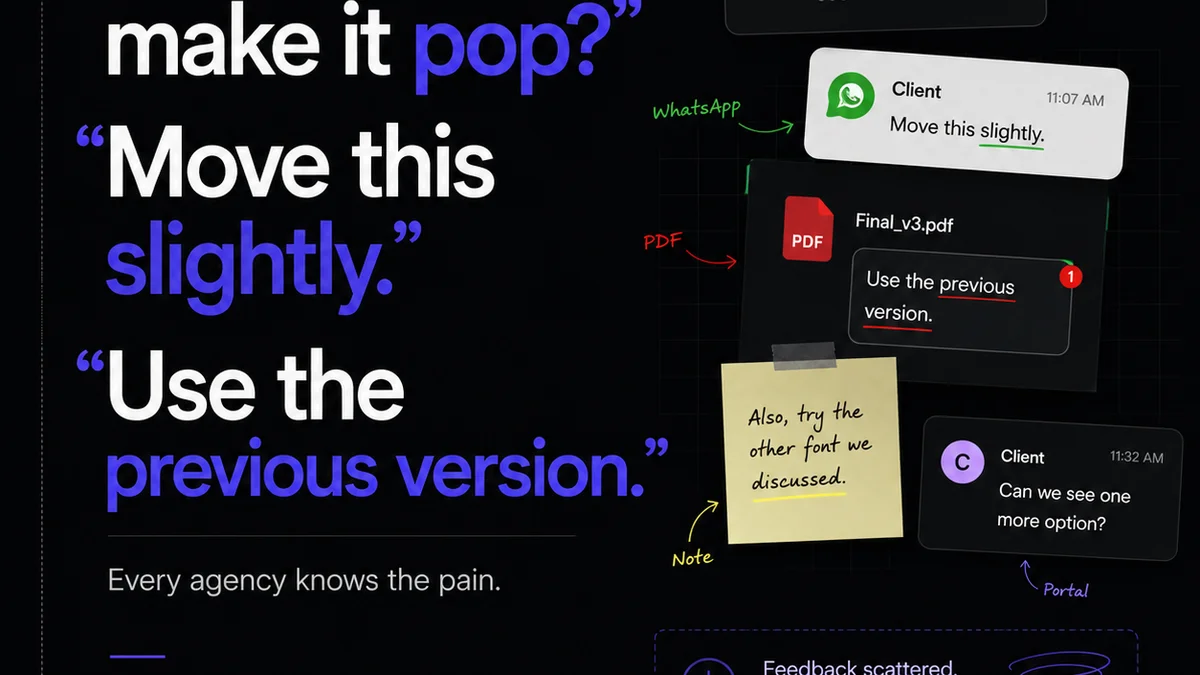
Everyone agrees a good review process is crucial for creative work. You need to get feedback, make revisions, and get approvals. It’s the engine of client collaboration.
Most agencies think this means more meetings, more emails, and more complex spreadsheets. You’re drowning in feedback, but nothing’s actually moving forward.
None of that is wrong. But it’s incomplete.
The hard truth? Your review process is failing because it’s built on assumptions, not on how people *actually* work. It’s too complicated, too opaque, and too easy to ignore.
1. The Myth of the Universal Reviewer
You assume everyone involved in a project understands what’s needed from them during a review. That’s a mistake. Stakeholders have different priorities, different levels of engagement, and different definitions of “good.”
Some people just want to rubber-stamp. Others want to micromanage every pixel. And most are somewhere in between, with limited time and attention.
Defining Roles and Expectations
Before you even *start* a review, you need crystal clarity on who is doing what. This isn’t just about naming a client contact. It’s about understanding their role in the feedback loop.
- The Decision Maker: The person with the final say. Their input is weighted heavily.
- The Subject Matter Expert: Provides feedback on specific areas (e.g., legal, technical).
- The Stakeholder: Needs to be informed, but may not need to provide detailed feedback.
- The Collaborator: Offers input and suggestions, but the final decision rests elsewhere.
Clearly communicating these roles *upfront* prevents scope creep and ensures the right people are providing the right kind of feedback.
The Feedback Window
When will feedback be collected? For how long? And what happens if it’s late?
A defined feedback window, communicated clearly, sets expectations. If feedback isn’t in by X date, the project moves forward with the feedback already received, or the stakeholder loses their chance to comment.
2. The Feedback Black Hole
You’re getting feedback, right? But is it organized? Is it actionable? Or is it just a stream of disconnected comments buried in email threads and Slack channels?
This is where most processes collapse. Feedback becomes a black hole, sucking in time and energy without producing clear outcomes.
Consolidating and Contextualizing Feedback
Scattered feedback is useless feedback. You need a single source of truth for all comments related to a specific creative asset.
Imagine a client leaves a comment on a PDF, another via email, and a third in a meeting. How do you reconcile that? How do you ensure no comment gets lost?
The goal is to centralize feedback so you can see it all in one place, attached to the specific version of the asset it refers to. This provides crucial context.
Actionable vs. Opinion
Not all feedback is created equal. Some is a clear instruction, others are vague opinions. Your process needs to differentiate.
- Actionable: “Change the headline to X.” “Make the button blue.” “Reduce the image size.”
- Opinion/Suggestion: “I don’t love this color.” “It feels a bit too corporate.” “Can we try something more… exciting?”
Your team needs to be trained to identify and prioritize actionable feedback. Opinions can be discussed, but they shouldn’t derail the project unless they’re backed by a clear rationale or come from the primary decision-maker.
3. The Revision Roulette
You’ve got feedback. Now what? The revision process is often the most chaotic part of the cycle. It’s a guessing game of who’s revising what, based on whose feedback, and when it’ll be ready.
This leads to endless back-and-forth, missed deadlines, and frustrated teams.
Version Control is Non-Negotiable
You absolutely *must* have a clear system for managing different versions of creative assets. Without it, you’re flying blind.
Which is the latest? Which one did the client approve? Which one has the latest round of edits?
Every revision needs to be tracked. Each new version should clearly supersede the previous one, with a record of what changed. This prevents confusion and ensures everyone is working from the most current iteration.
Clear Assignment and Tracking
Who is responsible for making the revisions? When are they due? How will you track progress?
Assigning ownership for each revision task is critical. A simple task list or project management board can work, but the key is visibility. Everyone involved should be able to see the status of revisions without having to ask.
4. The Approval Ambiguity
This is the moment of truth. But often, “approval” is a handshake, a quick email, or a vague “Looks good.” This ambiguity is a ticking time bomb.
What if the client later claims they never approved that specific element? What if a different stakeholder had concerns they never voiced?
Formalizing the Sign-Off
Approval needs to be explicit and documented. A casual “LGTM” (Looks Good To Me) isn’t enough for critical projects.
You need a clear, unambiguous sign-off mechanism. This could be a formal sign-off button within a review tool, a dedicated approval email with specific sign-off language, or a recorded meeting minute that is then confirmed by the client.
The key is that it signifies a commitment. It’s the point where the client accepts the work as complete for that stage.
Defining
Frequently asked questions
What is the most common mistake agencies make with their review process?
The most common mistake is assuming everyone understands their role and the process. Agencies often fail to clearly define who needs to provide what type of feedback, when it's due, and what constitutes final approval. This ambiguity leads to confusion, delays, and scope creep.
How can I ensure feedback is actionable?
Train your team and clients to differentiate between actionable feedback (specific instructions like 'change X to Y') and subjective opinions ('I don't like this'). Prioritize actionable feedback and use discussions to clarify subjective comments. Centralizing feedback also helps provide context, making it easier to understand the 'why' behind a comment.
What's the best way to manage different versions of creative work during reviews?
Implement strict version control. Each revision should be a new, clearly labeled version of the asset. Use a system that tracks changes between versions and ensures everyone is always looking at the most current iteration. This prevents confusion and ensures you're always working from the right file.
How do I get clients to actually follow the review process?
Set clear expectations from the start. Educate clients on the process, their roles, and the importance of timelines. Use tools that make it easy for them to provide feedback in a structured way and clearly communicate the consequences of late or unclear feedback. Consistency is key.