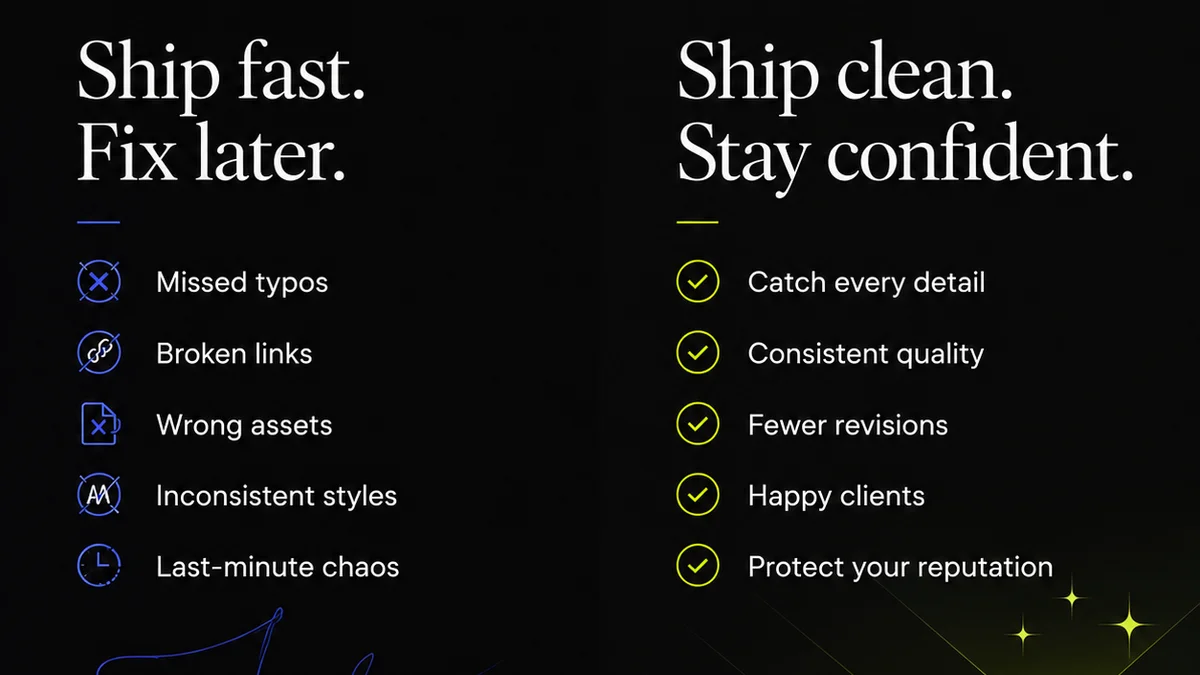
Most marketing teams think campaign Quality Assurance (QA) is primarily about catching typos. None of that is wrong. But it’s incomplete.
The hard truth? Effective campaign QA is less about the final polish and more about the operational engine that gets you there. It’s about building a system that prevents errors before they happen, streamlines approvals, and ensures brand consistency across every touchpoint. It’s the difference between a frantic last-minute scramble and a confident, on-time launch.
1. The Illusion of ‘Done’
What does ‘done’ even mean in a campaign context? Is it when the copy is approved? When the design is finalized? When the media plan is set?
The reality is, ‘done’ is a moving target. A campaign isn't a single asset; it's an ecosystem of interconnected elements. A change in one area can ripple through the entire project.
The Interconnectedness Trap
Consider a simple website banner. It needs to match the campaign’s core message. The copy needs to be approved. The design needs to align with brand guidelines. The banner needs to be correctly sized for different placements. It needs to link to the right landing page. The landing page itself needs to be live and functional. And all of this needs to be tracked and reported on.
If your QA process is linear and siloed, you’re setting yourself up for failure. You’re treating each asset as an island, not as part of a larger, integrated strategy.
2. The Cost of Rework
Every hour spent correcting an error discovered late in the process is an hour lost. This isn't just about wasted designer or copywriter time. It’s about:
- Missed deadlines
- Increased agency or internal costs
- Damaged client relationships
- Lost revenue opportunities
- Team burnout
These aren't abstract concepts. They are the daily realities of teams struggling with inefficient workflows.
When ‘Good Enough’ Becomes Expensive
Skipping thorough QA to meet a tight deadline is a false economy. The shortcuts you take today will cost you more tomorrow, in rework, in reputational damage, and in team morale. The goal of campaign QA isn't just to avoid mistakes; it's to build confidence in your process and your output.
3. Beyond the Spellcheck: What Real QA Looks Like
True campaign QA goes far beyond simple proofreading. It’s a multi-faceted approach that encompasses:
a. Strategic Alignment
Does the campaign element directly support the overarching campaign goals and objectives? Is the messaging consistent with the target audience and value proposition?
b. Brand Consistency
Are the correct logos, colors, fonts, and tone of voice being used? Does it feel like it came from your brand, or from anyone?
c. Technical Accuracy
Are all links working and pointing to the correct destinations? Are image resolutions appropriate for their intended use? Are ad specs (file size, format, dimensions) met?
d. Functional Integrity
For interactive elements like landing pages or emails, do forms submit correctly? Do CTAs function as expected? Is the user experience seamless?
e. Legal and Compliance
Are all disclaimers, terms, and conditions present and accurate? Does the content comply with relevant regulations (e.g., GDPR, ADA accessibility standards)?
f. Cross-Channel Cohesion
Does the asset fit within the context of the channel it’s deployed on? How does it relate to other campaign elements running concurrently?
4. Building a Proactive QA Framework
A robust QA process isn't an afterthought; it's baked into the workflow from the start. This means:
Clear Roles and Responsibilities
Who is responsible for what type of QA? Define ownership clearly to avoid confusion and ensure accountability.
Standardized Checklists
Develop detailed checklists tailored to different asset types and channels. These aren't just for proofing; they cover strategic, technical, and brand elements.
Defined Approval Gates
Establish clear stages where different stakeholders must provide formal approval. This prevents scope creep and ensures everyone is aligned before moving forward.
Version Control
Maintain a clear history of changes and approvals. Knowing which version is the latest and who approved it is critical.
Feedback Loops
Ensure feedback is constructive, specific, and actionable. Implement a system for tracking feedback and ensuring it’s addressed.
5. Where Revue Fits In
Managing campaign QA across multiple stakeholders, assets, and revisions can quickly become chaotic. This is where a centralized platform like Revue becomes essential.
Revue is built to bring clarity and control to creative workflows. Instead of chasing feedback across emails, Slack messages, and random documents, you can:
- Centralize Feedback: Consolidate all client and stakeholder comments directly on the creative assets within Revue. No more hunting for that one email thread.
- Streamline Revisions: Track every version of an asset, see who made what changes, and understand the revision history at a glance. This visibility is crucial for QA.
- Manage Approvals: Formalize the approval process. Stakeholders can mark assets as approved, rejected, or require revisions, providing a clear audit trail. This automates a critical QA gate.
- Enhance Quality Checks: With all feedback and revisions logged, performing final quality checks becomes a matter of reviewing a clear, documented history rather than an ambiguous final file.
By providing a single source of truth for feedback, revisions, and approvals, Revue helps teams move beyond ad-hoc QA to a structured, efficient process that catches more issues earlier and reduces costly rework.
6. Final Thought
Is your current campaign QA process a safety net, or is it a bottleneck? The distinction matters more than you think.
A true QA system empowers your team, builds client trust, and ultimately drives better campaign performance. It’s not just about preventing mistakes; it’s about building a more resilient, efficient, and effective creative operation.
Frequently asked questions
What's the difference between proofreading and campaign QA?
Proofreading focuses solely on surface-level errors like typos and grammatical mistakes. Campaign QA is a much broader process that includes strategic alignment, brand consistency, technical accuracy, functional integrity, legal compliance, and cross-channel cohesion, in addition to proofreading.
How can I make my campaign QA process more efficient?
Efficiency comes from standardization and centralization. Use detailed, asset-specific checklists, clearly define roles and responsibilities, establish formal approval gates, and utilize a platform like Revue to manage feedback and revisions in one place, avoiding scattered communication.
What are the biggest risks of skipping thorough QA?
The biggest risks include missed deadlines, increased project costs due to rework, damaged client relationships, lost revenue opportunities from delayed launches, and team burnout from last-minute firefighting.
How does version control help with campaign QA?
Version control provides a clear history of changes and approvals for each asset. This allows QA teams to easily see what has been modified, who made the changes, and when they were approved, preventing confusion and ensuring that the correct, finalized version is being reviewed.