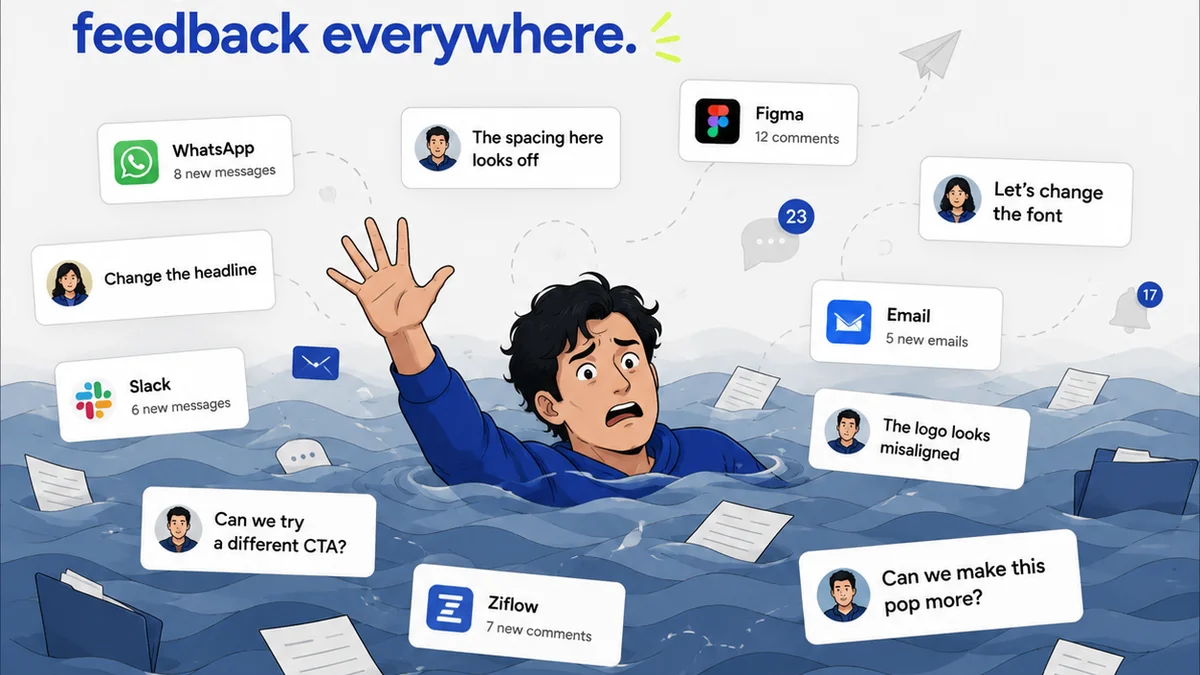
Everyone knows client feedback is crucial. It’s the North Star guiding your creative work. You collect it, you process it, you implement it. Simple, right?
None of that is wrong. But it’s incomplete.
The hard truth is that most agencies and creative teams mishandle client feedback. Not maliciously, but systematically. They treat it like a passive input, not an active, often chaotic, part of the workflow. This leads to endless revisions, missed deadlines, and strained client relationships.
Let’s break down the common mistakes and how to fix them.
1. The 'Everything and the Kitchen Sink' Feedback Dump
This is the most common symptom of a broken process. You send a deliverable, and the client responds with a massive email or document containing dozens of points. Some are critical, some are minor tweaks, and some are completely contradictory.
The Assumption: Clients know what they want, and they’re just telling you. It’s your job to sort it out.
The Hard Truth: Clients often don’t know *how* to articulate their feedback effectively. They’re looking at the output, not the underlying strategy. And they’re often under pressure themselves. A disorganized feedback dump is a sign they aren’t being guided through the review process.
Symptoms of the 'Kitchen Sink'
- Feedback arrives all at once, overwhelming the team.
- You spend more time deciphering feedback than acting on it.
- Conflicting comments from different stakeholders are common.
- The scope creep meter starts spinning wildly.
- The project timeline balloons unexpectedly.
How to Avoid It
The key is to structure the feedback process before you send the deliverable.
Use structured review stages. Define what each review stage is for. Is it for conceptual alignment? For detailed copy edits? For final approval? Communicate this clearly to the client.
Set clear expectations for feedback. Explain *how* you want feedback. For example:
- “For this conceptual review, please focus on the overall direction and messaging. We’ll handle detailed copy edits in the next stage.”
- “Please consolidate feedback from your team into a single document or comment thread to avoid conflicting requests.”
- “We’ve used [tool] for commenting so you can pinpoint exactly what you’re referring to.”
Guide their thinking. Ask specific questions. Instead of “What do you think?”, try “Does this headline effectively convey the core benefit?” or “Is the call to action clear and compelling?”
2. The 'Reply All' Nightmare
Client communication, especially around feedback, can quickly devolve into a chaotic mess of “reply all” threads. Important comments get buried. Decisions get lost. People work off outdated versions.
The Assumption: Everyone needs to be in the loop, so “reply all” is the safest bet.
The Hard Truth: “Reply all” is the enemy of efficient communication. It creates noise, fosters confusion, and guarantees that crucial information will be missed by at least one person.
Symptoms of 'Reply All' Chaos
- Multiple versions of the same document are floating around.
- Team members are working on superseded feedback.
- Key stakeholders miss critical decisions made in a long thread.
- You constantly have to ask, “Who said what, and when?”
- Misunderstandings about scope and requirements are rampant.
How to Avoid It
Establish a single source of truth for all feedback and communication.
Centralize feedback. Use a platform designed for this. Tools that allow for commenting directly on the creative asset are invaluable. This eliminates ambiguity about what is being commented on.
Designate a feedback point person. Ideally, this is a project manager or account lead on your side who is responsible for consolidating and clarifying feedback before it goes to the creative team. On the client side, encourage them to designate a similar point person.
Use version control religiously. Clearly label all deliverables with version numbers and dates. Communicate which version is the current one being worked on.
3. The 'Gut Feeling' Revision
You receive feedback that feels vague or subjective. “I just don’t like it,” or “Make it pop more.” These are impossible to act on effectively.
The Assumption: Clients have an intuitive sense of what works, and you should trust their gut.
The Hard Truth: While client intuition can sometimes be right, relying on vague subjective feedback without probing deeper is a recipe for endless, unproductive revisions. It means the initial brief or strategy wasn’t fully understood or agreed upon.
Symptoms of 'Gut Feeling' Revisions
- Requests to “make it better” or “add more energy.”
- The client can’t articulate *why* they don’t like something.
- Revisions are made, but the client is still unsatisfied.
- The project feels like it’s constantly shifting goalposts.
- Your team feels demotivated by arbitrary changes.
How to Avoid It
Push for clarity and data-driven decisions.
Ask 'why'. When you get subjective feedback, gently probe for the reasoning. “Can you tell me more about what’s not working for you?” or “What specifically about the current design feels flat?”
Connect feedback to objectives. Refer back to the project brief and goals. “Our goal here was to convey trustworthiness. Does this element feel less trustworthy to you, and why?”
Use objective criteria. If possible, define measurable criteria for success. For a website, this might be conversion rates. For an ad, it might be click-through rates. While not always applicable to early creative stages, it’s a good principle to keep in mind.
Educate the client. Sometimes, clients need a gentle reminder of the strategic goals or design principles at play. Frame it as a collaborative effort to achieve the best outcome.
4. Ignoring the 'Silent Stakeholder'
You get feedback from the main point person, you implement it, and you ship. Then, weeks later, a different stakeholder surfaces with entirely different concerns that should have been addressed early on.
The Assumption: The primary contact is the sole decision-maker and represents all necessary viewpoints.
The Hard Truth: The primary client contact might not have the authority, the perspective, or the inclination to gather and represent all necessary internal feedback. Ignoring other potential stakeholders creates significant risk.
Symptoms of the Silent Stakeholder
- Major feedback emerges late in the process from an unexpected source.
- The project gets held up by a new, previously unknown, decision-maker.
- Internal client politics derail progress.
- You have to redo significant work because a key department’s needs weren’t considered.
- The final deliverable doesn't meet the needs of a critical internal user group.
How to Avoid It
Proactively identify and involve all key stakeholders.
Ask about the approval process early. In your kickoff meeting, ask: “Who are the key people who need to review and approve this work? What is their role? How do they typically provide feedback?”
Request an internal client meeting. Suggest a brief internal client alignment meeting before the first major deliverable is shared. This helps ensure everyone is on the same page from the start.
Facilitate multi-stakeholder reviews. When appropriate, include multiple client stakeholders in review meetings or set up shared review sessions. Use a platform that allows multiple users to comment and see each other’s feedback.
Clarify roles. Understand who has the final say versus who provides input.
5. The 'Revision Roulette'
You implement feedback, and the client comes back with *more* feedback. Then you implement that, and they have *more* feedback. This cycle can repeat indefinitely, with each round adding cost and time.
The Assumption: More revisions mean a better final product.
The Hard Truth: Unfettered revisions are a sign of an unclear scope, poor initial brief, or a lack of defined endpoints. They erode profitability and damage team morale.
Symptoms of Revision Roulette
- The number of revision rounds far exceeds the original scope.
- Clients seem to be discovering new issues with each round.
- The project is consistently running over budget and timeline.
- Your team is burning out or becoming disengaged.
- The client relationship is becoming strained.
How to Avoid It
Define scope and limits clearly, and stick to them.
Scope it out. Clearly define the number of revision rounds included in your proposal and contract. Be specific about what constitutes a “round.”
Define ‘done’. Agree on clear criteria for final approval. What does success look like? What are the gatekeepers for sign-off?
Charge for out-of-scope revisions. If the client requests changes that fall outside the agreed-upon scope, be prepared to discuss additional costs and time. Present this professionally: “This request falls outside our original scope. We can accommodate it for an additional X investment and Y days. Would you like to proceed?”
Use phased approvals. Break the project into phases and get sign-off at each stage. This prevents major shifts late in the game.
Where Revue Fits In
Managing client feedback effectively isn’t about having a magic wand; it’s about having the right systems. It’s about creating clarity, accountability, and efficiency.
Tools like Revue are built to tackle these exact challenges. By centralizing all client feedback, comments, and approvals in one place, you eliminate the “reply all” chaos and the buried feedback.
You can easily track who said what, when, and ensure all stakeholders have visibility. This structured approach helps you:
- Centralize Feedback: All comments live on the asset, not lost in email chains.
- Manage Revisions: Track the history of changes and feedback, making it clear what’s been addressed and what’s next.
- Ensure Approvals: Formalize the sign-off process, reducing ambiguity and scope creep.
- Maintain Quality: Easily reference feedback and previous versions to ensure the final output meets all requirements.
This isn’t about adding another piece of software; it’s about implementing a workflow that respects your team’s time and your client’s investment.
Final Thought
Client feedback is a gift, but only if it’s given and received properly. Are you treating feedback as a collaborative input that requires structure and guidance, or are you letting it dictate your workflow in a chaotic, reactive cycle?
Frequently asked questions
What is the biggest mistake agencies make with client feedback?
The biggest mistake is treating client feedback as a passive input rather than an active, often chaotic, part of the workflow. This leads to disorganized feedback dumps, endless revisions, and missed deadlines because the process isn't structured or guided effectively.
How can I stop clients from sending vague or subjective feedback?
Gently probe for the 'why' behind their feedback. Ask specific questions that tie back to the project objectives. For example, instead of 'Make it pop more,' ask 'What specific aspect of the design isn't conveying the intended energy, and how does it relate to our goal of X?'
What's the best way to manage multiple stakeholders' feedback?
Proactively identify all key stakeholders early in the project. Encourage the client to designate a primary feedback point person, but also seek to understand who else needs to review and approve. Facilitate multi-stakeholder review sessions or use a platform where all feedback can be seen and managed centrally.
How do I handle feedback that goes beyond the original project scope?
Clearly define the number of revision rounds included in your contract. If a client requests changes outside that scope, present it professionally. Explain that it's outside the original agreement and provide a quote for the additional time and cost involved before proceeding.