Everyone talks about data. About metrics. About making smarter decisions. And that’s all good advice.
But for creative agencies, the common narrative around data often misses the point entirely. It fixates on vanity metrics or superficial performance indicators. It tells you *what* happened, but rarely *why* or, more importantly, *what to do next*.
The hard truth? Most agencies are leaving money on the table by not truly leveraging creative analytics. They’re busy creating, but not systematically learning from what works and what doesn’t.
1. The Illusion of Creative Success
You’ve just delivered a killer campaign. The client *loves* it. They’re thrilled with the visuals, the copy, the whole shebang. You tick the box, send the invoice, and move on to the next project.
This feels like success. And in many ways, it is. But is it *profitable* success?
The assumption is that client happiness and a successful project delivery are the sole indicators of value. This is a dangerous oversight for your agency’s bottom line.
The Real Cost of Guesswork
Without digging deeper, you’re operating on assumptions. Assumptions about:
- Client preferences
- Effective creative approaches
- Revision cycles
- Resource allocation
- Profitability per project
Every assumption that proves wrong costs you time, money, and potentially future business. It’s the hidden tax on creative work.
Beyond Gut Feel
Your team’s intuition is valuable. It’s honed by experience. But intuition alone can’t predict market response or optimize for profitability across a portfolio of clients.
Creative analytics forces you to move beyond gut feel and into the realm of evidence-based decision-making. It’s the bridge between creative output and business outcome.
2. What Creative Analytics *Really* Means for Agencies
Forget the endless dashboards filled with click-through rates and engagement scores that your marketing team might obsess over. For an agency, creative analytics is about understanding the *impact* of your creative output on client objectives and your own profitability.
It’s about a systematic process of capturing, analyzing, and acting on data related to your creative workflow and its outcomes.
Key Areas to Track
This isn't just about final campaign performance. It's about the entire lifecycle of creative work:
- Feedback Patterns: Who gives feedback? What type of feedback is most common? Is it clear, actionable, or vague?
- Revision Cycles: How many rounds of revisions are typical for different project types? Which clients or project managers lead to more revisions?
- Approval Bottlenecks: Where do approvals get stuck? Who is the bottleneck? How long does each stage take?
- Resource Allocation vs. Time Spent: Are your estimates accurate? Are specific team members or roles consistently under- or over-utilized?
- Client Profitability: Which clients and project types are the most profitable? Where are you losing money due to scope creep or inefficient processes?
- Creative Effectiveness: Which creative elements (visual styles, messaging, formats) consistently drive client results? (This requires client-side data, but you can ask for it!)
This data provides a clear, objective view of your operations.
The ROI Connection
How does this translate to ROI? Directly.
- Reduced Rework: By understanding common feedback pitfalls, you can preemptively address them, cutting down on costly revisions.
- Accurate Estimating: Historical data on time spent and revisions leads to more precise project bids, protecting your margins.
- Optimized Resource Allocation: Knowing where your team’s time actually goes allows for better staffing and prevents burnout or underutilization.
- Streamlined Approvals: Identifying bottlenecks helps you implement better processes or client communication strategies, speeding up delivery.
- Demonstrable Value: By tracking the impact of your creative work (even if it’s just reporting on campaign elements that correlate with success), you prove your worth beyond aesthetics.
This isn't about turning your agency into a data science lab. It's about using data to make your creative process more efficient, predictable, and profitable.
3. Implementing Creative Analytics Without Drowning in Data
The biggest fear? Getting bogged down in complex tools and overwhelming spreadsheets. You’re a creative agency, not a hedge fund.
The key is to start small, focus on actionable insights, and integrate data collection into your existing workflows.
Start with the Obvious Pain Points
Where does your agency bleed time and money? Is it endless client revisions? Projects that consistently go over budget? Client communication breakdowns?
Pick one or two major pain points and start tracking the data related to them. Don’t try to boil the ocean.
Leverage Existing Tools (and Smart New Ones)
Your project management software, time-tracking tools, and even your communication platforms likely hold a treasure trove of data. You just need to know what to look for and how to extract it.
For example:
- Project Management Software: Track task completion times, revision counts per task, and approval stage durations.
- Time Tracking: Analyze where billable hours are spent versus estimates. Identify non-billable overhead that’s eating into profits.
- Communication Logs: Look for patterns in client requests, feedback clarity, and response times.
This is where specialized tools like Revue become invaluable. They centralize feedback, track revision history, and provide clear visibility into the entire approval process. This structured data is far more valuable than scattered email threads.
Define Clear KPIs
What metrics will actually tell you if you’re improving? Don’t just track everything. Track what matters for your chosen pain points.
Examples:
- Average number of revision rounds per project type.
- Average time from brief to final approval.
- Variance between estimated and actual hours spent on projects.
- Percentage of projects delivered on time and on budget.
These are concrete indicators of operational health.
Make it a Team Effort
Data collection shouldn't fall on one person. Train your team on what data to capture and why it’s important. Foster a culture where objective feedback and data-informed discussions are the norm.
Regular Review and Action
Collecting data is useless if you never look at it. Schedule regular (weekly or bi-weekly) reviews of your key metrics. Discuss what the data is telling you and, crucially, what actions you will take based on those insights.
This is where the ROI happens. It’s in the *action* taken based on the data.
4. Where Revue Fits In
You might be thinking, “This sounds like a lot of work. How do I even start capturing this granular data?”
That’s precisely the problem Revue was built to solve for creative teams.
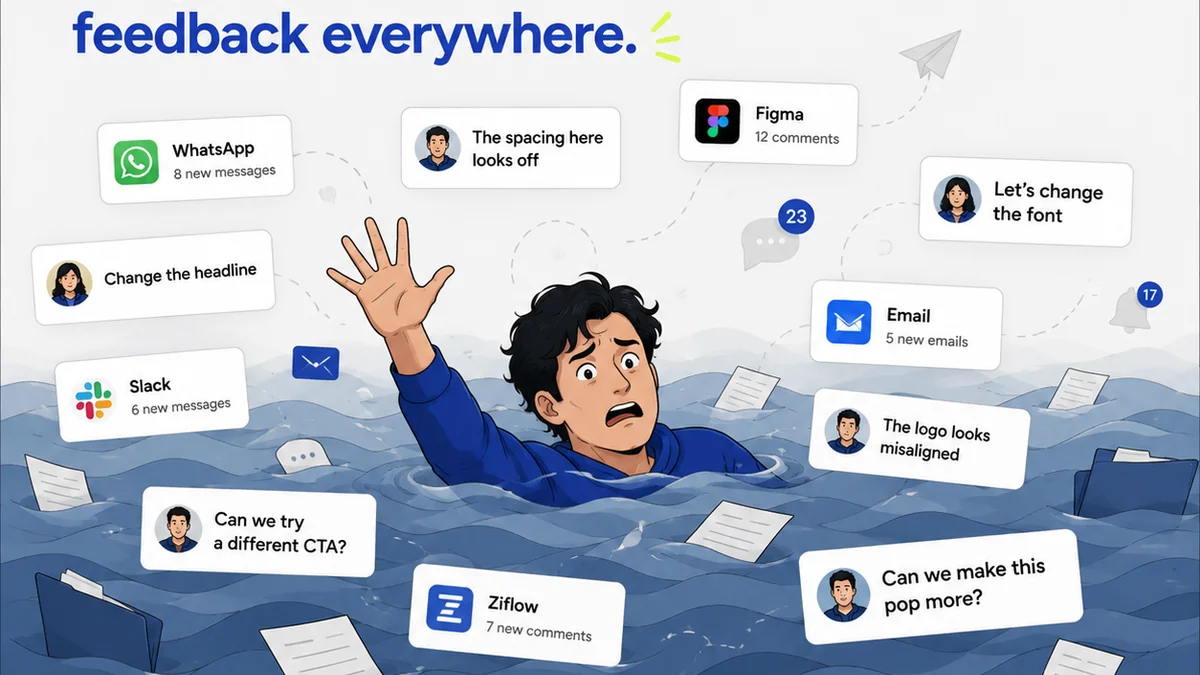
Creative work is messy. Feedback gets lost in email chains, Slack messages, and random documents. Revisions are tracked manually, leading to confusion and scope creep. Approvals become black holes.
Revue acts as your centralized hub for all creative project communication, feedback, and approvals. It brings structure to the chaos.
- Centralized Feedback: All client comments live in one place, attached directly to the creative asset. No more hunting through inboxes.
- Version Control & Revisions: Easily track every iteration of a design or piece of content. See exactly what changed and when.
- Clear Approval Workflows: Define and manage approval stages, ensuring accountability and visibility. See who needs to approve what, and when.
- Audit Trail: Every comment, revision, and approval is logged, creating an indisputable record. This is invaluable for understanding project history and resolving disputes.
By centralizing these critical workflow elements, Revue automatically generates the kind of structured data you need to perform effective creative analytics. You gain immediate visibility into revision cycles, feedback clarity, and approval times without adding manual data entry burdens to your team.
This isn’t just about managing projects better; it’s about generating the raw material for smarter business decisions that directly impact your agency’s profitability.
5. The Long Game: Building a Data-Informed Creative Culture
Shifting to a data-informed approach isn't an overnight fix. It’s a cultural evolution.
It requires a commitment from leadership to prioritize operational efficiency alongside creative excellence.
It means empowering your team with the tools and training to see data not as a threat, but as an ally.
An ally that helps them:
- Understand client needs more deeply.
- Refine their creative process.
- Justify their creative decisions with objective insights.
- Ultimately, contribute to a more sustainable and profitable business.
The agencies that thrive in the coming years will be those that master this blend of creative vision and operational intelligence.
Final Thought
Are you managing your creative projects, or are your projects managing you? The answer lies not just in the quality of your creative output, but in the rigor of your operational insight.
Frequently asked questions
What is the primary benefit of creative analytics for an agency?
The primary benefit is moving from guesswork to evidence-based decision-making, leading to increased efficiency, reduced costs from rework, more accurate project bids, and ultimately, improved profitability and ROI.
How can I implement creative analytics without overwhelming my team?
Start by identifying your agency's biggest operational pain points (e.g., excessive revisions, slow approvals). Focus on tracking data related to those specific issues using existing tools or specialized software like Revue. Make data collection a team effort and schedule regular reviews to take action on insights.
What kind of data should agencies track for creative analytics?
Key areas include feedback patterns (type, source, clarity), revision cycle lengths, approval times and bottlenecks, resource allocation vs. time spent, client profitability, and (where possible) creative elements that correlate with client success.
How does a tool like Revue help with creative analytics?
Revue centralizes client feedback, revision history, and approval workflows. This structured data automatically provides insights into project efficiency, revision counts, and approval times, eliminating manual tracking and forming the foundation for deeper analytics without extra effort.