Everyone talks about the creative handoff. They say it’s about clear briefs, organized files, and precise specs. None of that is wrong. But it’s incomplete.
The real story of a smooth creative handoff is buried deeper, in the operational friction you’re not talking about. It’s about predictable processes, shared accountability, and systems that prevent errors before they happen. It’s about moving beyond “good enough” to reliably excellent.
1. The Illusion of the Perfect Brief
You think a killer brief solves everything. It’s the foundation, sure. But a brief’s brilliance fades fast if the process it feeds is broken.
A great brief is just the first step in a long relay race. If the baton drops between creative and development, or between design and marketing, the brief becomes useless paperwork.
The hard truth? The brief is only as good as the system that executes it. And most systems are ad-hoc, relying on tribal knowledge and heroic effort.
The Symptoms of Brief Breakdown
- Endless clarification questions weeks after the brief was “final.”
- Scope creep disguised as “minor tweaks” because the initial scope was never truly locked.
- Misunderstandings about core objectives leading to rework.
- The blame game starts: “You didn’t specify…” vs. “You didn’t ask…”
2. Beyond File Naming: The Anatomy of a Production-Ready Asset
We all know about consistent file naming conventions. It’s basic hygiene. But a production-ready asset is far more than just a well-named PSD or Sketch file.
It’s about the embedded metadata, the color profiles, the font licensing. It’s about understanding the end-use environment and packaging the asset accordingly.
Think about it: Are your assets truly ready for prime time, or do they require significant prep work by the receiving team? That prep work is a hidden cost, a drag on efficiency.
Essential Asset Specifications
- Correct color space (sRGB for web, CMYK for print, etc.).
- Embedded fonts or clear licensing information.
- Appropriate resolution and file format for the intended platform.
- Layer organization and naming for easy editing.
- Clear annotation for interactive elements or dynamic content.
This isn't just about making life easier for the next person. It's about reducing errors, speeding up deployment, and ensuring brand consistency across all touchpoints.
3. Version Control: The Unsung Hero of Handoff
Email chains with subject lines like “Logo_Final_v3_USE_THIS_ONE.ai” are a creativity killer. They breed confusion and lead to outdated versions being used.
This isn't just a minor annoyance; it’s a critical failure point in the creative handoff. Without a clear, single source of truth for creative assets, chaos ensues.
Developers might pull an old logo. Marketing might use outdated campaign imagery. The client sees a disjointed brand experience.
A robust version control strategy is non-negotiable for any agency serious about efficient creative handoffs. It ensures everyone is working from the latest, approved iteration.
Why Version Control Matters
- Prevents the use of obsolete assets.
- Provides an audit trail of changes.
- Facilitates rollback if a new version introduces issues.
- Reduces time wasted searching for the correct file.
This applies not just to final assets, but to all interim versions during the review and approval cycles. Transparency here is key.
4. Defining the Handoff Gates: When is it *Really* Done?
The biggest assumption? That “done” means the same thing to everyone. It rarely does.
Creative teams might consider a design “done” when it meets aesthetic and functional requirements. Developers might see “done” as when it’s coded and technically sound. Marketing might see “done” as when it’s live and performing.
This misalignment is a ticking time bomb for the handoff. You need to define specific checkpoints and clear criteria for what constitutes “done” at each stage.
Establishing Handoff Gates
- Creative Sign-off: All aesthetic and functional requirements met. Final assets are ready.
- Technical Review: Assets are production-ready, specs are accurate, and implementation is feasible.
- QA/UAT: The implemented work meets all defined requirements and functions as expected in the target environment.
- Launch/Deployment: The work is live and performing.
Each gate requires clear communication and explicit approval. Without this, you’re essentially throwing work over the wall and hoping for the best.
5. The Human Element: Communication and Collaboration
We often focus on tools and processes, forgetting that people are at the center of any workflow. Effective creative handoffs rely heavily on clear, consistent communication.
This isn’t just about sending an email. It’s about fostering a collaborative environment where questions are encouraged, feedback is constructive, and assumptions are challenged early.
When teams feel comfortable raising concerns or asking for clarification without fear of judgment, the entire handoff process becomes smoother and less prone to error.
Fostering Better Collaboration
- Schedule brief alignment meetings between creative and development leads.
- Encourage asynchronous communication for non-urgent queries.
- Create a shared understanding of project goals and constraints.
- Celebrate successful handoffs and learn from difficult ones.
This human-centric approach builds trust and ensures that the technical and procedural steps are supported by a strong team dynamic.
Where Revue Fits In
Managing the complexities of a creative handoff workflow requires more than just good intentions. It demands a system designed to bring clarity and control.
Revue acts as that central nervous system for your creative work. It’s where feedback converges, revisions are tracked, and approvals are solidified.
Imagine a world where every stakeholder, from the designer to the developer to the client, has a single source of truth for the project’s status. No more digging through email chains or Slack messages to find that one crucial decision.
With Revue, you can:
- Centralize Client Feedback: All comments, annotations, and stakeholder input live in one place, linked directly to the creative asset. This eliminates confusion and ensures feedback isn’t missed or misinterpreted.
- Manage Revisions and Approvals with Visibility: Track every iteration, see who approved what and when. This creates an undeniable audit trail and clarifies the path from concept to final sign-off.
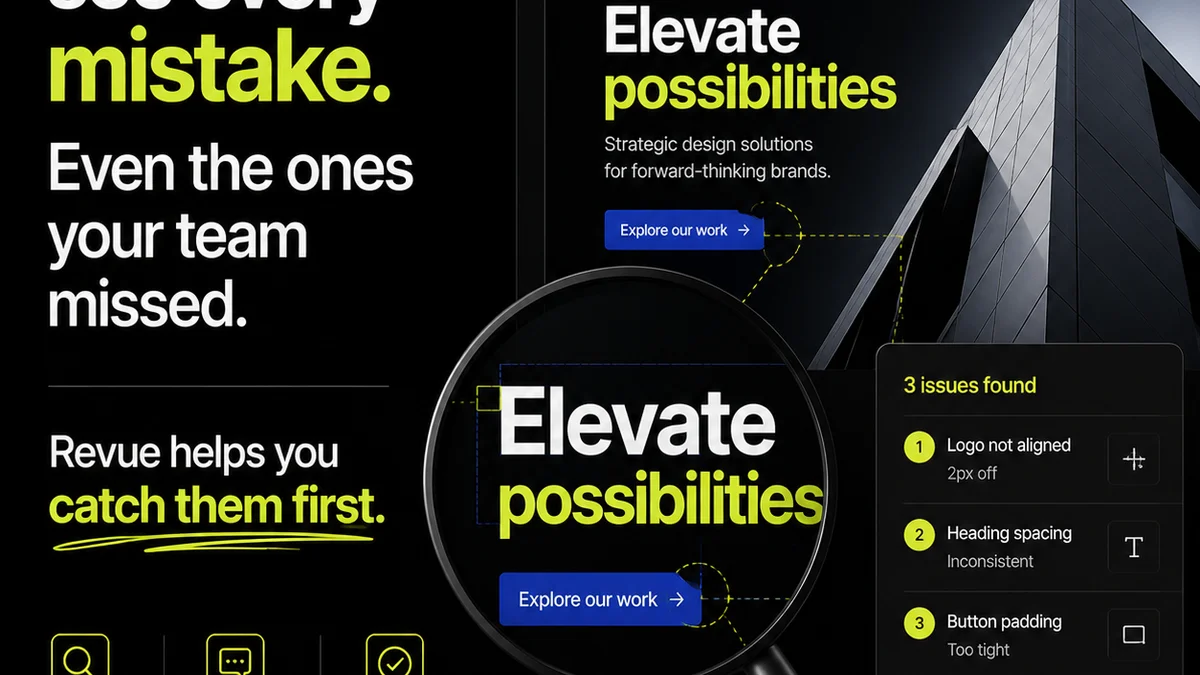
- Run Quality Checks Seamlessly: Ensure that what’s approved is what gets handed off. Use checklists and clear approval stages to catch potential issues before they impact development or launch.
This structured approach transforms the handoff from a potential point of failure into a predictable, efficient stage of the project lifecycle. It’s about operationalizing excellence.
6. The Cost of a Broken Handoff
Let’s be blunt: a chaotic creative handoff isn’t just inefficient; it’s expensive.
Think about the developer hours spent deciphering unclear specs. The designer time spent re-explaining requirements. The client frustration leading to scope creep or delayed payments.
These aren’t abstract costs. They directly impact your agency’s profitability and your team’s morale.
Every rework cycle, every missed deadline, every miscommunication adds up. It erodes your margins and damages your reputation.
Investing in a robust creative handoff workflow isn’t an overhead; it’s a profit driver. It’s the difference between barely scraping by and consistently delivering high-quality work on time and on budget.
7. Automating for Predictability
While human communication is vital, relying solely on it for complex workflows is a recipe for inconsistency. This is where automation and structured processes become indispensable.
Think beyond simple checklists. Consider how you can automate notifications, standardize asset packaging, and enforce approval stages.
The goal is to build a system that guides users toward the correct actions, minimizing the opportunity for error. This isn't about replacing human judgment but about supporting it with reliable scaffolding.
Opportunities for Automation
- Automated notifications for pending approvals.
- Templated project setups for recurring handoff needs.
- Integration with project management tools to sync status updates.
- Automated generation of spec sheets based on design parameters.
When processes are automated, they become repeatable and scalable. This predictability is the bedrock of a high-performing agency.
Final Thought
The creative handoff is often treated as a final, almost administrative step. It’s seen as the bridge between “making it” and “shipping it.”
But if that bridge is weak, rickety, or constantly under construction, everything you’ve built on the creative side is at risk.
Are you treating your creative handoff as a critical operational process, or just as a task to get through?
Frequently asked questions
What are the key components of a successful creative handoff?
A successful creative handoff involves a clear brief, production-ready assets with correct specifications (color profiles, fonts, formats), robust version control, defined approval gates with clear criteria, and effective communication between teams.
How can I prevent scope creep during the creative handoff?
Prevent scope creep by having a well-defined brief, locking down scope before the handoff begins, establishing clear approval stages with explicit sign-offs at each gate, and using a system that tracks all changes and approvals.
What is the role of version control in creative handoffs?
Version control ensures that everyone is working with the latest, approved version of a creative asset. It prevents confusion, reduces the risk of using outdated materials, and provides an audit trail of all changes, which is crucial for accountability and troubleshooting.
How does a tool like Revue improve the creative handoff process?
Revue centralizes client feedback, manages revisions with clear visibility, and facilitates quality checks. This eliminates scattered communication, provides a single source of truth for approvals, and ensures that what is approved is what gets handed off, reducing errors and delays.