Everyone thinks a great creative leader is a visionary. Someone who conjures brilliant ideas out of thin air and then magically makes them happen. They’re the artistic director, the client whisperer, the ultimate decision-maker.
None of that is wrong. But it’s incomplete.
The real, hard truth is that effective creative leadership isn't about being the sole source of brilliance. It's about building a system where brilliance can emerge, be refined, and delivered without grinding the entire operation to a halt.
This isn't about delegating tasks. It's about orchestrating workflow. It’s about creating an environment where your team thrives, clients feel heard, and projects actually *move*.
1. The Myth of the Indispensable Creative Director
We worship the idea of the singular genius. The CD who has the final say on every pixel. The one person who can ‘see’ the final campaign in their head from day one.
This creates bottlenecks. It makes everyone else on the team dependent on one person’s availability and mood.
It also stifles growth.
When junior designers and art directors know their ideas will just be “fixed” by the CD, why bother pushing themselves? Why take risks?
The Real Work: Cultivating Collective Intelligence
Your job as a leader isn't to have all the answers. It's to ask the right questions. And to build a process that helps your team find those answers collaboratively.
This means:
- Creating clear briefs that allow for interpretation.
- Establishing review stages where feedback is constructive, not just critical.
- Empowering team members to present their own work and defend their rationale.
- Recognizing and rewarding initiative, not just final execution.
It’s about shifting from a top-down command structure to a networked intelligence model. Your team’s collective brainpower is far more potent than yours alone.
2. The Bottleneck of Indecision and Vague Feedback
The fastest way to kill creative momentum is through endless revision cycles fueled by unclear direction. You’ve seen it: the client who says “make it pop” without specifying what that means. Or the CD who can’t commit to a direction, sending the team back to the drawing board for the fifth time.
This isn't just frustrating; it's expensive. Every unproductive hour is a direct hit to your agency’s profitability.
Indecision is a leadership failure. Vague feedback is a communication breakdown.
The Hard Truth: Clarity is King (and Queen)
Your primary role in managing creative output is to ensure absolute clarity at every stage. This involves:
- Defining Success Upfront: What does a ‘win’ look like for this project? What are the KPIs? What’s the core message?
- Structured Feedback Loops: Implement a system for collecting feedback. Make it specific, actionable, and tied back to the original brief.
- Decision-Making Authority: Empower individuals or small teams to make decisions within defined parameters. Not every choice needs to go to the top.
- Managing Client Expectations: Educate clients on the revision process and the cost of ambiguity.
When decisions are made swiftly and feedback is precise, the team can iterate efficiently. They know what they’re aiming for, and they know when they’ve hit the mark.
3. The Illusion of Speed Through Rushing
Many leaders believe that to go fast, you simply tell everyone to hurry up. That more hours logged equals faster delivery.
This is a recipe for burnout and subpar work.
Rushing creative talent doesn’t make them faster; it makes them more likely to make mistakes, overlook details, and produce work that’s technically sound but creatively hollow.
The Real Driver: Efficient Process, Not Just Pressure
True speed in creative output comes from optimizing the workflow, not just cranking up the pressure. This means:
- Accurate Scoping: Underestimating the time and resources needed is a guaranteed way to fall behind.
- Phased Deliverables: Break down large projects into smaller, manageable milestones. This allows for progress tracking and early course correction.
- Parallel Processing: Identify tasks that can be done concurrently rather than sequentially. Can design and copy development happen at the same time?
- Clear Handoffs: Ensure that when one stage is complete, the next team has everything they need to start immediately. No waiting for files or explanations.
- Proactive Problem-Solving: Anticipate potential roadblocks (e.g., client approvals, technical limitations) and have contingency plans.
An efficient process respects the creative’s time and focus, allowing them to do their best work without unnecessary friction.
4. The Risk of Unseen Quality Control
You might think quality control is the final check before delivery. A quick once-over to catch typos.
This is a dangerous assumption.
Quality isn’t a last-minute add-on; it’s woven into the fabric of the entire creative process. If you’re only checking for errors at the end, you’re missing fundamental issues that might require significant rework.
Integrating Quality from the Start
A robust quality assurance process looks like this:
- Brief Alignment Checks: Does the work still align with the original brief and objectives? This should happen at key milestones, not just at the end.
- Brand Consistency Reviews: Are we adhering to brand guidelines? Is the tone of voice consistent?
- Technical Audits: For digital work, are there performance issues? Is it responsive? For print, are the specs correct?
- Peer Reviews: Encourage team members to review each other’s work constructively throughout the process.
- Client-Side Checks: Involve key client stakeholders at defined points to ensure alignment and catch subjective issues early.
When quality is a continuous effort, the final review is a formality, not a frantic scramble to fix problems.
Where Revue Fits In
Managing this kind of efficient, high-quality creative workflow requires visibility and control. You need a central hub that keeps everything organized and moving.
That’s where Revue comes in.
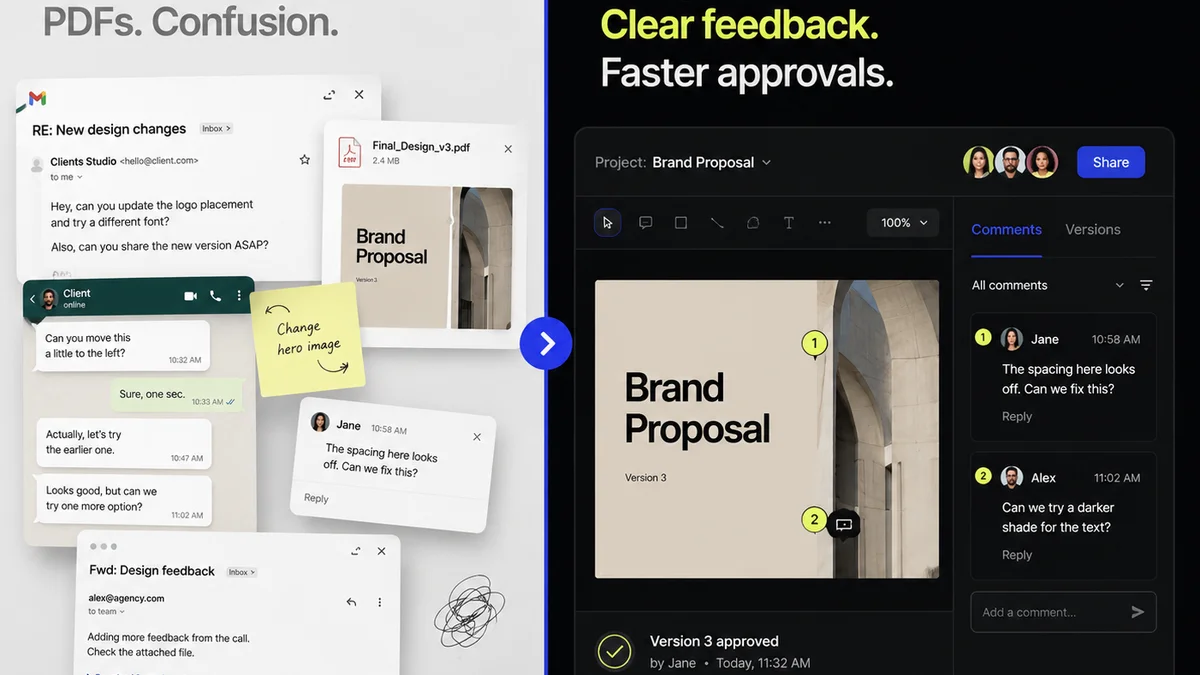
Revue is built to tackle the operational friction that slows creative teams down. It centralizes client feedback, making it easy to track comments, requests, and approvals in one place. No more digging through endless email chains or Slack messages.
This visibility means you can easily see where projects stand, identify bottlenecks, and ensure that feedback is actionable. Revision cycles become clearer, and accountability is built-in.
When everyone is working from a single source of truth, and the progress is transparent, your team can focus on what they do best: creating brilliant work.
Final Thought
Are you a creative leader, or a creative bottleneck? The distinction lies not in how many brilliant ideas you have, but in how effectively you enable your team to bring theirs to life.
The goal isn’t to be the indispensable genius. It’s to build an indispensable team.
Frequently asked questions
What is the biggest mistake creative leaders make?
The biggest mistake is assuming leadership means being the sole source of ideas and decisions. This creates bottlenecks and stifles team growth. True leadership empowers the team to collaborate and innovate.
How can I ensure my team delivers high-quality work quickly?
Focus on process, not just pressure. Optimize workflow, ensure clear briefs and feedback, break down projects into phases, and integrate quality control throughout the entire creative process, not just at the end.
What's the difference between delegating tasks and empowering a team?
Delegating tasks means assigning specific jobs. Empowering a team means giving them the autonomy, resources, and trust to make decisions, solve problems, and take ownership of their work within a defined scope.
How can technology help creative leaders manage their teams better?
Tools that centralize feedback, streamline approvals, and provide project visibility are crucial. They reduce administrative overhead, clarify communication, and help identify and resolve bottlenecks efficiently.