Everyone talks about creative metrics. Client satisfaction scores. Project completion rates. Profit margins. None of that is wrong. But it’s incomplete.
The hard truth? Most agencies focus on the *outcomes* of their work, not the *inputs* that actually drive those outcomes. They measure success after the fact, instead of building systems to ensure success from the start.
1. The Wrong Metrics Are Easy Metrics
It’s tempting to track the obvious. Likes on a social post. Website traffic after a redesign. Conversion rates from a campaign.
These are easy to measure. They’re often provided by the client’s analytics platforms or are publicly available.
But they don’t tell you *why* something succeeded or failed. They don’t reveal the quality of your creative process or the efficiency of your team.
Vanity vs. Actionable
Vanity metrics are like a scale that only shows your weight after a diet. They don’t tell you if you’re losing fat or muscle. They don’t tell you *how* you lost it.
Actionable metrics, on the other hand, are like your daily calorie intake and exercise logs. They tell you what’s working and what needs adjustment *during* the process.
2. The Real Metrics: Process, Not Just Product
The best agencies understand that the creative *process* is the engine of consistent results. They measure the health of that engine.
This means looking at:
- Feedback Quality: Is client feedback specific, actionable, and timely? Or is it vague, contradictory, and delayed?
- Revision Cycles: How many rounds of revisions are typical for a project? Are they efficient, or do they drag on endlessly?
- Internal Collaboration: How smoothly does work move between teams (strategy, creative, account management)? Are there bottlenecks?
- Approval Speed: How long does it take to get from submission to final sign-off?
- Scope Creep Identification: Are potential scope changes flagged early and managed formally?
These aren't the headline-grabbing numbers. But they are the ones that predict profitability, client retention, and team sanity.
The Cost of Bad Process
Every extra revision round costs time. Time costs money. Unclear feedback leads to rework, which erodes margins and frustrates your team.
Delayed approvals mean missed launch dates and unhappy clients.
The Gain of Good Process
Streamlined feedback loops mean faster turnarounds. Clearer communication means fewer mistakes. Efficient approvals mean predictable project timelines.
This is how you build a reputation for reliability, not just creativity.
3. Tracking for Improvement, Not Just Reporting
Metrics are useless if they don’t lead to action. The goal isn’t to collect data; it’s to use data to improve.
Consider a common scenario: a project consistently goes over budget due to excessive revisions.
A basic agency might just note the overage and try to charge more next time. Not very strategic.
The Deep Dive
A leading agency would ask:
- Where in the process did the revisions originate? Was it the initial brief? The first creative concepts? Mid-project changes?
- What was the nature of the feedback? Was it subjective (
Frequently asked questions
What are vanity metrics in an agency context?
Vanity metrics are easy-to-measure numbers that look good but don't necessarily reflect true business health or drive actionable insights. Examples include raw social media likes or website traffic without context. For agencies, focusing solely on these can be misleading.
How can agencies track the quality of client feedback?
Agencies can track feedback quality by analyzing its specificity, timeliness, and constructiveness. Look for feedback that clearly states what needs to change, why, and offers suggestions, rather than vague comments like 'I don't like it' or 'Make it pop'.
Why are revision cycles important to track?
Tracking revision cycles helps identify inefficiencies in the creative process. An excessive number of rounds often indicates issues with the initial brief, communication breakdowns, or unclear approval processes. Monitoring this helps in optimizing workflows and managing project profitability.
How does Revue help with tracking creative metrics?
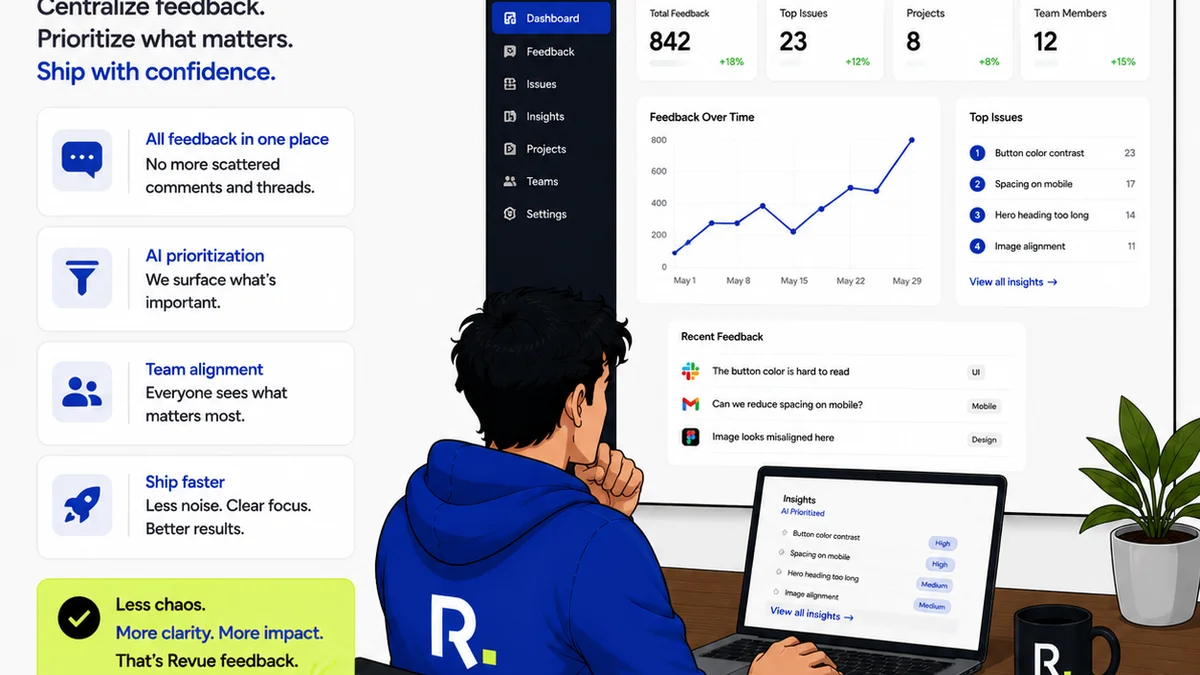
Revue helps by centralizing client feedback, making it easy to see the history, nature, and timeliness of comments. It provides visibility into revision stages and approval status, allowing agencies to identify bottlenecks and track the efficiency of their creative workflow directly within the platform.