Everyone talks about creative metrics. They point to engagement rates, likes, shares, and conversion numbers. None of that is wrong. But it’s incomplete.
The hard truth? Most agencies and in-house teams track the wrong creative metrics, or they track the right ones in a vacuum. This leads to wasted effort, misallocated resources, and ultimately, a failure to prove creative’s value.
What if you could measure creative performance not just for its own sake, but for its impact on client business goals? What if you had a clear, actionable checklist to ensure your creative metrics actually matter?
This isn't about vanity. This is about proving value and driving real business outcomes.
1. Defining What Matters: Beyond Likes and Shares
Vanity metrics are easy to track. They look good on a report. But they rarely tell the full story of creative effectiveness.
True creative metrics align directly with business objectives. Think about the client’s ultimate goal: more sales? better brand perception? increased customer loyalty? Your creative metrics must ladder up to these.
The Problem with Surface-Level Tracking
- Focusing solely on engagement (likes, comments) without understanding the *quality* of that engagement.
- Measuring reach (impressions) without considering relevance or impact.
- Ignoring the long-term brand-building effects in favor of short-term campaign wins.
- Failing to connect creative performance to actual revenue or lead generation.
This superficial approach makes it impossible to justify creative budgets or demonstrate ROI.
Shifting to Outcome-Oriented Metrics
Start by asking: What does success look like for this specific creative project or campaign, *from the client’s business perspective*?
This requires a deeper understanding of the client’s business, not just their marketing goals. What are their sales targets? What are their customer acquisition costs? What is their customer lifetime value?
Once you understand the business objectives, you can identify the creative metrics that *drive* those objectives.
2. The Core Pillars of Effective Creative Measurement
Successful creative measurement isn't a single number; it’s a system built on several key pillars. Each pillar needs attention.
Pillar 1: Alignment with Business Objectives
This is non-negotiable. Before any creative work begins, or at the very least, during the brief, you must understand and document how the creative will serve the client’s business goals.
Key Questions:
- What specific business problem is this creative intended to solve?
- What tangible business outcome are we aiming for (e.g., 10% increase in qualified leads, 5% reduction in churn)?
- How will we know if the creative contributed to this outcome?
Without this alignment, any metrics you track are just noise.
Pillar 2: Audience Resonance and Engagement Quality
Engagement is important, but *quality* of engagement is paramount. Are the right people engaging, and what is the nature of their interaction?
Metrics to Consider:
- Click-Through Rates (CTR): For digital ads, landing pages, emails. Higher CTR often indicates relevant messaging and compelling creative.
- Time on Page/Site: For content marketing or website design. Indicates audience interest and content value.
- Bounce Rate: A high bounce rate might suggest creative misalignment or a poor user experience.
- Conversion Rates: The ultimate measure of whether creative drove a desired action (purchase, sign-up, download).
- Sentiment Analysis: For social media and reviews. Understand *how* people are talking about your creative and brand.
This goes beyond simple likes. It’s about understanding if the creative is connecting with the intended audience in a meaningful way.
Pillar 3: Brand Impact and Perception
Creative work, especially brand campaigns, aims to shape how an audience perceives a brand. This is harder to quantify but crucial.
Metrics to Consider:
- Brand Recall/Awareness Surveys: Pre- and post-campaign surveys can measure shifts in brand recognition.
- Share of Voice (SOV): How often your brand is mentioned compared to competitors.
- Brand Sentiment Tracking: Monitoring online conversations for positive, negative, or neutral mentions.
- Website Traffic (Direct & Branded Search): Increases here can indicate growing brand interest.
Measuring brand impact is often a longer-term play, but essential for sustainable growth.
Pillar 4: Efficiency and Production Metrics
Creative success isn't just about the final output; it's also about how efficiently you get there. This impacts profitability and client satisfaction.
Metrics to Consider:
- Project Timelines vs. Actuals: Are projects delivered on time?
- Revision Cycles: How many rounds of revisions are typical? Excessive cycles indicate scope creep or communication breakdown.
- Resource Utilization: Are your creative teams working efficiently, or are they bogged down?
- Cost Per Asset/Project: Understanding the true cost of producing creative.
These operational metrics are vital for agency health and client trust.
3. Building Your Creative Metrics Checklist
Let’s translate these pillars into an actionable checklist. This isn’t a one-size-fits-all solution, but a framework you can adapt.
Phase 1: Strategy & Briefing
- Client Business Goals Defined? (e.g., Increase sales by X%, improve customer retention by Y%)
- Creative Objectives Clearly Stated? (e.g., Drive traffic to landing page, increase brand awareness among Z demographic)
- Key Performance Indicators (KPIs) Identified? (Specific, measurable metrics tied to objectives)
- Target Audience Profile Established? (Demographics, psychographics, behaviors)
- Success Benchmarks Set? (What does good look like based on past performance or industry standards?)
- Measurement Tools & Access Confirmed? (Analytics platforms, survey tools, CRM)
Phase 2: Creative Development & Production
- Creative Brief Adherence Checked? (Does the concept align with strategy?)
- Feedback Loops Established? (Clear process for client input)
- Revision Tracking Implemented? (Logging changes and rationale)
- Quality Assurance (QA) Process in Place? (Technical checks, brand consistency)
- Asset Production Timelines Monitored?
Phase 3: Deployment & Campaign Launch
- Tracking Codes Implemented Correctly? (UTMs, pixels, etc.)
- A/B Testing Plan Ready? (If applicable, for optimizing creative elements)
- Launch Day Monitoring Checklist? (Technical checks, initial performance review)
Phase 4: Performance Analysis & Reporting
- Data Collection Scheduled? (Daily, weekly, monthly reporting cadence)
- KPIs Tracked Against Benchmarks?
- Qualitative Feedback Analyzed? (Comments, sentiment)
- Brand Impact Metrics Assessed? (Awareness, perception shifts)
- Operational Efficiency Reviewed? (Timelines, revisions, costs)
- Insights Documented? (What worked, what didn’t, why?)
- Actionable Recommendations Developed? (For future creative)
- Client Report Delivered with Context? (Not just data, but narrative and recommendations)
4. Where Revue Fits In
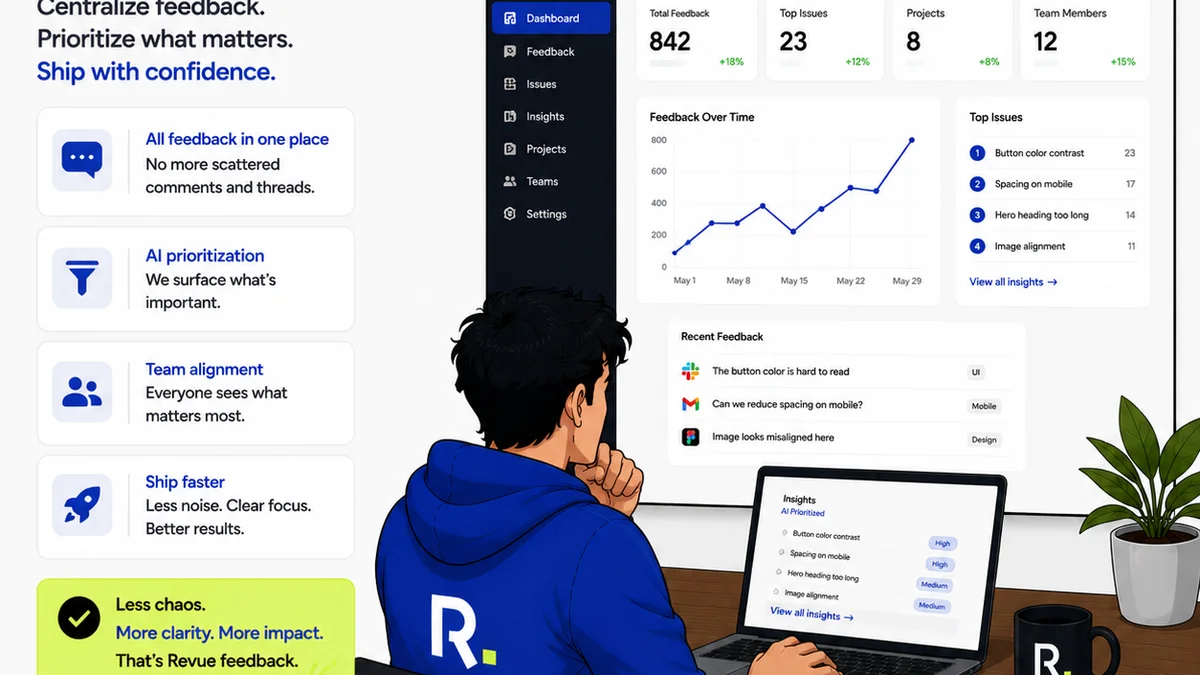
Managing this level of detail across multiple clients and projects can quickly become chaotic. This is where a centralized platform like Revue becomes invaluable.
Revue streamlines the entire creative review and approval process. It brings clarity to feedback, making it easier to track revisions and ensure alignment with strategic goals.
Centralized Feedback
Instead of scattered email threads and endless Slack messages, all client feedback lives in one place. This ensures nothing gets lost and provides a clear audit trail.
You can link feedback directly to specific creative assets, making it easy to see the history of changes and the rationale behind them.
Revision and Approval Visibility
Revue provides a clear, visual workflow for revisions and approvals. Stakeholders can see exactly where a project stands, who needs to provide input, and what decisions have been made.
This transparency reduces confusion and speeds up the approval process, directly impacting your operational efficiency metrics.
Quality Checks
By centralizing assets and feedback, Revue helps maintain brand consistency and adherence to project requirements. You can ensure that final approved assets meet the brief and pass necessary QA checks before delivery.
This visibility helps prevent costly errors and ensures the creative delivered is not just good, but *correct*.
Ultimately, Revue helps you manage the *process* of creative production and feedback more effectively, which directly impacts the efficiency and quality metrics that matter to your agency and your clients.
5. Avoiding Common Pitfalls
Even with a checklist, traps await. Be aware of these common mistakes.
Pitfall 1: The Data Dump
Simply presenting a wall of numbers to a client is useless. Data needs context. Explain what the numbers mean, how they relate to the initial goals, and what the next steps are.
Pitfall 2: Ignoring Qualitative Feedback
Not all feedback can be quantified. Sometimes, a client’s gut feeling or a specific comment points to a deeper issue that metrics alone won’t reveal. Listen to the narrative.
Pitfall 3: Chasing Trends Over Strategy
Jumping on the latest social media trend without considering if it aligns with the client’s brand or objectives is a recipe for disaster. Stick to the strategy.
Pitfall 4: Lack of Follow-Through
Collecting data is only half the battle. The real value comes from analyzing it, drawing insights, and *acting* on those insights to improve future creative.
Pitfall 5: Blaming the Creative for Business Failure
Creative is one piece of the puzzle. If a campaign underperforms, it’s rarely *just* the creative’s fault. Market conditions, product issues, or poor media placement can all play a role. A holistic view is essential.
Final Thought
Are you measuring creative for the sake of measurement, or are you measuring it to genuinely improve performance and prove its business value? The difference is profound.
By adopting a structured checklist and focusing on metrics that truly matter, you can transform your creative operations from a cost center into a demonstrable driver of client success.
Frequently asked questions
What are vanity metrics in creative work?
Vanity metrics are performance indicators that look good on paper but don't necessarily translate to business success. Examples include raw follower counts, impressions, and simple 'likes' on social media, without considering the quality of engagement or the business impact.
How do I align creative metrics with business objectives?
Start by deeply understanding the client's core business goals (e.g., sales growth, customer retention). Then, identify specific creative objectives that directly support these goals and select KPIs that measure progress towards those objectives. For example, if the business goal is increased sales, a creative objective might be to drive qualified leads, measured by conversion rates on a landing page.
What's the difference between engagement and quality engagement?
Engagement refers to any interaction (likes, shares, comments). Quality engagement means that the *right* audience is interacting in a way that signifies genuine interest or intent, often leading to desired actions like clicks, conversions, or positive brand sentiment. It's about the depth and relevance of the interaction, not just the quantity.
How can a platform like Revue help with creative metrics?
Revue centralizes client feedback and streamlines the revision and approval process. This leads to clearer communication, better audit trails, and improved operational efficiency (fewer revision cycles, faster approvals). By managing the workflow effectively, it helps ensure creative assets meet requirements and align with strategic goals, indirectly supporting the measurement of creative success.