Everyone agrees that measuring creative performance is crucial. You need to know if your efforts are paying off. You track engagement, conversions, brand mentions, all the usual suspects. These are the numbers that show up in board meetings and executive summaries. They seem objective. They seem important.
None of that is wrong. But it’s incomplete.
The hard truth is that most companies fail at creative metrics because they focus on the wrong things. They chase vanity metrics or proxy measures that don’t reflect true creative impact or business value. This leads to wasted effort, misaligned strategies, and a general feeling of futility. Real creative measurement isn’t about counting likes; it’s about understanding how creative work drives business objectives and client satisfaction.
1. The Illusion of Control: Focusing on Output, Not Outcome
It’s easy to count things. How many social posts did we publish? How many ad variations did we test? How many design concepts did we deliver?
This is output. It’s tangible. It’s easy to report.
But output doesn’t guarantee outcome. A hundred social posts with zero engagement is just noise. Fifty design concepts that miss the brief entirely are a waste of everyone’s time.
The Real Question: What Did the Work *Achieve*?
Instead of asking “How much did we make?” ask:
- Did this campaign increase qualified leads?
- Did this redesign improve user task completion rates?
- Did this content piece drive customer retention?
- Did this brand refresh lead to a measurable shift in brand perception?
These are outcome-oriented questions. They tie creative effort directly to business results. They require a different kind of tracking, one that goes beyond the creative team’s direct deliverables.
2. The Proxy Trap: Mistaking Activity for Impact
Many teams fall into the “proxy trap.” They measure things that *might* indicate success, but aren’t success itself.
Examples:
- Website Traffic: High traffic is good, but if those visitors aren’t converting or engaging meaningfully, it’s just a number.
- Social Media Likes/Shares: A quick ego boost, but rarely a direct driver of revenue or strategic goals for most businesses.
- Time Spent on Page: Could mean engagement, or it could mean confusion and users struggling to find what they need.
- Number of Revisions: Often seen as a negative, but sometimes a sign of a collaborative, iterative process that leads to a better final product. Conversely, *no* revisions might mean the client wasn’t engaged or the brief was poorly understood.
Moving Beyond Proxies
Proxies are easy to measure. They feel like progress. But they can actively mislead you.
Consider a client who wants to improve their product’s user experience. They might track page views on their help center as a proxy for user satisfaction. But what if the content is confusing, and users are *forced* to visit the help center repeatedly? The higher page views here indicate a problem, not a success.
The real metrics are tied to the business goal: reduced support tickets, higher task completion rates, improved customer satisfaction scores (CSAT), or Net Promoter Score (NPS).
3. The Siloed Measurement: Disconnecting Creative from Business Goals
Creative teams often operate in a vacuum. They get a brief, they execute, they deliver. Their success is measured by internal benchmarks or the client’s subjective approval.
Meanwhile, the marketing or sales team is measuring different things: lead generation, conversion rates, customer acquisition cost (CAC).
These two worlds rarely talk. The creative team doesn't see how their work impacts the sales funnel. The sales team doesn't understand the creative nuances that might be hindering or helping performance.
The Integration Gap
This disconnect is fatal for effective creative measurement.
To truly measure creative success, you need to:
- Understand the overarching business objectives. What are we trying to achieve as a company or for this client?
- Align creative KPIs with business KPIs. If the business goal is to increase Q4 sales by 15%, what creative metrics will directly contribute to that?
- Establish clear lines of accountability. Who owns which metric? How does creative performance feed into broader business outcomes?
- Facilitate cross-functional communication. Creative, marketing, sales, and product teams need to share insights and data.
This requires a more holistic view of the customer journey and a commitment to transparency across departments.
4. The Data Deficit: Lack of Qualitative Insights
Quantitative data tells you *what* is happening. Qualitative data tells you *why*.
Most companies are drowning in quantitative data but starving for qualitative insight.
They see a drop in conversion rates but don’t know if it’s due to a confusing call-to-action, a technical glitch, or a competitor’s aggressive promotion.
The Power of Context
Qualitative feedback adds crucial context.
This includes:
- User interviews: Direct conversations with your target audience.
- Usability testing: Observing users interacting with your creative assets or products.
- Sentiment analysis: Monitoring social media and reviews for emotional tone.
- Client feedback: Direct, structured input from the people who commissioned the work.
When combined with quantitative data, these insights can reveal the root causes of performance issues and highlight opportunities for improvement that numbers alone can’t capture.
5. The Tools Mismatch: Using the Wrong Instruments
You wouldn’t use a hammer to screw in a bolt. Similarly, you shouldn’t use the wrong tools to measure creative performance.
Many teams rely on generic analytics platforms that track website visits and basic engagement. These are useful, but insufficient for deep creative evaluation.
They might lack the ability to:
- Track granular feedback on specific design elements.
- Visualize revision histories and approval chains.
- Connect client comments directly to project milestones.
- Automate quality checks for brand consistency or accessibility.
The Need for Specialized Solutions
Measuring creative impact requires tools that understand the creative workflow.
This means platforms that can:
- Centralize all client feedback, regardless of source (email, Slack, meetings).
- Provide version control and clear audit trails for revisions.
- Streamline the approval process, reducing ambiguity and delays.
- Offer project management features tailored to creative tasks.
Without the right instruments, you’re trying to conduct a symphony with a kazoo.
Where Revue Fits In
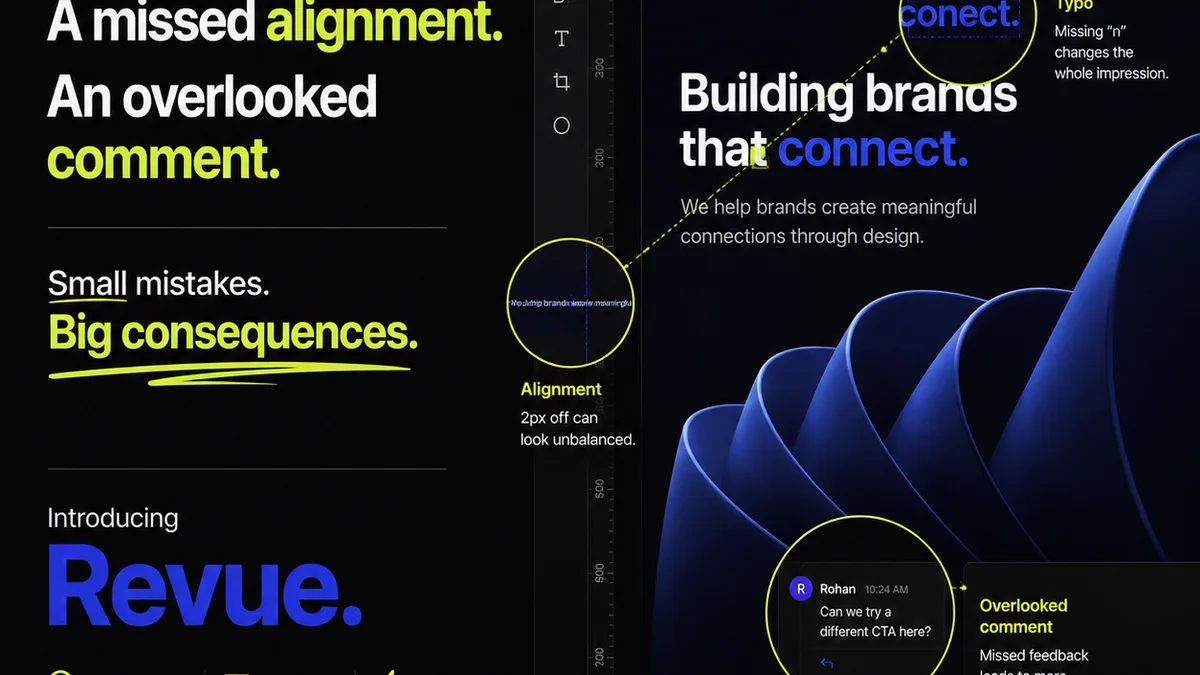
This is where a tool like Revue becomes essential. It’s built to address the very gaps that cause companies to fail at creative metrics.
Revue provides a centralized hub for client feedback. Instead of chasing down comments across emails, Slack channels, and random documents, all feedback lives in one place, attached to the specific creative asset. This eliminates ambiguity and ensures nothing gets lost.
It offers clear visibility into revision and approval workflows. You can see exactly who has reviewed what, what decisions were made, and where the project stands. This not only speeds up the process but provides a verifiable record – a form of crucial data in itself.
Furthermore, Revue aids in quality checks by ensuring that feedback is addressed and that the final output meets the agreed-upon standards. By documenting the entire process, it allows for post-project analysis: Did the feedback loop contribute to a better outcome? Were there recurring issues with clarity of feedback or the approval process?
This structured approach moves beyond simple output counting. It helps connect the creative process to tangible project success and client satisfaction, providing the data context needed to understand *why* certain creative decisions or processes led to specific results.
Final Thought
Are you measuring what you *think* you’re measuring? Or are you measuring what actually matters?
The difference between activity and impact is often just a matter of perspective—and the right set of tools to see it clearly.
Frequently asked questions
What are vanity metrics in creative work?
Vanity metrics are statistics that look good on paper but don't actually contribute to business goals. Examples include high social media follower counts with low engagement, or website traffic that doesn't convert. They provide a false sense of success.
How can I measure the *impact* of creative work, not just the output?
To measure impact, tie creative efforts directly to business objectives. Ask: Did this campaign increase leads? Did this design improve user task completion? Focus on outcomes like conversion rates, customer satisfaction (CSAT), or revenue generated, rather than just the number of assets produced.
Why is qualitative feedback important for creative metrics?
Quantitative data shows *what* is happening (e.g., low conversion rates), but qualitative feedback explains *why*. Insights from user interviews, usability testing, or direct client comments provide crucial context, helping to identify root causes and opportunities that numbers alone can't reveal.
How does centralized feedback improve creative measurement?
Centralizing feedback, for example using a tool like Revue, ensures all input is captured in one place, linked to specific assets. This prevents lost comments, clarifies decisions, and creates an auditable trail. This structured data allows for better analysis of how feedback influenced the final outcome and overall project success.