Everyone talks about metrics. Growth. Profitability. Client retention. You've probably heard that tracking these numbers is the key to scaling your agency. And none of that is wrong.
But it’s incomplete. Dangerously incomplete.
The real hard truth is that most growing agencies are tracking the wrong metrics, or tracking the right metrics in the wrong way. This isn't just an academic problem. It directly impacts your team's sanity, your client relationships, and your actual bottom line.
Let’s cut through the noise and talk about the metrics mistakes that are secretly throttling your agency’s growth.
1. Mistaking Activity for Productivity
It's easy to get caught up in the sheer volume of work. Hours logged. Tasks completed. Emails sent. These are all signs of activity, sure. But are they signs of productive activity?
Many agencies track billable hours as a primary metric. High billable hours can feel like success. But what if those hours are spent on inefficient processes, endless revisions, or work that doesn't actually move the needle for the client?
The Illusion of Busyness
You see your team busy. They're putting in the time. The timesheets look full. This feels like progress.
But behind that busyness might be:
- clients who don't know what they want, leading to scope creep and endless back-and-forth.
- internal processes that are clunky and require too much manual effort.
- a lack of clear project briefs, resulting in work that misses the mark.
- team members working in silos, duplicating effort or missing crucial information.
The real metric isn't hours logged; it's value delivered efficiently.
2. Ignoring the Cost of Rework
Everyone expects some level of revisions. It’s part of the creative process. But treating rework as a freebie, or simply rolling it into overhead, is a critical mistake.
Every hour spent on revisions is an hour not spent on new business, strategic development, or improving your core services. It’s an hour that’s eating into your profit margin without generating new revenue.
The Hidden Drain
Think about it:
- Time Cost: The actual hours your team spends redoing work.
- Opportunity Cost: What else could that time have been used for?
- Client Satisfaction Cost: Frequent or excessive revisions can frustrate clients, even if they pay for it.
- Team Morale Cost: Constantly redoing work is demoralizing.
If your metrics don't account for the true cost of rework, you're operating under a false sense of profitability.
3. Over-Reliance on Vanity Metrics
Vanity metrics are those that look good on paper but don't necessarily correlate with actual business success. Think raw website traffic, social media follower counts, or even just total revenue without context.
A growing agency needs to look beyond these superficial numbers.
What Looks Good vs. What IS Good
- Website Traffic: High traffic is great, but what if none of it converts into leads?
- Social Media Followers: A large audience is nice, but do they engage? Are they potential clients?
- Total Revenue: High revenue can mask low profit margins if costs are out of control.
- Project Count: Completing many small projects might look busy, but is it strategically valuable or profitable?
Focus on metrics that reflect genuine business health and client success, not just superficial popularity.
4. Measuring Client Satisfaction Incorrectly
Client satisfaction is crucial. But how do you measure it? A simple “NPS score” or an end-of-project survey can be misleading.
These methods often capture a snapshot in time, influenced by recent events, and don't reflect the day-to-day client experience, which is where most friction occurs.
The Survey Says... Maybe
- Response Bias: Only the happiest or unhappiest clients tend to respond.
- Lagging Indicator: By the time you get feedback, significant damage might already be done.
- Lack of Specificity: General satisfaction doesn't tell you *why* they are satisfied or dissatisfied.
True client satisfaction is built through consistent, smooth, and transparent project execution. It's reflected in repeat business, positive referrals, and a willingness to collaborate, not just a survey score.
5. Neglecting Profitability Per Project/Client
This is perhaps the most common and damaging mistake. Agencies often focus on overall agency profit, but fail to drill down into the profitability of individual projects or clients.
You might have a few high-revenue, low-profit clients subsidizing your more profitable ones. Or you might be taking on work that, while seemingly strategic, is consistently a money pit.
The Profit Leak
Without granular profitability data, you can’t:
- Accurately price future projects.
- Identify which client relationships are truly valuable.
- Make informed decisions about which types of work to pursue.
- Spot and fix inefficiencies on specific projects.
Knowing the true profit margin on every piece of work is essential for sustainable growth.
6. Not Measuring Team Efficiency and Bottlenecks
A happy, efficient team is the engine of a growing agency. But are you measuring the factors that contribute to this?
This isn't about micromanaging. It's about understanding where your processes break down and where your team is getting stuck.
Where Does the Time Go?
Consider metrics related to:
- Time to First Draft: How long does it take to get initial concepts out?
- Time to Approval: How long does it take to get from draft to final sign-off?
- Revision Cycles: How many rounds of revisions are typical for different project types?
- Resource Allocation: Are key people overloaded while others are underutilized?
Identifying these points allows you to streamline workflows and improve team morale.
Where Revue Fits In
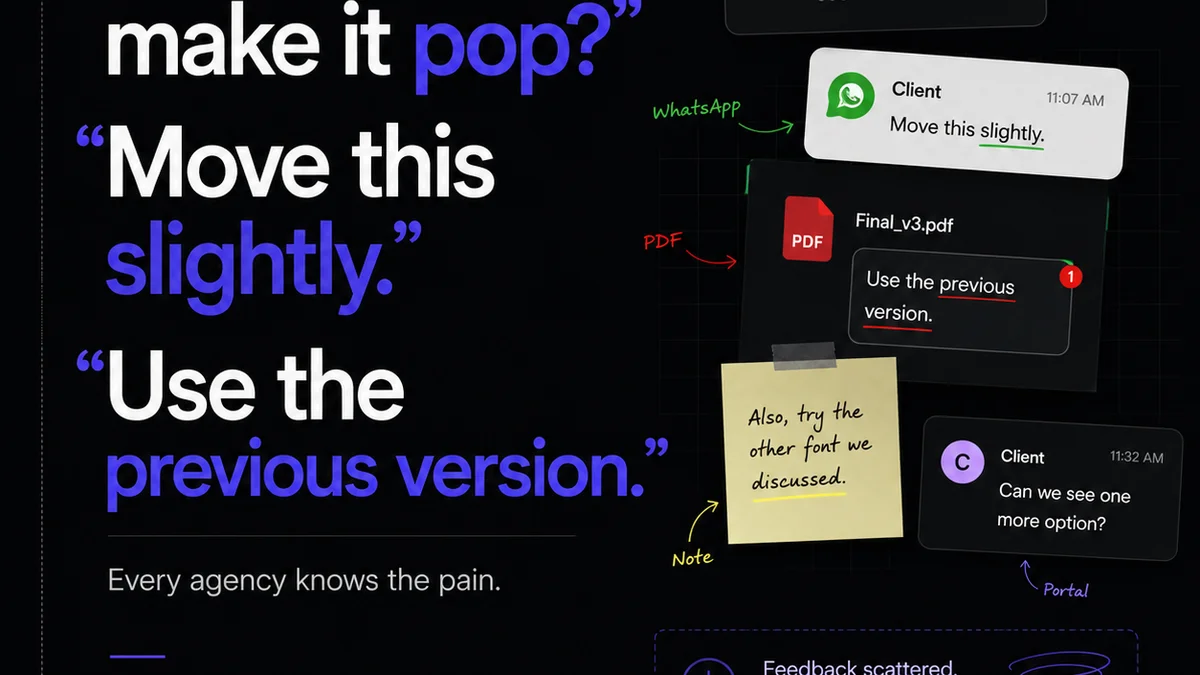
Many of these metrics mistakes stem from a lack of clear visibility into the creative workflow. When feedback is scattered across emails, Slack messages, and random documents, it’s impossible to track accurately.
Revue is designed to bring that visibility.
Centralizing client feedback directly on the creative assets eliminates confusion and speeds up the approval process. You get a clear audit trail of every comment, every revision, and every approval.
This means:
- Reduced Rework: Clearer feedback loops mean fewer misunderstandings and less time wasted on unnecessary revisions.
- Faster Approvals: Clients know exactly what needs to be reviewed and approved, streamlining the sign-off process.
- Accurate Project Timelines: With clear visibility into revision cycles, you can better estimate project completion and resource needs.
- Improved Client Communication: A single source of truth for feedback and approvals builds trust and transparency.
By providing this clarity, Revue helps you gather the data needed to actually measure what matters: efficient delivery of high-quality creative work.
Final Thought
Are you measuring what makes your agency successful, or just measuring what's easy? The difference between activity and productivity, between perceived success and actual profit, often lies in the metrics you choose to prioritize. It's time to look beyond the surface and start tracking the hard truths that drive real, sustainable growth.
Frequently asked questions
What are vanity metrics for an agency?
Vanity metrics are numbers that look good but don't necessarily reflect true business health or drive growth. Examples include raw website traffic without conversions, or social media follower counts without engagement. They create a false sense of success.
How can I reduce rework in my agency?
Reduce rework by improving your intake process with detailed briefs, centralizing client feedback on creative assets (like with Revue), establishing clear approval workflows, and tracking the true cost and frequency of revisions to identify patterns.
Why is tracking profitability per project important?
Tracking profitability per project allows you to understand which clients and types of work are genuinely contributing to your bottom line. This insight is crucial for accurate pricing, identifying profitable relationships, and making strategic decisions about future business.
How does centralized feedback improve metrics?
Centralized feedback, as offered by tools like Revue, eliminates confusion and speeds up approvals. This directly impacts metrics by reducing time spent on rework, shortening project timelines, improving client satisfaction through clarity, and providing accurate data on revision cycles.