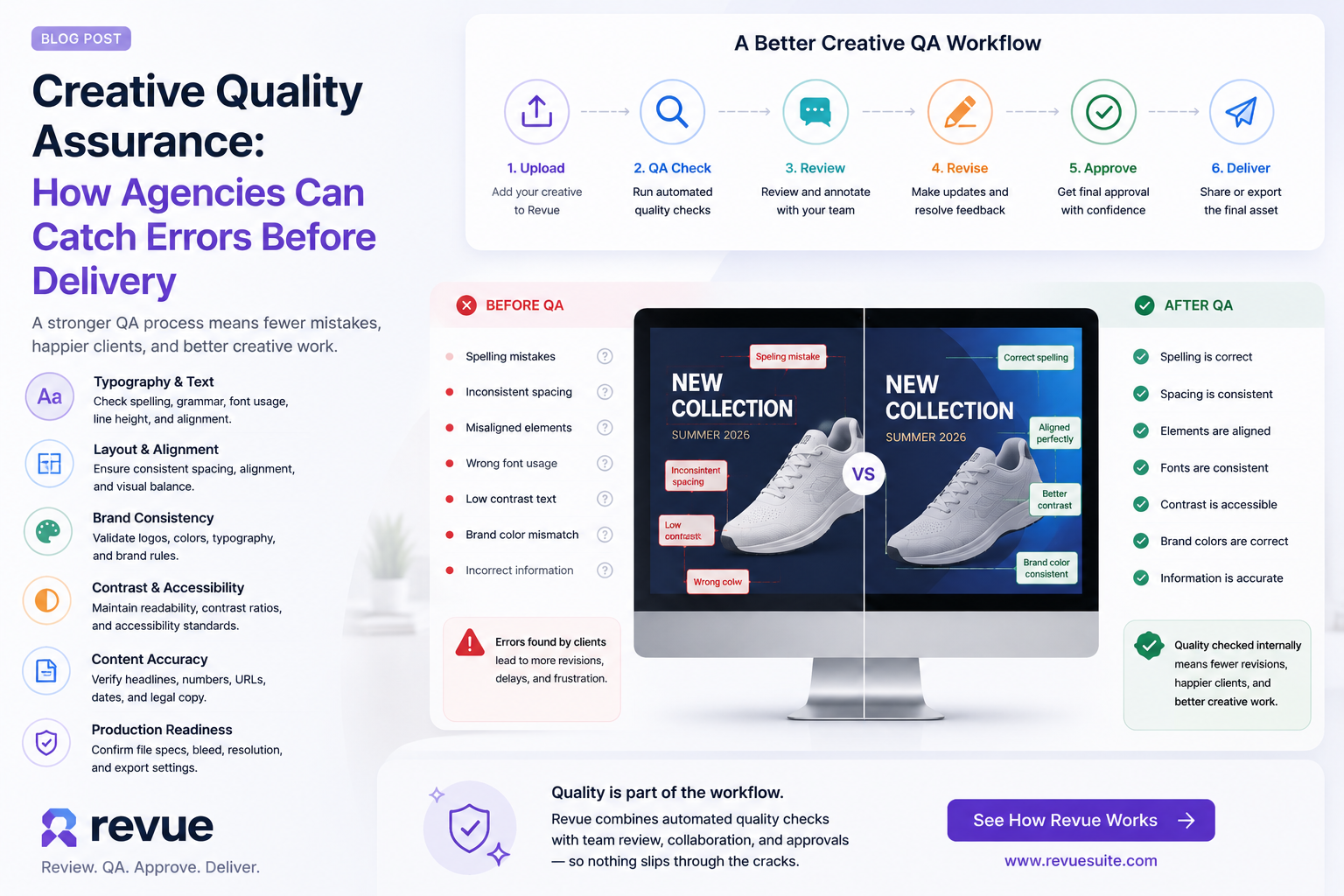
A client shouldn't be the person who finds the typo.
It happens.
A campaign goes through the designer.
Then the creative director.
Then the account manager.
Then the client.
And somehow the client is the first person to notice that the headline has a spelling mistake.
That's not just embarrassing.
It tells you something about your process.
Your creative quality assurance system isn't strong enough.
For US agencies managing high volumes of creative work, quality assurance needs to become more than a final glance before delivery.
It needs to be part of the workflow.
What Is Creative Quality Assurance?
Creative quality assurance, or creative QA, is the process of checking creative work for errors, inconsistencies, and quality issues before it reaches the client, developer, printer, publisher, or audience.
Depending on the project, creative QA can include checking:
Typography
Spelling
Grammar
Alignment
Spacing
Layout
Contrast
Brand consistency
Content accuracy
Asset placement
Version accuracy
Production requirements
The goal is simple:
Catch problems before someone outside the creative team does.
Why Creative QA Gets Skipped
Most creative teams aren't intentionally careless.
They're under pressure.
The project is due Friday.
The client is waiting.
The designer has already made six revisions.
The account team wants to send it.
So someone opens the final file, looks at it for thirty seconds, and says:
“Looks good.”
That's not quality assurance.
That's a visual confidence check.
And humans are surprisingly bad at repeatedly spotting small inconsistencies in work they've already seen.
The Problem With Manual Design Reviews
Manual review still matters.
Creative directors need to evaluate:
Strategy
Concept
Hierarchy
Brand expression
Audience fit
Visual quality
But not every QA task requires subjective creative judgment.
Some problems are objective.
For example:
Is the text aligned?
Is the spacing consistent?
Is there a spelling error?
Does the layout contain an obvious inconsistency?
These are exactly the kinds of checks that can be supported by automation.
The creative team should spend its attention on creative decisions, not repeatedly hunting for mechanical errors.
Creative QA Should Happen Before Client Review
This is one of the biggest workflow mistakes agencies make.
They send the work to the client first.
Then the client finds the problem.
Then the designer fixes it.
Then the client reviews it again.
You've just created another revision cycle.
A better sequence is:
Create → Internal Review → Creative QA → Client Review → Revision → QA → Approval
The exact workflow can vary by agency.
But the principle is important:
Don't make the client your QA department.
What Should a Creative QA Checklist Include?
A useful creative QA checklist should cover more than spelling.
1. Typography
Check:
Font consistency
Font sizes
Line height
Tracking
Kerning
Text alignment
Paragraph spacing
Typography errors are easy to overlook because the brain tends to read the meaning rather than inspect every visual detail.
2. Layout and Alignment
Check whether:
Elements align correctly
Margins are consistent
Objects are positioned correctly
Spacing follows the design system
Components are visually balanced
Small alignment problems can make otherwise polished work feel unfinished.
3. Content
Verify:
Headlines
Body copy
CTAs
Product names
Dates
Numbers
URLs
Legal copy
Disclaimers
A beautifully designed ad with the wrong URL is still a failed asset.
4. Brand Consistency
Check:
Logo usage
Brand colors
Typography
Imagery
Tone
Spacing
Approved brand assets
This becomes particularly important for agencies producing large volumes of creative for enterprise clients.
5. Accessibility and Contrast
Depending on the deliverable, review:
Text/background contrast
Readability
Font size
Visual hierarchy
Color-dependent information
A design can look good and still create usability problems.
Automated Design QA Changes the Workflow
This is where automation becomes interesting.
Imagine a designer finishes an asset.
Instead of immediately sending it to the client, the system performs an automated quality check.
It identifies potential issues.
The designer reviews those findings.
The team fixes them.
Then the work moves to human creative review.
Then it goes to the client.
The result isn't AI replacing designers.
It's AI handling the repetitive checks so designers can focus on the decisions that actually require creative judgment.
That's a much more useful way to think about AI in creative operations.
Human Review + Automated QA
The strongest workflow isn't:
AI OR humans
It's:
AI + humans
Automation can help identify objective inconsistencies.
Humans handle:
Creative direction
Brand interpretation
Strategy
Taste
Context
Client intent
Final judgment
The combination is more powerful than either approach alone.
How Revue Fits Into Creative QA
This is one of the areas where Revue has a different story to tell.
Revue isn't only about collecting client comments.
Its workflow brings quality checking, creative review, revisions, client communication, and approval closer together.
A typical workflow can look like:
Upload → Quality Check → Review → Annotate → Revise → Client Review → Approve
That means quality doesn't have to be an isolated final step.
It can become part of the creative workflow itself.
Explore Revue's creative quality-check workflow →
And that's the bigger opportunity.
Instead of asking:
“Did someone look at this?”
you can ask:
“Did this asset actually pass our quality process?”
That's a much stronger standard.
How US Agencies Can Build a Better Creative QA Process
You don't need a complicated system.
Start with five rules.
Rule 1: Define what quality means
Different deliverables require different checks.
A social media graphic isn't reviewed exactly like a print advertisement.
Create clear criteria.
Rule 2: Separate creative review from mechanical QA
Don't make one person responsible for everything.
Creative judgment and objective quality checks are different jobs.
Rule 3: QA before client delivery
Catch obvious errors internally.
Don't wait for the client to find them.
Rule 4: Keep QA connected to the correct version
If the designer fixes V4, the QA result shouldn't accidentally refer to V3.
Version clarity matters.
Rule 5: Track recurring errors
If your team repeatedly finds the same problems, that's a process issue.
Use those patterns to improve your workflow.
Creative QA Is Becoming an Operational Advantage
For a small agency producing five assets a week, manual QA might be manageable.
For an agency producing hundreds of creative assets across multiple clients and campaigns, it becomes a scaling problem.
More work means:
More files.
More versions.
More stakeholders.
More opportunities for mistakes.
You can't solve that simply by telling everyone to “be more careful.”
You need a system.
That's what creative quality assurance should provide.
Not another checkbox.
A repeatable way to protect the quality of the work before it leaves your team.
Final Thought
Creative teams shouldn't be measured by how quickly they can fix mistakes.
They should be measured by how effectively their workflow prevents those mistakes from reaching the client.
That means building QA into the process rather than treating it as the last five minutes before delivery.
Create better.
Review smarter.
Catch errors earlier.
Approve with confidence.
That's where creative QA becomes more than quality control.
It becomes part of how a modern creative team operates.
Frequently asked questions
What is creative quality assurance?
Creative quality assurance is the systematic process of checking creative work for errors, inconsistencies, and quality issues before delivery.
What is the difference between creative QA and design review?
Design review often focuses on creative direction, strategy, and overall quality. Creative QA focuses more heavily on objective checks such as typography, spacing, alignment, spelling, and consistency.
Can creative QA be automated?
Yes. Certain repetitive and objective design checks can be automated, allowing creative teams to spend more time on subjective creative decisions.
Why should agencies perform QA before client review?
Finding errors internally prevents unnecessary client revision cycles and creates a more professional client experience.
What should be included in a creative QA checklist?
A strong checklist can include typography, alignment, spacing, spelling, grammar, content accuracy, brand consistency, contrast, and version accuracy.