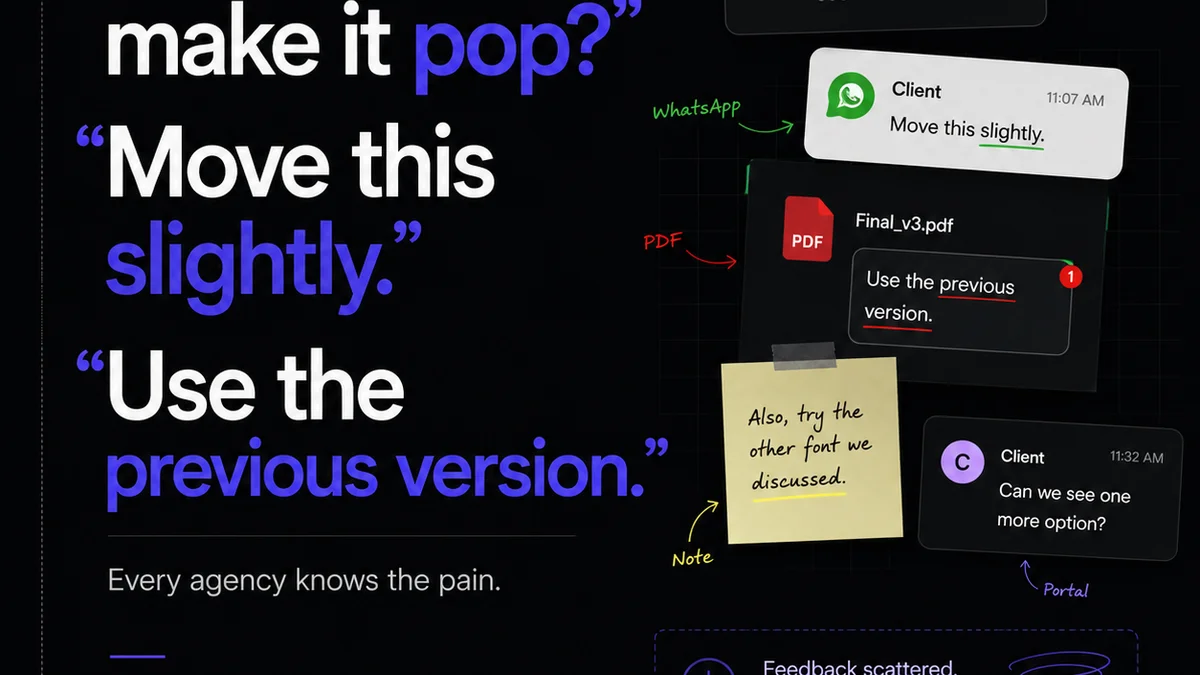
Everyone blames clients for bad creative briefs. They say clients don't know what they want, they change their minds, and they can’t articulate their needs. None of that is wrong. But it’s incomplete.
The harder truth? Most companies fail at creative requests because their internal systems for gathering, managing, and acting on that feedback are fundamentally broken.
1. The Vague Brief Isn't the Real Problem
We’ve all seen them: the one-sentence brief, the mood board of unrelated images, the “just make it pop” directive. It’s easy to point fingers at the client for this.
But a great agency or in-house team can often navigate even a weak brief. They ask clarifying questions. They build in checkpoints. They use their expertise to fill the gaps.
The real issue isn’t the initial vagueness. It’s what happens *after* the brief lands on your desk.
The Information Decay
A brief is just the starting point. The real requirements, the nuances, the critical context – that information usually comes later. It’s in follow-up emails, Slack messages, and impromptu hallway chats.
This information doesn't live in one place. It gets scattered. It gets misinterpreted. It gets lost.
When you try to build something based on fragmented, decaying information, the end result is rarely what anyone truly wanted.
2. Feedback Loops Are Broken, Not Just Long
A common complaint is that clients take too long to give feedback. Again, true sometimes. But the length of the feedback loop is often a symptom, not the disease.
The real problem is the *structure* of the feedback process.
Is feedback siloed? Does it come from one person, then another, then a third, each with conflicting opinions?
The Email Chain Nightmare
Imagine a design is sent to a client. Feedback comes via email. Then a reply-all chain starts. Then someone forwards it to another department. Then someone else leaves a comment on a shared Google Doc.
Suddenly, you have five different versions of feedback, none of which is the *official* version.
Which feedback do you action? Who owns the decision?
This chaos leads to:
- Wasted revisions
- Frustrated designers
- Missed deadlines
- Clients who feel ignored
3. Approval is an Event, Not a Process
Many teams treat
Frequently asked questions
What are the most common reasons creative briefs are ineffective?
Ineffective creative briefs often suffer from vagueness, lack of specific goals, unclear target audiences, and insufficient context about the product or service. They might also include conflicting requirements or rely on subjective language like 'make it pop.'
How can agencies improve their internal feedback process?
Agencies can improve internal feedback by centralizing all communication and assets in one platform, establishing clear roles for who provides feedback and who makes final decisions, setting defined timelines for feedback rounds, and using visual annotation tools for precise comments.
Is it better to get feedback via email or a dedicated tool?
A dedicated tool is almost always better. Email leads to scattered feedback, version control issues, and difficulty tracking changes. Dedicated platforms centralize communication, provide clear audit trails, and often offer features like visual annotation, making feedback precise and actionable.
How does a lack of revision visibility impact a project?
Lack of revision visibility means team members and clients don't know what changes have been made, why they were made, or who requested them. This leads to redundant work, confusion, and can erode trust as stakeholders feel their input isn't being properly tracked or implemented.