Everyone talks about the tech. The algorithms. The user experience. The seamless onboarding. These are crucial, no doubt. But they’re only part of the story.
The real engine driving successful FinTech products and client relationships isn't just the code; it's the clarity and execution of creative requests.
This isn't about pretty pictures. It's about operational rigor, client alignment, and ultimately, revenue. Let's break down why.
1. Beyond the Brief: The 'Why' Behind the 'What'
A common assumption is that a creative request is just a list of deliverables. A logo here, a landing page there, a few social posts. Simple enough, right?
Wrong.
A truly effective creative request goes deeper. It’s a strategic document that forces clarity on the *purpose* behind the creative work. For FinTech, this purpose is inextricably linked to trust, compliance, and customer acquisition.
Understanding the Audience and Objective
Who are we talking to? Are they seasoned investors looking for complex analytics, or first-time users needing simple guidance on a budgeting app?
What action do we want them to take? Sign up for a demo? Download a whitepaper? Complete a transaction? Each objective requires a different creative approach.
A generic request for 'marketing materials' fails to account for these critical nuances. It’s like asking a chef to 'make food' without specifying a cuisine or dietary needs.
The Compliance Tightrope
FinTech operates in a heavily regulated space. Every piece of communication—from a website banner to an email confirmation—must adhere to strict compliance guidelines. Think GDPR, KYC, AML, and a host of other acronyms.
A poorly defined creative request can lead to:
- Missed disclaimers.
- Misleading claims.
- Non-compliant user flows.
- Costly legal reviews and rework.
When a request doesn't explicitly state the compliance requirements or the target regulatory environment, it puts the creative team in an impossible position. They’re expected to be legal experts and designers simultaneously.
The Cost of Ambiguity
Every revision cycle, every misinterpretation, costs time and money. For a FinTech company, where speed to market and operational efficiency are paramount, this isn't just an annoyance; it's a drain on resources that could be used for product development or customer support.
Clear, detailed creative requests minimize back-and-forth, reduce errors, and accelerate delivery. This is the hard truth: operational efficiency in creative execution directly impacts the bottom line.
2. Defining Deliverables: Precision Over Volume
Many organizations fall into the trap of requesting *everything*, fearing they'll miss something. This leads to bloated, unfocused creative briefs.
The real power lies in defining the *right* deliverables for the specific objective.
Asset Specificity
Instead of 'website assets,' a good request specifies:
- Hero banner dimensions and copy points.
- Call-to-action button text and placement.
- Key feature icons and accompanying descriptions.
- Schema markup requirements for SEO.
For digital products, this also extends to UI elements. A request for a new feature might specify the exact interaction states, error messages, and accessibility considerations, linking to established design systems like Material Design or Apple's Human Interface Guidelines.
Content Requirements
What is the message? What tone of voice? Are there specific keywords to incorporate for SEO? What is the desired length and format?
For instance, a request for a blog post on investment strategies needs to specify the target audience (novice vs. expert), the desired word count, the inclusion of relevant financial terms (and perhaps definitions), and any specific calls to action (e.g., 'open an account').
Brand Consistency
FinTech brands trade on trust. Inconsistent branding erodes that trust faster than almost anything. A clear request reinforces brand guidelines.
- Logo usage.
- Color palettes.
- Typography rules.
- Imagery style.
When these are clearly articulated, the creative output is consistently on-brand, reinforcing the company's professional image.
3. The Feedback Loop: From Noise to Signal
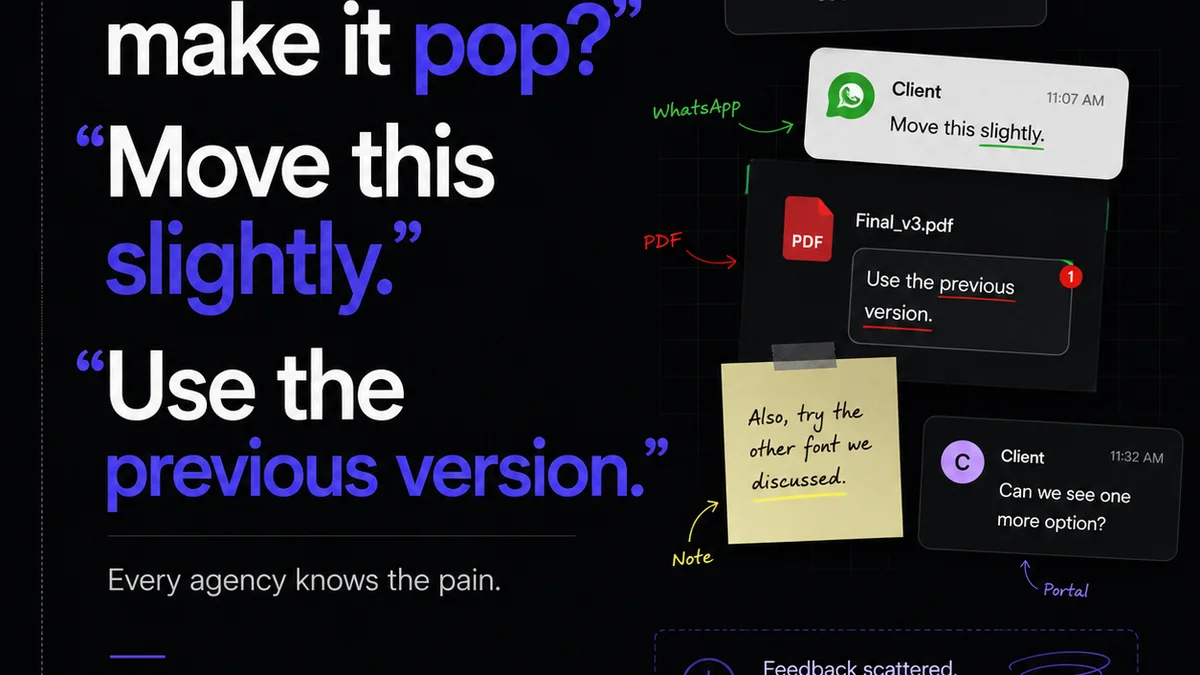
Client feedback is essential, but it's often the weakest link in the creative process. Unstructured, vague, or contradictory feedback can derail even the best projects.
This is where the structure of the *request* and the *feedback process* become critical.
Structured Feedback Mechanisms
Instead of a lengthy email chain, feedback should be tied to specific elements of the creative work.
Imagine a designer presenting a new app flow. Instead of a general
Frequently asked questions
Why are clear creative requests more important in FinTech than other industries?
FinTech operates under heavy regulation and relies on building immense trust. Vague creative requests can lead to compliance breaches, eroded trust, and costly rework, directly impacting financial outcomes and customer acquisition.
What are the key components of a strong FinTech creative request?
A strong request clearly defines the target audience, specific objectives, compliance requirements, precise deliverables (including asset specs and content needs), and the desired tone of voice. It moves beyond just 'what' to include 'why' and 'for whom'.
How can structured feedback improve creative request outcomes?
Structured feedback, often managed through specialized tools, ensures comments are tied to specific creative elements, are actionable, and avoid contradictions. This reduces ambiguity, minimizes revisions, and speeds up the approval process, which is crucial for FinTech's fast-paced environment.
Can better creative requests prevent compliance issues in marketing materials?
Absolutely. By explicitly stating all necessary disclaimers, legal requirements, and regulatory considerations within the initial request, creative teams can build compliance in from the start, rather than treating it as an afterthought.